Evaluation of the impact of postural restrictions after Semont liberatory maneuver on immediate reactions and short-term outcome in the posterior semicircular canal canalolithiasis: a preliminary study
Andrea Albera, Marco Boldreghini, Sergio Lucisano, Roberto Albera, Claudia Cassandro, Alma Barci, Giuseppe Riva, Andrea Canale

TL;DR
This study examines whether postural restrictions after a specific vertigo treatment affect recovery, finding that a specific eye movement is a better indicator of success than restrictions.
Contribution
The study provides evidence that postural restrictions after the Semont maneuver are unnecessary and that nystagmus during position 2 predicts treatment success.
Findings
Postural restrictions did not significantly improve treatment success rates.
Nystagmus in position 2 of the Semont maneuver is a strong predictor of successful outcomes.
Immediate reactions after the maneuver are more reliable than postural behavior in predicting success.
Abstract
Benign paroxysmal positional vertigo is the most frequent peripheral vestibular disorder, characterized by brief but intense vertigo crises related to changes in position. The Liberatory maneuver is considered the gold-standard treatment, with a short-term resolution of the vertigo in over 70% of cases, and achieving a 90% success rate after four maneuvers. An immediate reaction to the subsequent repositioning maneuver is often an orthotropic nystagmus (Ny) occurring in the same direction as the Ny observed after returning to the primary position. This reaction, occurring seconds to minutes after reaching the second position, is considered a positive predictor of the maneuver’s effectiveness. To improve the success rate after the maneuver, many authors have suggested postural restrictions. To determine the best predictors of outcome between the immediate behavior after the Semont…
Genes, proteins, chemicals, diseases, species, mutations and cell lines named across the full text — each resolved to its canonical identifier and authoritative record.
Click any figure to enlarge with its caption.
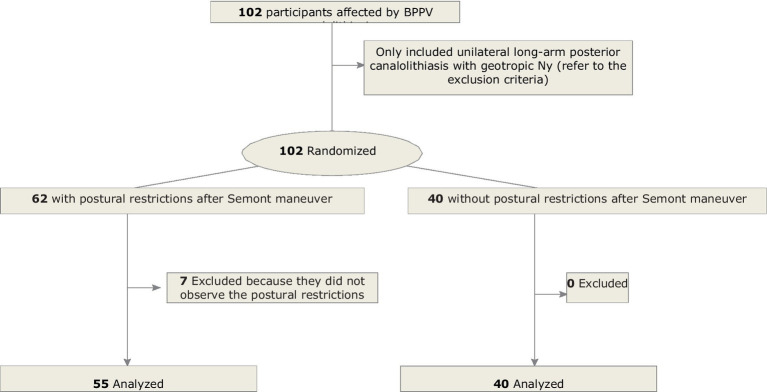 Figure 1
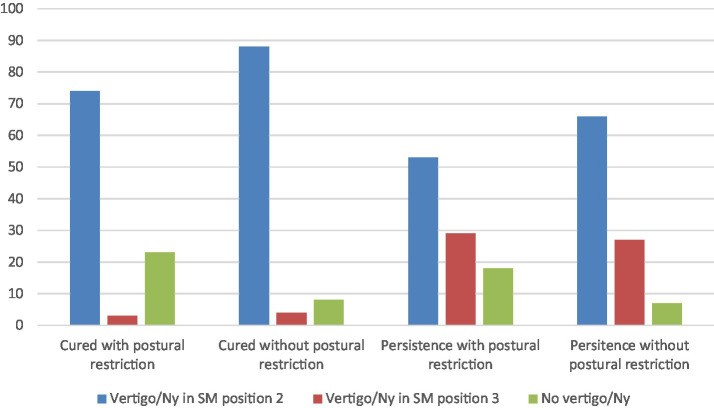 Figure 2
Peer Reviews
No public reviews on file for this paper yet. If you reviewed it on a platform where reviews are public (OpenReview, ICLR, NeurIPS, ICML), you can paste yours below so the community can read it here.
Videos
No videos yet. Explain this paper in a talk, walkthrough, or lecture? Add one.
Taxonomy
TopicsVestibular and auditory disorders · Ophthalmology and Eye Disorders · Glaucoma and retinal disorders