Increasing the smoking cessation success rate by enhancing improvement of self-control through sleep-amplified memory consolidation: protocol of a randomized controlled, functional magnetic resonance study
Sarah Gerhardt, Michaela Kroth, Alexandra Seeger, Roland Schmitt, Heiner Fritz, Lorena Diring, Yury Shevchenko, Karen D Ersche, Gordon Feld, Sabine Vollstädt-Klein

TL;DR
This study explores how combining exercise, cognitive training, and sleep improvement can help people quit smoking more successfully.
Contribution
The study introduces a novel combination of cognitive and physical interventions timed with sleep to improve smoking cessation outcomes.
Findings
Combining cognitive and physical interventions may improve cognitive control and reduce relapse rates.
Timing of interventions (morning vs. evening) may influence treatment effectiveness.
Improved sleep quality could enhance smoking cessation success.
Abstract
Tobacco use disorder (TUD) remains a global health crisis characterized by high relapse rates despite extensive cessation efforts. This study aims to enhance treatment outcomes by addressing the cognitive and neural imbalances associated with habitual and goal-directed behaviours among individuals with TUD. We hypothesise that by integrating high-intensity interval training (HIIT), cognitive remediation treatment (CRT) via app-based chess training and a standard smoking cessation program (SCP) for cognitive control and sleep quality will be improved, thereby facilitating smoking cessation. The study will enrol 140 treatment-seeking smokers aged 18–65 years who meet the DSM-5 criteria for TUD. The participants will be randomly assigned to four groups: CRT + HIIT in the morning, CRT + HIIT in the evening, HIIT alone in the morning, and HIIT alone in the evening. Assessments will be…
Genes, proteins, chemicals, diseases, species, mutations and cell lines named across the full text — each resolved to its canonical identifier and authoritative record.
Click any figure to enlarge with its caption.
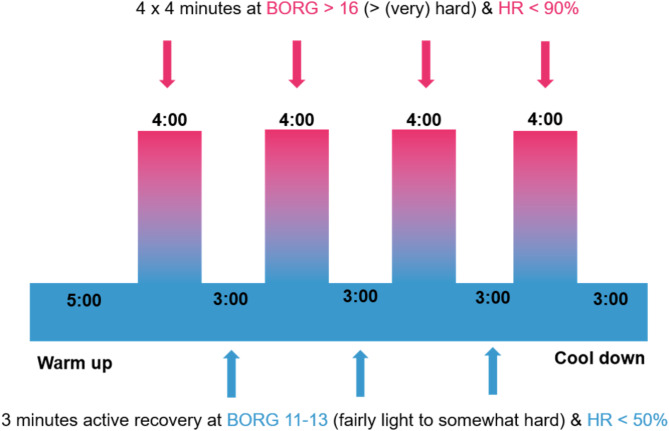 Figure 1
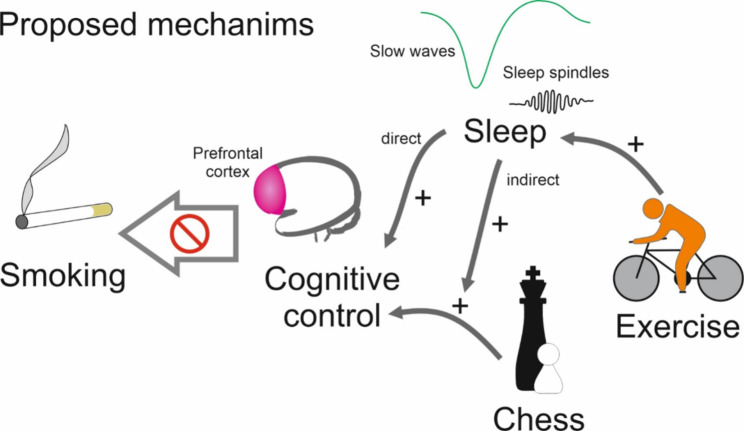 Figure 2
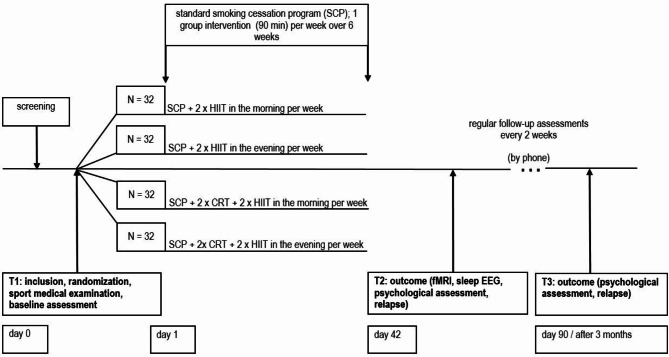 Figure 3
Peer Reviews
No public reviews on file for this paper yet. If you reviewed it on a platform where reviews are public (OpenReview, ICLR, NeurIPS, ICML), you can paste yours below so the community can read it here.
Videos
No videos yet. Explain this paper in a talk, walkthrough, or lecture? Add one.
Taxonomy
TopicsCircadian rhythm and melatonin · Sleep and related disorders · Mental Health Research Topics