Single- versus multi-fraction spine stereotactic radiosurgery (ALL-STAR) for patients with spinal metastases: a randomized phase III trial protocol
Aniket Pratapneni, Daniella Klebaner, Scott Gerard Soltys, Elham Rahimy, Iris Catrice Gibbs, Steven Daniel Chang, Gordon Li, Melanie Hayden Gephart, Anand Veeravagu, Gregory Arthur Szalkowski, Xuejun Gu, Lei Wang, Cynthia Chuang, Lianli Liu, Scott Jackson, Rong Lu

TL;DR
This clinical trial compares single- and multi-fraction spine stereotactic radiosurgery for spinal metastases to determine which provides better local control and fewer side effects.
Contribution
The study isolates the effect of fractionation on local control by using equivalent biological equivalent doses in a randomized phase III trial.
Findings
The trial will assess one-year local control as the primary endpoint using SPINO criteria.
Secondary outcomes include quality of life, pain response, and vertebral compression fracture rates.
The study aims to provide guidance on optimal dose and fractionation for spine metastases treatment.
Abstract
For patients with spine metastases, stereotactic radiosurgery (SRS) provides excellent local control and pain response. Despite increasing use of this treatment modality, there is no consensus on the optimal dose and fractionation of spine SRS for efficacy and toxicity. We have initiated a single-center phase III randomized trial that compares two dose regimens with similar biological equivalent dose (BED) to determine the isolated effect of SRS fractionation on local control. Patients with one to three cervical, thoracic, or lumbar spine metastases spanning no more than two contiguous vertebral levels in need of radiation will be eligible for enrollment. Patients will be assigned 1:1 to receive either 22 Gy in 1 fraction or 28 Gy in 2 fractions. Biased coin randomization will be used to randomly assign patients while balancing the following stratifying variables between the two…
Genes, proteins, chemicals, diseases, species, mutations and cell lines named across the full text — each resolved to its canonical identifier and authoritative record.
Click any figure to enlarge with its caption.
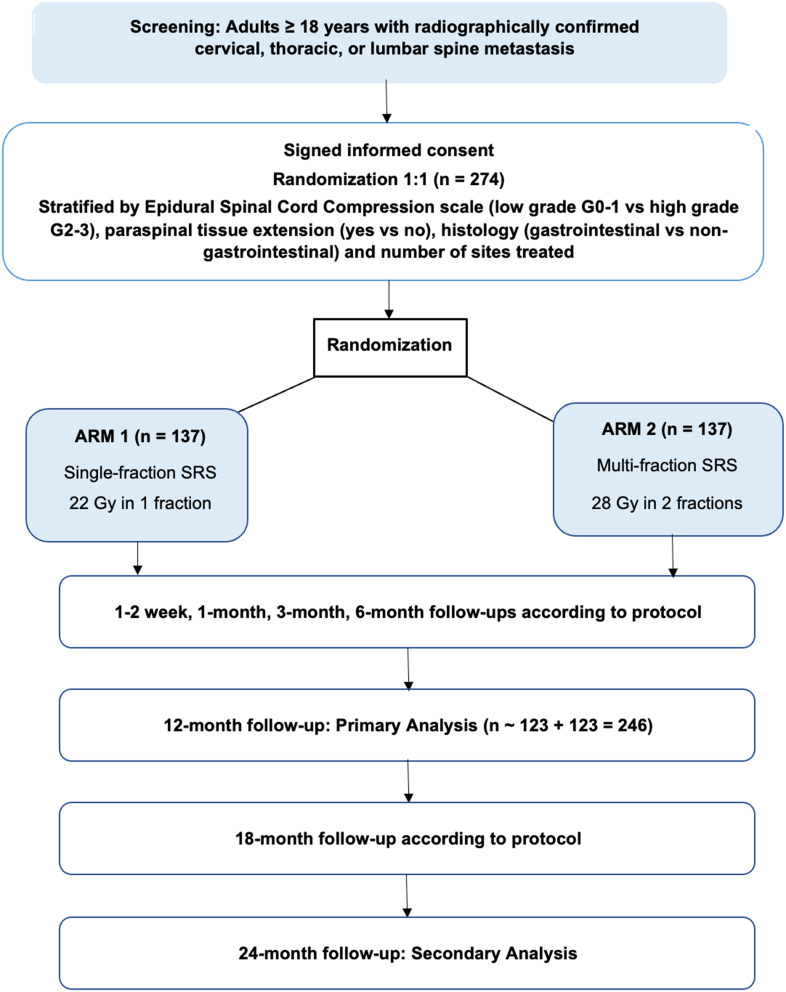 Figure 1
 Figure 2
Peer Reviews
No public reviews on file for this paper yet. If you reviewed it on a platform where reviews are public (OpenReview, ICLR, NeurIPS, ICML), you can paste yours below so the community can read it here.
Videos
No videos yet. Explain this paper in a talk, walkthrough, or lecture? Add one.
Taxonomy
TopicsManagement of metastatic bone disease · Spinal Fractures and Fixation Techniques · Spine and Intervertebral Disc Pathology