KBG syndrome: report and follow-up on three unrelated patients observed at different ages
Gregorio Serra, Pierandrea Elefante, Ylenia Gazzitano, Luigi Memo, Valeria Mineo, Carla Morando, Rosaria Nardello, Ettore Piro, Laura Travan, Giovanni Corsello

TL;DR
This paper reports on three unrelated KBG syndrome patients with varied ages at diagnosis, highlighting clinical and genetic features to improve early detection and management.
Contribution
The study contributes three new KBG syndrome cases with distinct genetic findings and variable diagnostic approaches, enhancing understanding of clinical and genomic profiles.
Findings
Three unrelated KBG syndrome patients were identified with typical features like triangular face and macrodontia.
Genetic analysis revealed different mutations in ANKRD11 and other genes, including a deletion involving multiple genes.
Early diagnosis through specific clinical features and genetic testing improves patient and family outcomes.
Abstract
KBG syndrome (MIM #148050) is a rare genetic disease, showing an autosomal dominant pattern of inheritance. It was first described by Herrmann et al. in 1975 in three affected families, whose initial letters gave origin to the acronym. A peculiar facies including triangular face, synophrys, macrodontia of the upper central incisors, as well as short stature, skeletal defects and neurodevelopmental disorders (developmental delay, intellectual disability, epilepsy) are the main features of the syndrome. Mutations of the ankirin repeat domain 11 gene (ANKRD11), which harbors at chromosome 16q24.3, have been associated to the syndrome. The encoded protein inhibits ligand-dependent activation of transcription. Due to the growing number of detected ANKRD11 variants associated to phenotypes with various degree of severity, the precise definition of the clinical and genomic profiles of patients…
Genes, proteins, chemicals, diseases, species, mutations and cell lines named across the full text — each resolved to its canonical identifier and authoritative record.
Click any figure to enlarge with its caption.
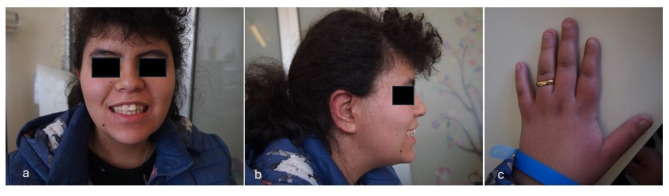 Figure 1
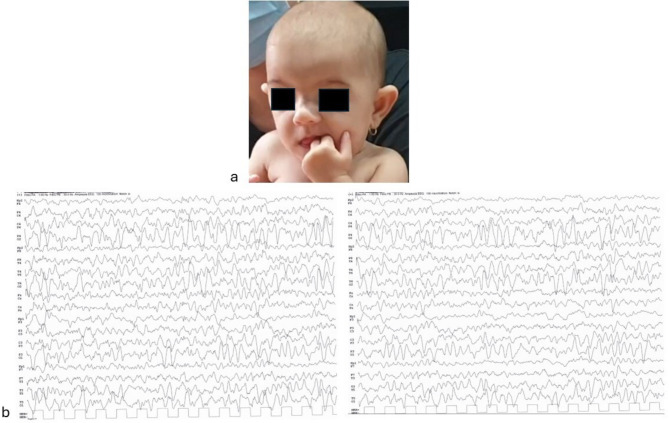 Figure 2
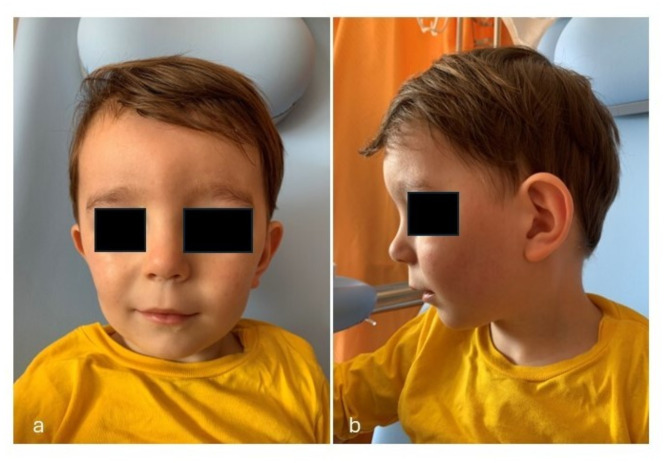 Figure 3
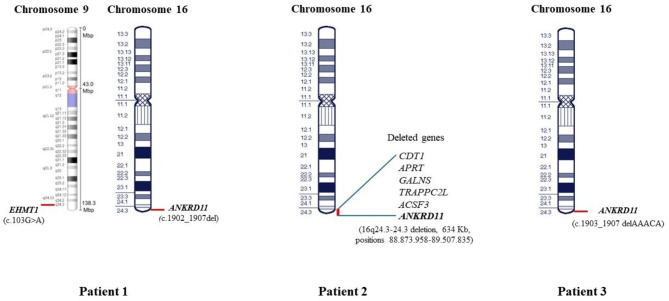 Figure 4
Peer Reviews
No public reviews on file for this paper yet. If you reviewed it on a platform where reviews are public (OpenReview, ICLR, NeurIPS, ICML), you can paste yours below so the community can read it here.
Videos
No videos yet. Explain this paper in a talk, walkthrough, or lecture? Add one.
Taxonomy
TopicsGenomics and Rare Diseases · Genomic variations and chromosomal abnormalities · Immunodeficiency and Autoimmune Disorders