Meiotic activation of Mitf/TFEB declines with age in the Drosophila testis
Tyler J. Butsch, Alyssa E. Johnson, K. Adam Bohnert

TL;DR
This study shows that lysosome activity in fruit fly testes declines with age, affecting sperm viability.
Contribution
The paper reveals that Mitf/TFEB activity during meiosis decreases with age in Drosophila testes.
Findings
Mitf/TFEB activity increases in meiotic-stage spermatocytes.
Mitf activity declines in older males, linked to reduced V-ATPase expression.
Lysosome activation patterns are connected to Mitf regulation during spermatogenesis.
Abstract
Lysosome activity regulates germline development in multiple species. In the Drosophila testis, lysosomes activate as germ cells exit mitosis and enter meiosis. Notably, reduced activity of germ-cell lysosomes, which is seen during aging, leads to fewer viable sperm. Here, we investigated the activity of Mitf/TFEB, a master regulator of lysosome biogenesis, during Drosophila spermatogenesis. We discovered that Mitf activity was upregulated in meiotic-stage spermatocytes, consistent with the lysosome-activation pattern. However, Mitf activity in spermatocytes declined in older males, concurrent with reduced expression of a Mitf-targeted V-ATPase component. These findings provide insight into the regulation of upstream lysosome controls during spermatogenesis.
Genes, proteins, chemicals, diseases, species, mutations and cell lines named across the full text — each resolved to its canonical identifier and authoritative record.
Click any figure to enlarge with its caption.
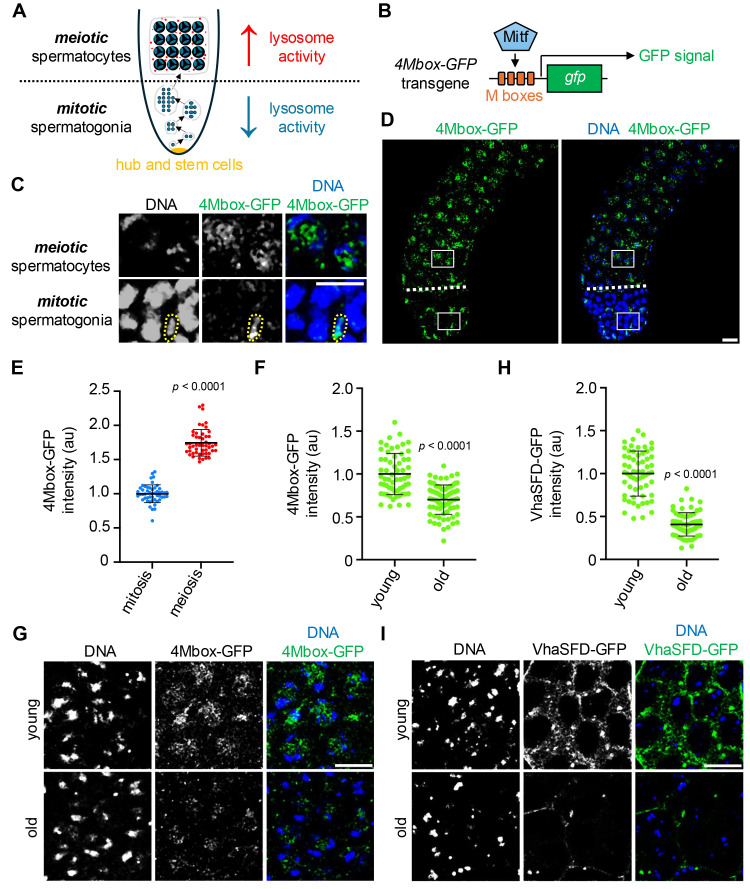 Figure 1
Peer Reviews
No public reviews on file for this paper yet. If you reviewed it on a platform where reviews are public (OpenReview, ICLR, NeurIPS, ICML), you can paste yours below so the community can read it here.
Videos
No videos yet. Explain this paper in a talk, walkthrough, or lecture? Add one.
Taxonomy
TopicsNF-κB Signaling Pathways · interferon and immune responses · Ubiquitin and proteasome pathways