Arabidopsis accessions and their difference in heat tolerance during meiosis
Joke De Jaeger-Braet

Abstract
Genes, proteins, chemicals, diseases, species, mutations and cell lines named across the full text — each resolved to its canonical identifier and authoritative record.
Click any figure to enlarge with its caption.
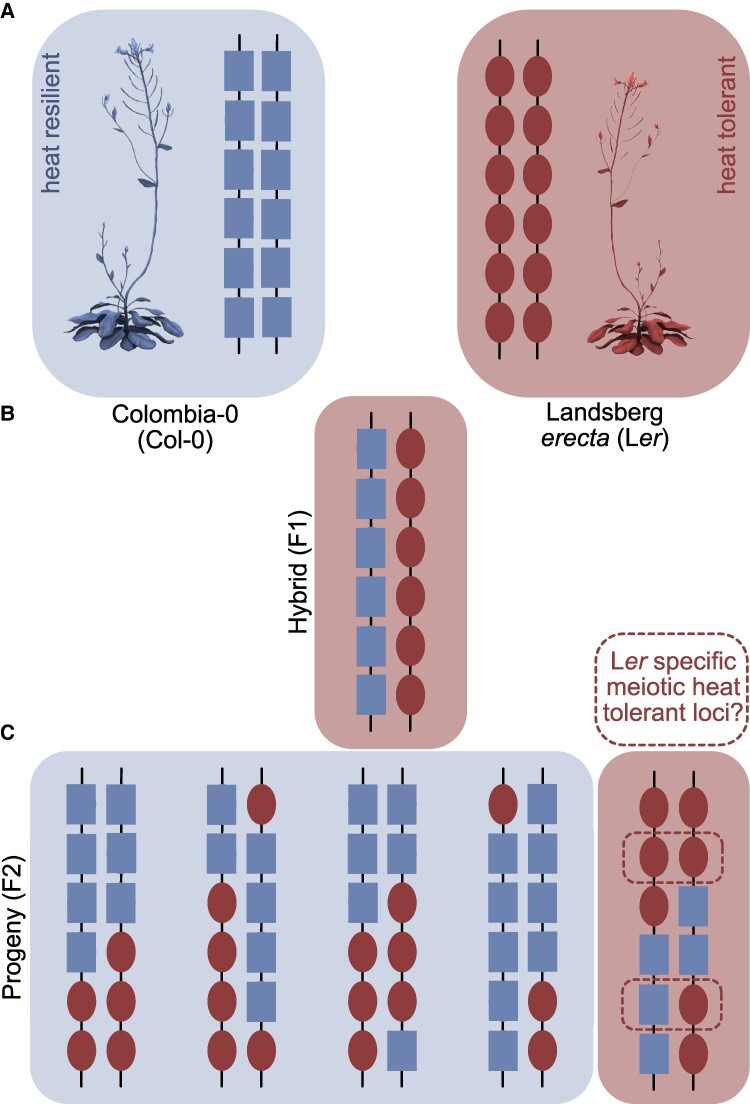 Figure 1
Peer Reviews
No public reviews on file for this paper yet. If you reviewed it on a platform where reviews are public (OpenReview, ICLR, NeurIPS, ICML), you can paste yours below so the community can read it here.
Videos
No videos yet. Explain this paper in a talk, walkthrough, or lecture? Add one.
Taxonomy
TopicsPhotosynthetic Processes and Mechanisms · Plant Stress Responses and Tolerance · Plant Genetic and Mutation Studies
With the changing climate, it is becoming more and more crucial to understand the natural existing heat tolerance in plants for agricultural and breeding purposes. The model plant Arabidopsis thaliana is well suited for the study of natural genetic variation with its many sequenced accessions (Lian et al. 2024). In this issue of Plant Physiology, Zhao and colleagues analyzed and compared 2 of those accessions, Columbia (Col-0) and Landsberg erecta (Ler), and their hybrids to understand the mechanisms behind meiotic heat tolerance (Zhao et al. 2024).
Meiosis is a specialized cell division that is an essential part of sexual reproduction. In meiosis, 1 round of DNA replication is followed by 2 rounds of chromosome segregation events, halving the chromosome number. In addition to random chromosome segregation, genetic diversity of the progeny occurs through the exchange of genetic information between homologous chromosomes (homologs) through a process called meiotic recombination (Zickler and Kleckner 2023). Meiotic recombination is initiated by the formation of double strand breaks (DSBs) in DNA. Those DSBs get repaired by DNA strand insertion into the homolog, which leads to the formation of cross-overs (COs).
Although the effect of high temperature on meiotic division has been studied over the last decades (reviewed in De Jaeger-Braet and Schnittger 2024), a detailed molecular understanding of it is still lacking. Previously, Zhao and colleagues have investigated the molecular impact of extreme heat stress during meiosis (Ning et al. 2021; Fu et al. 2022; Zhao et al. 2023). Here, they continued their investigation by making use of previous studies that showed that there are natural genetic differences in stress tolerance and meiotic recombination (Sidhu et al. 2015; Ziolkowski et al. 2017; Chen et al. 2021; Zhu et al. 2021).
Zhao et al. investigated the effect of extreme heat stress (37 °C) on meiosis in Col-0 and Ler plants by first looking at the end product of meiosis, 4 haploid cells that are also called tetrads. Under nonstressed conditions, both Col-0 and Ler form 4 equally sized cells, whereas under heat stress irregular meiotic end products could be found. The irregularities include unequally sized cells and deviating number of cells, that is, 2, 3, or more than 4. The occurrence of those irregular products was much more frequent in Col-0 than in Ler, 86% and 9%, respectively. In addition, this difference was also reflected in pollen viability defects between Col-0 and Ler that indicate that the Ler accession is more thermotolerant than Col-0.
To further investigate this higher thermotolerance of Ler, Zhao et al. surveyed different steps of the meiotic division: microtubule organization, DSB and CO formation, pairing of homologs, and synapsis (the stabilization of paired homologs). Comparing the results of those different aspects between Ler and Col-0 plants under heat stress led to the conclusion that the meiotic division of Ler is less affected by heat compared with Col-0 (Fig. A). Specifically, heat does not affect synapsis and recombination in Ler. For example, under nonstressed conditions at the end of the recombination pathway, around 11 and 9 COs are made in Col-0 and Ler, respectively (Ziolkowski et al. 2017). Under extreme heat stress, no COs could be detected in Col-0, in contrast to Ler, which showed around 10 COs.
The authors further tested if several kinases involved in floral architecture play a role in the heat response—for example, Ler contains a mutation in kinase gene ERECTA (van Zanten et al. 2009). The mutants of those kinases in Col-0 had the same heat meiotic phenotype as Col-0, indicating that ERECTA is not the primary determinant of the heat tolerance.
Zhao et al. analyzed Col-0 and Ler hybrids (F1) and their progeny (F2) under heat stress. Interestingly, although plant morphology of the hybrids was most similar to Col-0, the heat phenotype was more similar to Ler than Col-0. This indicated that the Ler thermotolerant loci are dominant over susceptible Col-0, which leads to the thermotolerant meiosis division in the hybrids (Fig. B).
Interestingly, when the authors tested the progeny of the Col/Ler hybrids (the F2 plants) under heat, only 20% resembled the Ler phenotype (Fig. C). This observation suggests that the heat tolerance of Ler might be conferred by the cooccurrence of multiple Ler alleles. In the Ler parent and the F1 hybrids these alleles are present, but in the F2 population the Col-0 and Ler alleles randomly recombined during meiosis, leading into progeny with different genetic background (Fig. C). As meiotic recombination causes allelic segregation that deviates from the canonical Mendelian segregation, it leads to a smaller proportion of the F2 population with the heat-tolerant phenotype.
To further obtain the Ler specific genetic alleles that lead to thermotolerance during meiosis, it would be of great interest to obtain the genetic background of those heat-tolerant progeny. This might lead to a set of candidate genes that give rise to the thermotolerant phenotype of Ler (Fig. C), which could be crucial for breeding purposes.
Overall, the research of Zhao and colleagues has contributed to our understanding of the effect of extreme heat stress in Ler accession and Col-0/Ler hybrids. These results pave the road for further research to identify the Ler genetic loci that are responsible for the meiotic heat tolerance.
The reference list from the paper itself. Each links out to its DOI / PubMed record.
- 1Chen Y , Dubois M, Vermeersch M, Inze D, Vanhaeren H. Distinct cellular strategies determine sensitivity to mild drought of Arabidopsis natural accessions. Plant Physiol. 2021:186(2):1171–1185. 10.1093/plphys/kiab 11533693949 PMC 8195540 · doi ↗ · pubmed ↗
- 2De Jaeger-Braet J , Schnittger A. Heating up meiosis—chromosome recombination and segregation under high temperatures. Curr Opin Plant Biol. 2024:80:102548. 10.1016/j.pbi.2024.10254838749207 · doi ↗ · pubmed ↗
- 3Fu H , Zhao J, Ren Z, Yang K, Wang C, Zhang X, Elesawi IE, Zhang X, Xia J, Chen C, et al Interfered chromosome pairing at high temperature promotes meiotic instability in autotetraploid Arabidopsis. Plant Physiol. 2022:188(2):1210–1228. 10.1093/plphys/kiab 56334927688 PMC 8825311 · doi ↗ · pubmed ↗
- 4Lian Q , Huettel B, Walkemeier B, Mayjonade B, Lopez-Roques C, Gil L, Roux F, Schneeberger K, Mercier R. A pan-genome of 69 Arabidopsis thaliana accessions reveals a conserved genome structure throughout the global species range. Nat Genet. 2024:56(5):982–991. 10.1038/s 41588-024-01715-938605175 PMC 11096106 · doi ↗ · pubmed ↗
- 5Ning Y , Liu Q, Wang C, Qin E, Wu Z, Wang M, Yang K, Elesawi IE, Chen C, Liu H, et al Heat stress interferes with formation of double-strand breaks and homolog synapsis. Plant Physiol. 2021:185(4):1783–1797. 10.1093/plphys/kiab 01233793950 PMC 8133540 · doi ↗ · pubmed ↗
- 6Sidhu GK , Fang C, Olson MA, Falque M, Martin OC, Pawlowski WP. Recombination patterns in maize reveal limits to crossover homeostasis. Proc Natl Acad Sci U S A. 2015:112(52):15982–15987. 10.1073/pnas.151426511226668366 PMC 4703008 · doi ↗ · pubmed ↗
- 7van Zanten M , Snoek LB, Proveniers MC, Peeters AJ. The many functions of ERECTA. Trends Plant Sci. 2009:14(4):214–218. 10.1016/j.tplants.2009.01.01019303350 · doi ↗ · pubmed ↗
- 8Zhao J , Fu H, Wang Z, Zhang M, Liang Y, Cui X, Pan W, Ren Z, Wu Z, Zhang Y, et al Genetic variation in Arabidopsis thaliana reveals the existence of natural heat resilience factors for meiosis. Plant Physiol.2024:197(1):kiae 671. 10.1093/plphys/kiae 67139711182 · doi ↗ · pubmed ↗