The complete mitochondrial genome of a rarely reported porcelain crab, Pisidia striata (Anomura, Galatheoidea, Porcellanidae), from the Chinese waters
Xifei Wang, Xuefeng Fang, Dong Dong

TL;DR
This paper reports the full mitochondrial genome of a rare porcelain crab found in Chinese waters, providing insights into its evolutionary relationships.
Contribution
The complete mitochondrial genome of Pisidia striata is newly sequenced and analyzed for phylogenetic relationships.
Findings
The mitochondrial genome is 15,357 bp long with 13 protein-coding genes, 22 tRNAs, and 2 rRNAs.
Pisidia striata is closely related to P. serratifrons within the Pisidia clade with strong phylogenetic support.
The genome provides a valuable resource for evolutionary studies of the Porcellanidae family.
Abstract
The species Pisidia striata is predominantly distributed along the southeastern coast of China and belongs to the shallow-water crab family Porcellanidae. The complete mitochondrial genome of P. striata, which spans 15,357 bp and contains 13 protein-coding genes, 22 tRNAs and 2 rRNAs, is presented in this study. The nucleotide composition reveals A (37.81%), T (35.48%), G (9.75%), and C (16.96%). Phylogenetic analysis demonstrates a close relationship between P. striata and P. serratifrons within the Pisidia clade with robust bootstrap support values. This mitochondrial genome will be a significant supplement for the genus Pisidia and whole mitogenome phylogenetic analysis provided insights into further evolutionary research of Porcellanidae.
Genes, proteins, chemicals, diseases, species, mutations and cell lines named across the full text — each resolved to its canonical identifier and authoritative record.
Click any figure to enlarge with its caption.
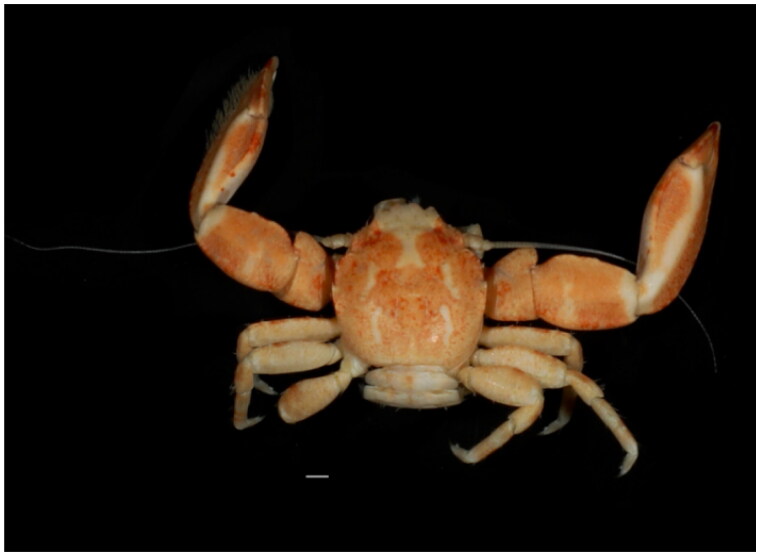 Figure 1
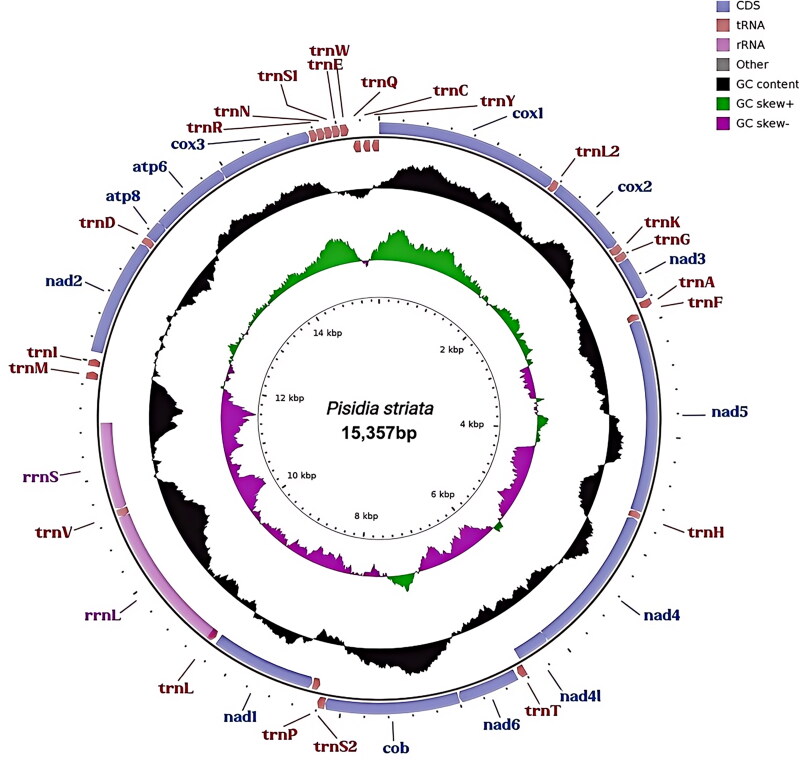 Figure 2
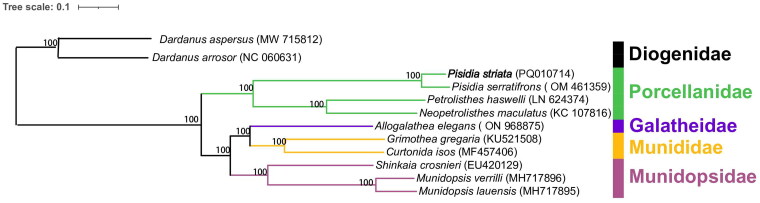 Figure 3
- —the National Key R&D Program of China
- —the Senior User Project of RV KEXUE
- —the Biological Resources Programme, Chinese Academy of Sciences
Peer Reviews
No public reviews on file for this paper yet. If you reviewed it on a platform where reviews are public (OpenReview, ICLR, NeurIPS, ICML), you can paste yours below so the community can read it here.
Videos
No videos yet. Explain this paper in a talk, walkthrough, or lecture? Add one.
Taxonomy
TopicsCrustacean biology and ecology · Identification and Quantification in Food · Coral and Marine Ecosystems Studies
Introduction
Pisidia striata Yang and Sun 1990 inhabits low-tidal regions, either beneath rocks or on coarse-grained sand substrates. It is also observed hiding inside the oyster and scallop cages (Yang and Sun 1990). Currently, it is only known to inhabit Chinese waters, with its distribution range extending from Shandong Province in northern China to Fujian Province in southeastern China. Morphologically similar to Pisidia serratifrons (Stimpson 1858), P. striata possesses a broad median rostral lobe that is anteriorly serrated and nearly twice as wide as the lateral lobes. Both species are sympatric in China and can be easily mistaken for each other. Pisidia striata can be distinguished from the latter by having the anterior margins of the rostral lobes weakly serrated instead of distinctly spinose or denticulate; the dorsal surface of the smaller chela rugose along the midline ridge, instead of crenulated or tuberculate; and the carpus of the cheliped only with distal spine on the dorso-extensor margin instead of armed with two spines. Unlike its relative P. serratifrons, there have been limited reports on P. striata since its establishment, resulting in a lack of comprehensive molecular genetics studies (Yang and Sun 1990). The genus Pisidia Leach 1821 currently comprises 14 species worldwide (Osawa and McLaughlin 2010), with only one species, P. serratifrons, has been sequenced for the mitochondrial genome (Lü et al. 2023).
In this study, we provided the complete mitochondrial genome of P. striata, which represents the second mitochondrial genome of this genus and the fourth within the family Porcellanidae. This research contributes to a better understanding of macrobenthos biodiversity in Chinese coastal waters and enhances the available mitochondrial molecular data for further phylogenetic investigations within Porcellanidae.
Materials and methods
The P. striata samples were collected from the subtidal zone in their living states at two sites: Dingzi Bay (36°38’N, 121°08’E), Shandong Province, in June 2022 and Haizhou Bay (35°01’N, 119°17’E), Jiangsu Province, in April 2024 (Figure 1). The specimens are deposited at the Marine Biological Museum (Dong Dong, [email protected]), Institute of Oceanology, Chinese Academy of Sciences, under the voucher numbers: MBM189317 (Dingzi Bay) and MBM189318 (Haizhou Bay). A specimen in MBM189317 was selected for the mitogenome sequencing. Whole genome DNA was extracted using the E.Z.N.A^®^ Tissue DNAkit (OMEGA). The DNA sample was sent to Biozeron Co. Ltd (Shanghai, China) for whole-genome sequencing using the Illumina TruSeq^™^ Nano DNA Sample Prep Kit method to construct the library. Subsequently, the library underwent 2×150 bp sequencing on the Illumina NovaSeq platform, resulting in a total of 80,973,172 clean reads obtained through Illumina HiSeq sequencing. The mitochondrial genome of P. striata was assembled using GetOrganelle v1.7.5 (Jin et al. 2020), and then annotated via the MITOS webserve (http://mitos.bioinf.uni-leipzig.de/index.py) (Bernt et al. 2013). Finally, the initiator/terminator condons of each protein-coding gene (PCG) were manually corrected in SnapGene Viewer with reference to the mitochondrial genome of P. serratifrons (GenBank: OM461359) (Lü et al. 2023).
Fresh photo of P. striata that taken by Dong Dong, MBM189318. Scale equals is 1.0 mm.
For the phylogenetic study, 13 PCGs from P. striata and nine other galatheoid species belonging to four different lineages – Porcellanidae, Munididae, Munidopsidae and Galatheidae – were analyzed (Supplemental Table S1). Two hermit crabs, Dardanus aspersus (Berthold, 1846) and D. arrosor (Herbst, 1796), were selected as the outgroups. The nucleotide sequences of each gene were aligned and trimmed using MEGA 6.0 (Tamura et al. 2013). Subsequently, the 13 PCGs were concatenated using PhyloSuite (Zhang et al. 2020). The phylogenetic relationships, based on the concatenated sequences, were inferred employing the maximum likelihood (ML) method implemented in the IQ-TREE (Nguyen et al. 2015). The best nucleotide base substitution model for each gene selected in present study was determined by PartitionFinder 2 (Lanfear et al. 2017) under the Akaike Information Criterion (AIC). The implementation of PartitionFinder 2 and IQ-TREE were pipelined in the program PhyloSuite. To validate the robustness of tree topology obtained, nodal support was evaluated with 5000 ultrafast bootstrap replicates (Minh et al. 2013). Eventually, the final phylogenetic tree visualization was accomplished using iTOL (Letunic and Bork 2019).
Results
The assembled mitochondrial genome displayed a range of read mapping depths, with the minimum depth being 7× and the maximum depth reaching 3442×. The average depth was calculated to be 1025.86× (Supplementary Figure 1). The complete mitochondrial genome of P. striata is 15,357 bp in length, encompassing a total of 13 PCGs, 22 tRNAs and two rRNAs (Figure 2). Among these genes, 23 were transcribed on the heavy (H) strand, while four PCGs (i.e. nad5, nad4, nad4l and nad1), eight tRNAs (i.e. trnF, trnH, trnP, trnL1, trnV, trnQ, trnC and trnY), as well as two rRNAs (rrnL and rrnS) were located on the light (L-) strand. The P. striata mitogenome exhibited a total of six overlapping regions, including rrnL (50 bp), nad4L/atp6 (7 bp), cox3 (1 bp), trnS2 (2 bp), and trnV (6 bp). Additionally, it contained 637 bp of intergenic spacers distributed across 19 regions, indicating the occurrence of tandem duplications and redundant gene deletions. The nucleotide composition of the mitogenome displayed a significant bias toward AT content (A: 37.81%, T: 35.48%, G: 9.75%, C: 16.96%). Genomic AT skewness was calculated as 0.270, while GC skewness was determined to be 0.032. All PCGs were initiated by an initiator codon ATN (ATT, ATG, ATA), except for cob which utilized TTG as its initiation codon. Regarding termination codons usage, cox1 and cox2 terminated with an incomplete termination codon (T -), whereas all other PCGs terminated with TAA codons. The lengths of the two ribosomal RNA genes (rrnS and rrnL) were measured at 781 bp and 1370 bp, respectively. A total of twenty-two tRNAs ranging in length from 63 bp (trnR) to 74 bp (trnV) demonstrated a substantial skewness toward high AT content at approximately 75.47%.
The organization of the mitogenome of P. striata. Genes for proteins and rRNAs are shown with standard abbreviations. Genes for tRNAs are represented by a single letter for the corresponding amino acid, with two leucine tRNAs and two serine tRNAs differentiated by numerals.
Based on the phylogenetic tree, the P. striata belongs to the clade of Porcellanidae and is most closely related to P. serratifrons (Figure 3).
The maximum-likelihood (ML) phylogenetic tree for P. striata and the other Galatheoidea species based on the concatenated nucleotide sequences of 13 mitochondrial protein-coding genes. Bootstrap support values are indicated at each node. All species in the tree are labeled with their scientific names and GenBank accession numbers on the right side. The position of P. striata is bold fonts. A list of scientific names, accession numbers, and references for all sequences used in this phylogeny is provided in Supplemental Table S1.
Discussion and conclusion
The P. striata mitogenome was subjected to sequencing analysis in this study, leading to the acquisition of new mitochondrial data for Porcellanidae. Our investigation covered various features of P. striata, including AT-skew and codon usage bias. The G content of P. striata is 9.75%, which is similar to its closely related conspecific, P. serratifrons (Lü et al. 2023), showing a relatively low proportion within the family Porcellanidae. In contrast, the G contents of the Petrolisthes haswelli and Neopetrolisthes maculatus were recorded as 11.34% and 11.35%, respectively (Shen et al. 2013; Tan et al. 2016). The phylogenetic relationships among the four Galatheoidea lineages were consistent with previous studies (Tan et al. 2018; Palero et al. 2019). Furthermore, this study provides valuable mitogenomic data for future investigations into the evolutionary history of Galatheoidea.
Supplementary Material
Table S1.docx
Supplementary Figure1.pdf
The reference list from the paper itself. Each links out to its DOI / PubMed record.
- 1Bernt M, Donath A, Jühling F, Externbrink F, Florentz C, Fritzsch G, Pütz J, Middendorf M, Stadler PF. 2013. MITOS: improved de novo metazoan mitochondrial genome annotation. Mol Phylogenet Evol. 69(2):313–319. doi:10.1016/j.ympev.2012.08.023.22982435 · doi ↗ · pubmed ↗
- 2Jin JJ, Yu WB, Yang JB, Song Y, de Pamphilis CW, Yi TS, Li DZ. 2020. Get Organelle: a fast and versatile toolkit for accurate de novo assembly of organelle genomes. Genome Biol. 21(1):241. doi:10.1186/s 13059-020-02154-5.32912315 PMC 7488116 · doi ↗ · pubmed ↗
- 3Lanfear R, Frandsen PB, Wright AM, Senfeld T, Calcott B. 2017. Partition Finder 2: new methods for selecting partitioned models of evolution formolecular and morphological phylogenetic analyses. Mol Biol Evol. 34(3):772–773. doi:10.1093/molbev/msw 260.28013191 · doi ↗ · pubmed ↗
- 4Letunic I, Bork P. 2019. Interactive tree of life (i TOL) v 4: recent updates and new developments. Nucleic Acids Res. 47(W 1):W 256–W 259. doi:10.1093/nar/gkz 239.30931475 PMC 6602468 · doi ↗ · pubmed ↗
- 5Lü J, Dong X, Li J, Ye Y, Xu K. 2023. Novel gene re-arrangement in the mitochondrial genome of Pisidia serratifrons (Anomura, Galatheoidea, Porcellanidae) and phylogenetic associations in Anomura. Biodivers Data J. 11:e 96231. doi:10.3897/BDJ.11.e 96231.38327357 PMC 10848379 · doi ↗ · pubmed ↗
- 6Minh BQ, Nguyen MA, von Haeseler A. 2013. Ultrafast approximation for phylogenetic bootstrap. Mol Biol Evol. 30(5):1188–1195. doi:10.1093/molbev/mst 024.23418397 PMC 3670741 · doi ↗ · pubmed ↗
- 7Nguyen L-T, Schmidt HA, von Haeseler A, Minh BQ. 2015. IQ-TREE: a fast and effective stochastic algorithm for estimating maximum-likelihood phylogenies. Mol Biol Evol. 32(1):268–274. doi:10.1093/molbev/msu 300.25371430 PMC 4271533 · doi ↗ · pubmed ↗
- 8Osawa M, Mc Laughlin PA. 2010. Annotated checklist of anomuran decapod crustaceans of the world (exclusive of the Kiwaoidea and families Chirostylidae and Galatheidae of the Galatheoidea) Part II—Porcellanidae. Raffles B Zool. Supplement No. 23:109–129.