A new genus and two new species of Opsiini leafhoppers (Hemiptera, Cicadellidae, Deltocephalinae) from China, with a key to genera

Abstract
Genes, proteins, chemicals, diseases, species, mutations and cell lines named across the full text — each resolved to its canonical identifier and authoritative record.
Click any figure to enlarge with its caption.
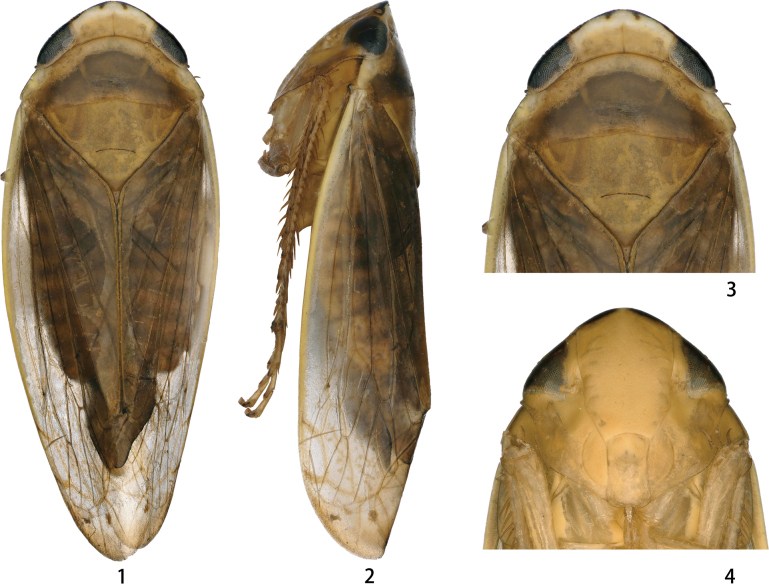 Figures 1–4
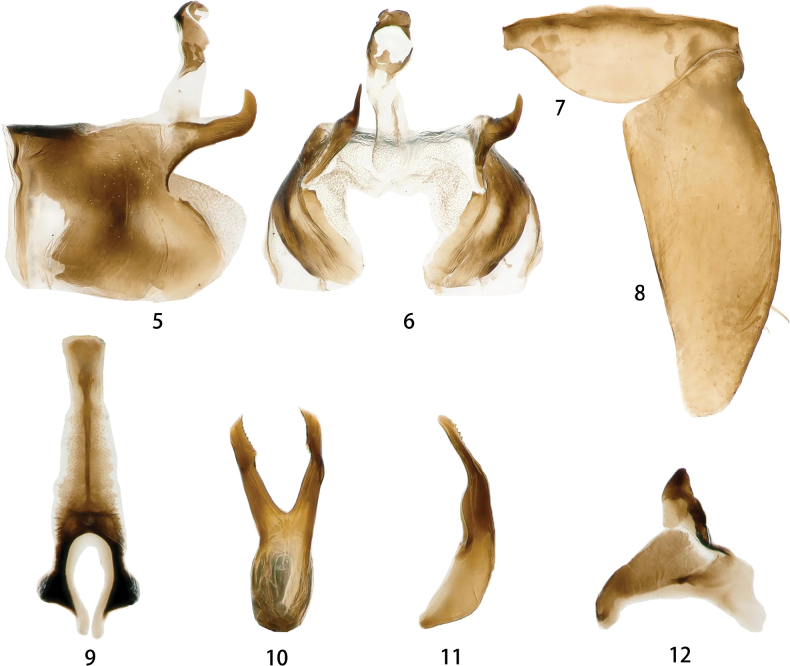 Figures 5–12
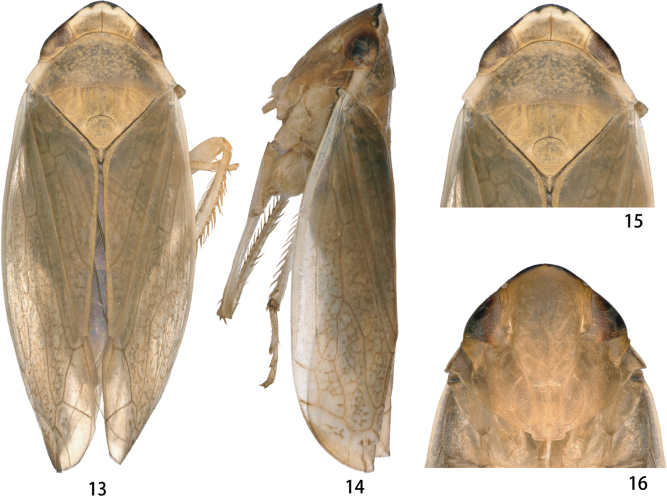 Figures 13–16
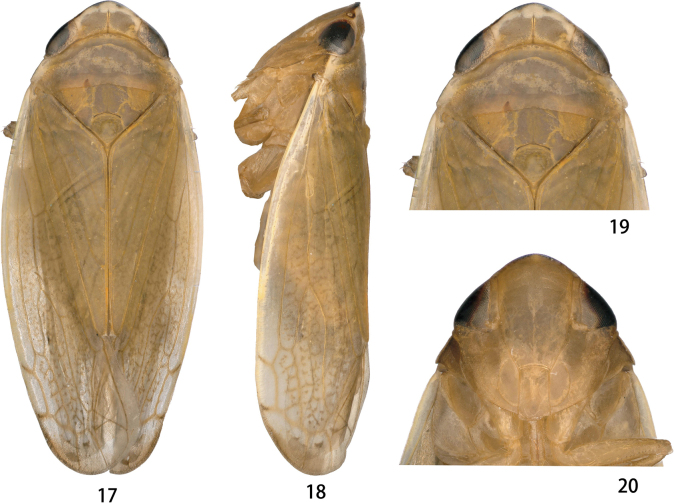 Figures 17–20
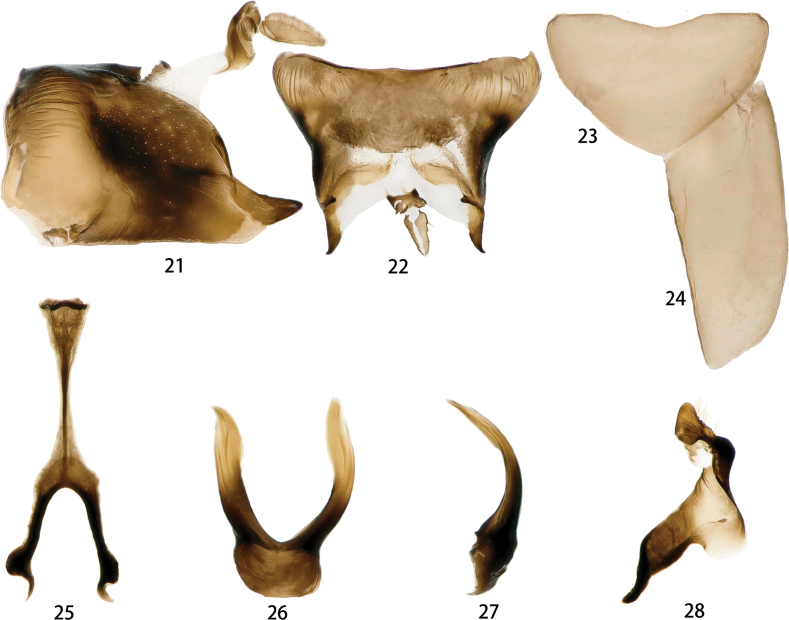 Figures 21–28
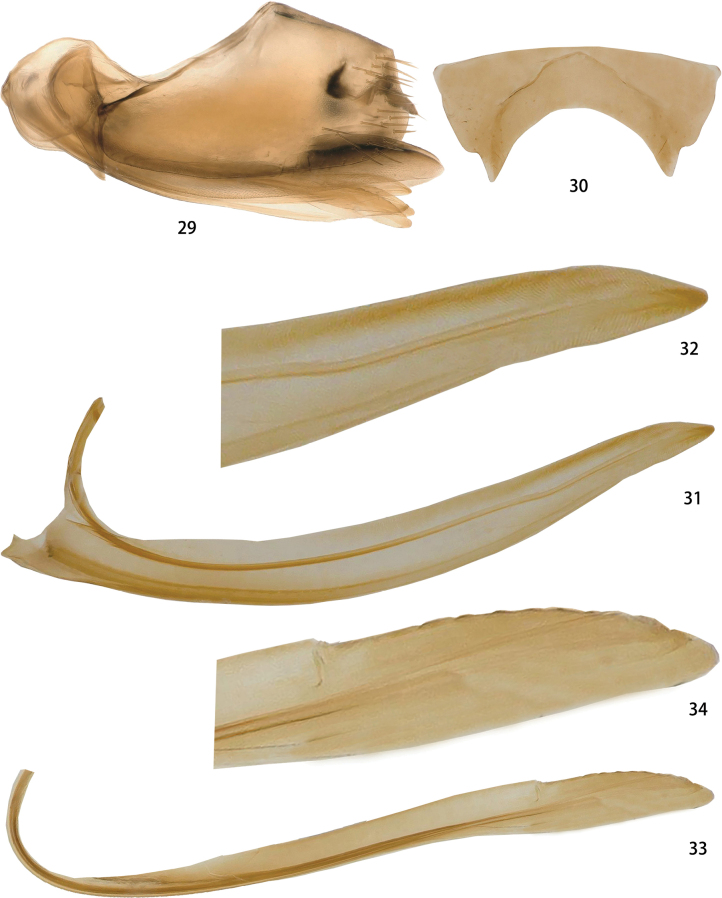 Figures 29–34
| 1 | Subgenital plates with macrosetae well developed and conspicuous |
|
| – | Subgenital plates with macrosetae absent or greatly reduced ( |
|
| 2 | Mesal margin of eye notched, single T-branched shaft arising from base of aedeagus, with shaft branches forming semicircle ( |
|
| – | Mesal margin of eye not notched, aedeagal shafts arising from base separately ( |
|
| 3 | Aedeagus shafts denticulate mesally on distal half |
|
| – | Aedeagus shafts without denticulation |
|
| 4 | Subgenital plate with an additional lateral plate at base |
|
| – | Subgenital plate without additional lateral plate |
|
| 5 | Pygofer with paired sharp lateral process arising ventrally |
|
| – | Pygofer without process |
|
| 6 | Crown, pronotum, scutellum and forewings with a few, or no, brown spots |
|
| – | Crown, pronotum, scutellum and forewings with numerous scattered brown spots |
|
| 7 | Aedeagal socle swollen and bulbous |
|
| – | Aedeagal socle not swollen |
|
| 8 | Aedeagal shafts with a subapical process |
|
| – | Aedeagal shafts with three or four subapical processes |
|
| 9 | Forewings with a triangular marble pattern forming in the middle of a darker rhomboidal spot when wings at rest |
|
| – | Forewings without triangular marble pattern forming in the middle of a darker rhomboidal spot when wings at rest |
|
| 10 | Aedeagus with atrium extending ventrad of shafts |
|
| – | Aedeagus with atrium not extending ventrad of shaft |
|
| 11 | Aedeagus without basal process arising from socle |
|
| – | Aedeagus with basal process arising from socle |
|
| 12 | Forewings with symmetrical longitudinal orange stripes |
|
| – | Forewings without symmetrical longitudinal orange stripes |
|
| 13 | Aedeagus with two or three pairs of shafts |
|
| – | Aedeagus with pair of shafts divided near base |
|
| 1 | Pygofer process arising from posterodorsal part of lobe (Fig. |
|
| – | Pygofer process arising from posteroventral part of lobe (Fig. |
|
Peer Reviews
No public reviews on file for this paper yet. If you reviewed it on a platform where reviews are public (OpenReview, ICLR, NeurIPS, ICML), you can paste yours below so the community can read it here.
Videos
No videos yet. Explain this paper in a talk, walkthrough, or lecture? Add one.
Taxonomy
TopicsPhytoplasmas and Hemiptera pathogens · Plant and Fungal Species Descriptions · Cocoa and Sweet Potato Agronomy
Introduction
The leafhopper tribe Opsiini belongs to the subfamily Deltocephalinae (Hemiptera, Cicadellidae) with Opsius Fieber, 1866 as its type genus. Until now, 42 genera and 353 species were known worldwide. The tribe is identified by the bifurcate aedeagus with two shafts and gonopores (Zahniser and Dietrich 2013). Sixty species belonging to 13 genera have been found in China (Cao and Xing 2022).
In this paper, a new genus Odonaellus gen. nov. and two new species from China are described and illustrated: O.serratus sp. nov. (type species; Yunnan) and O.expansus sp. nov. (Guangxi). Keys to Chinese genera of Opsiini and species of Odonaellus are provided. The type specimens of the new species are deposited in the Institute of Entomology, Guizhou University, Guiyang, China (GUGC).
Material and methods
Specimens used in this study were collected from Guangxi and Yunnan, China using a sweep net. Dry male specimens were used for the descriptions and illustrations. External morphology was observed under a stereoscopic microscope and characters were measured with an ocular micrometer. A Nikon SMZ1270 microscope was used to dissect the male genitalia. Color images for adult habitus and male genitalia were obtained using the Keyence VHX-6000 system. The genital segments of the examined specimen were macerated in 10% NaOH. Images were imported into Adobe Photoshop CS8 for labeling and plate composition. Morphological terminology follows Li et al. (2011).
Taxonomy
Tribe Opsiini Emeljanov, 1962
Key to subtribes and genera of Opsiini from China
Modified from Dai et al. 2010; Cao and Xing 2022.
**: **
Subtribe Eremophlepsiina Dmitriev, 2002
Odonaellus
gen. nov.
Taxon classificationAnimalia
EDF1D0E0-46E3-5ABF-A2AE-BBDF7E1B3082
https://zoobank.org/CDE39C57-F5A6-46C8-8556-424FB53F99E9
Type species.
Odonaellusserratus sp. nov.
Description.
Body yellowish-brown. Crown yellow, with white stripe and a pair of small black spots at apex of crown connected to a black transverse marginal band. Eyes dark brown; ocelli yellowish-brown and on anterior margin of head. Pronotum with anterior yellowish brown and posterior brown. Face pale brown. Forewing yellowish, with brown arched lines and patchy spots. Legs brownish yellow.
Body robust. Head including eyes narrower than pronotum; crown slightly produced medially, shorter than width between eyes; ocelli on anterior margin, separated from corresponding eye by approximately their own diameter; face slightly flattened, its width narrower than length; anteclypeus slightly expanded apically. Pronotum obviously longer than wide, anterior margin strongly and roundly produced, posterior margin slightly concave. Scutellum triangular, wider than long, slightly longer than pronotum, with transverse suture depressed. Forewing hyaline, about 3 times as long as wide, with 4 apical cells and 3 subapical cells; inner subapical cell closed. Fore femur with 2 dorsoapical setae; row IC with stout setae; row AV with short, stout setae; tibia with 2 rows of setae. Hind femur broadened distally and slightly bowed; apical setal formula 2+2+1; tibia flattened and nearly straight, row PD with 28 macrosetae decreasing in length toward base; row AD with approximately 13 long stout setae and 0–4 shorter stout setae between each long seta.
Male genitalia. Male pygofer slightly longer than high, with paired ventral process or dorsal process, without macrosetae, and setae on posterior margin. Valve subtriangular. Subgenital plate without macrosetae or with a few small macrosetae and with wide base, slightly narrowed posteriorly, without digitiform apical extension. Aedeagal shaft arising from base with paired shafts, denticular, curved, U-shaped in ventral view, gonopore subapical. Connective Y-shaped, articulated with aedeagus. Style broad at base, subapically slightly concaved.
Remarks.
This new genus is placed in subtribe Eremophlepsiina based on the following: crown concavely depressed, with a pair of apical black submedial maculae; head narrower than the pronotum; wings macropterous; macrosetae on the male subgenital plate reduced or absent, pygofer with paired posterior processes, aedeagus with shafts arising from the base; and the female ovipositor extending far beyond the pygofer apex. The genus is distinguished from other Eremophlepsiina by the lack of irregular brown markings on the head and pronotum, the much less prominent brown vermiculate markings on the forewing, and the apically denticulate shafts of the aedeagus. The two included species differ for some characters mentioned in the subtribal diagnosis provided by Zahniser and Dietrich (2013), suggesting that the genus may be intermediate between Eremophlepsiina and Opsiina (see Remarks for individual species below).
Etymology.
The new genus name is derived from the Latin word “odona” and the diminutive suffix “-ellus”, in reference to the denticulate (tooth-like) processes on the aedeagal shaft. Gender: masculine.
Distribution.
Oriental region (China).
Key to species of Odonaellus gen. nov. from China (males)
**: **
Odonaellus
serratus
sp. nov.
Taxon classificationAnimalia
6C7905DC-524C-5486-91AE-0D701E7A5893
https://zoobank.org/F7F35958-C834-4091-8158-DD8F222FCE02
Description.
Color pattern of anterior dorsum and face as in Figs 1–4. Face yellow with a few brown stripes (Fig. 4).
Other external features as in generic description.
Male genitalia. Male pygofer with one pair of finger-like dorsal processes arising caudally and with a few macrosetae along caudal margin; ventral margin expanded (Figs 5, 6). Valve small (Fig. 7). Subgenital plate with a few stout setae (Fig. 8). Aedeagal shaft lamellar, apical tapered and apcial inner margin dentate; gonopore subapical (Figs 10, 11). Connective with arms shorter than stem (Fig. 9). Style curved, apical apophysis stout and subapically concaved (Fig. 12).
Measurement. Length (including tegmen): ♂, 5.3–5.7 mm.
Type material.
Holotype: • ♂, China: Yunnan, Mengla County, Mohan; 21°22'30"N, 101°75'46"E; 13 May 2015, coll. Qiang Luo (GUGC); paratypes: • 5 ♂♂, Yunnan, Mengla County, Mohan; 21°13'21"N, 101°44'59"E; 13 May 2015, coll. Qiang Luo; • 3 ♂♂, Yunnan, Mengla County, Menglun; 21°91'32"N, 101°26'83"E; 12 May 2015, coll. Qiang Luo (GUGC).
Etymology.
The new species name is Latin adjective serratus, “serrate”, used in reference to the apically aedeagal shaft toothed like a saw.
Odonaellusserratus sp. nov. 1 ♂, dorsal view 2 ♂, lateral view 3 ♂, head and thorax, dorsal view 4 ♂, face.
Odonaellusserratus sp. nov. 5 male pygofer side, lateral view 6 male pygofer side, ventral view 7 valve, ventral view 8 subgenital plates, ventral view 9 connective, ventral view 10 aedeagus, ventral view 11 aedeagus, lateral view 12 style, dorsal view.
Remarks.
This species disagrees with the subtribal diagnosis of Eremophlepsiina, as provided by Zahniser and Dietrich (2013), in having small macrosetae present laterally on the male subgenital plate, the pygofer process arising dorsally rather than ventrally, and the valve distinctly shorter than wide.
Odonaellus
expansus
sp. nov.
Taxon classificationAnimalia
56F9F325-A87E-5CB6-8056-46FFBFA5438F
https://zoobank.org/662E89F3-915E-44F4-A0C3-3746755C2528
Figs 13–16 , 17–20 , 21–28 , 29–34
Description.
Color pattern of anterior dorsum and face as in Figs 13–20. Male pronotum dark brown with irregular fuscous spots (Fig. 15); female pronotum yellowish brown, without spot (Fig. 19).
Other external features as in generic description.
Male genitalia. Male pygofer with one pair of sharp ventral processes arising caudally and a pair of tiny posteroventral process grown in dorsal inner surface (Figs 21, 22). Valve large (Fig. 23). Subgenital plate without macrosetae (Fig. 24). Aedeagal shaft auricular and subapical inner margin with a few small dentae; gonopore subapical (Figs 26, 27). Connective with arms shorter than stem (Fig. 25). Style curved; apical apophysis stout and subapically concave. (Fig. 28).
Odonaellusexpansus sp. nov. 13 ♂, dorsal view 14 ♂, lateral view 15 ♂, head and thorax, dorsal view 16 ♂, face.
Odonaellusexpansus sp. nov. 17 ♀, dorsal view 18 ♀, lateral view 19 ♀, head and thorax, dorsal view 20 ♀, face.
Odonaellus sp. nov. 21 male pygofer side, lateral view 22 male pygofer side, dorsal view 23 valve, ventral view 24 subgenital plates, ventral view 25 aedeagus, ventral view 26 aedeagus, lateral view 27 connective, ventral view 28 style, dorsal view.
Female pygofer with ventroposterior margin sharply incurved (Fig. 29). Female seventh sternum posterior margin concave, resulting in projection on both sides (Fig. 30). First valvula of ovipositor slightly curved, attenuate to apex, with indistinct scale-like sculpture ventrally (Figs 31, 32). Second valvula with small teeth near apex (Figs 33, 34).
Measurement. Length (including tegmen): ♂, 5.4–5.7 mm; ♀, 5.8–6.5 mm.
Type material.
Holotype: • ♂, China: Guangxi Autonomous Region, Longzhou County, Nonggang; 22°25'21"N, 106°97'27"E; 4 May 2014, coll. Qu Wu (GUGC); paratypes: • 4 ♂♂ 5 ♀♀, Guangxi Autonomous Region, Longzhou County, Nonggang; 22°49'97"N, 106°97'49"E; 8 May 2012, coll. Zhiwei Fan, Hu Li; • 3 ♂♂, Guangxi Autonomous Region, Longzhou County, Nonggang; 22°52'66"N, 106°96'94"E; 4 May 2014, coll. Qu Wu (GUGC).
Etymology.
The new species name is Latin adjective expansus, “expanded”, which is in reference to the broadly expanded base of the aedeagal shaft.
Odonaellusexpansus sp. nov. 29 female genital capsule, lateral view 30 seventh sternite, ventral view 31 first valvula, lateral view 32 detail of sculptures of first valvula 33 second valvula, lateral view 34 detail of sculpture on second valvula.
Remarks.
This species agrees more closely with the subtribal diagnosis of Eremophlepsiina (Zahniser and Dietrich 2013) than does the type species of the genus. Unlike O.serratus, O.expansus has the male valve nearly as long as wide, the pygofer process ventrally arising, and the subgenital plate lacking macrosetae as in other Eremophlepsiina.
Supplementary Material
XML Treatment for Odonaellus
XML Treatment for Odonaellus serratus
XML Treatment for Odonaellus expansus
The reference list from the paper itself. Each links out to its DOI / PubMed record.
- 1Cao WJ Xing JC (2022) Japananoides, a new leafhopper genus from China (Hemiptera: Cicadellidae: Deltocephalinae).Zootaxa 5154: 345–354. 10.11646/zootaxa.5154.3.736095617 · doi ↗ · pubmed ↗
- 2Dai W Cui W Xiao B Zhang YL (2010) A new genus and species of Old World Opsiini (Hemiptera: Cicadellidae: Deltocephalinae), with a key to genera and species checklist for the tribe.Zootaxa 2607: 55–68. 10.11646/zootaxa.2607.1.2 · doi ↗
- 3Li ZZ Dai RH Xing JC (2011) Deltocephalinae from China (Hemiptera: Cicadellidae).Popular Science Press, Beijing, 336 pp. [in Chinese with English summary]
- 4Zahniser JN Dietrich CH (2013) A review of the tribes of Deltocephalinae (Hemiptera: Auchenorrhyncha: Cicadellidae).European Journal of Taxonomy 45: 1–211. 10.5852/ejt.2013.45 · doi ↗