INFOGRAPHIC: 2-year efficacy, durability and safety of intravitreal faricimab with treat-and-extend dosing up to 16 weeks in diabetic macular oedema (pooled results from YOSEMITE and RHINE)
Naomi Wijesingha, Kara Gibson, Jeffrey R. Willis, Sobha Sivaprasad

Abstract
Genes, proteins, chemicals, diseases, species, mutations and cell lines named across the full text — each resolved to its canonical identifier and authoritative record.
Click any figure to enlarge with its caption.
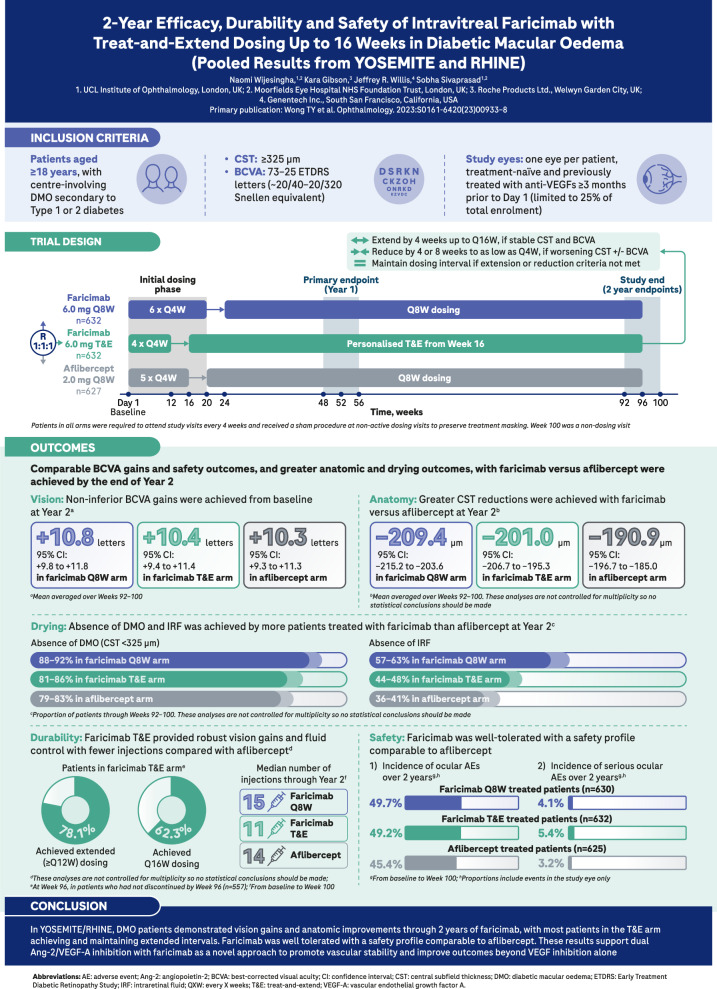 Figure 1
- —https://doi.org/10.13039/100004337Roche (F. Hoffmann-La Roche Ltd)
Peer Reviews
No public reviews on file for this paper yet. If you reviewed it on a platform where reviews are public (OpenReview, ICLR, NeurIPS, ICML), you can paste yours below so the community can read it here.
Videos
No videos yet. Explain this paper in a talk, walkthrough, or lecture? Add one.
Taxonomy
TopicsRetinal Diseases and Treatments · Retinal Imaging and Analysis · Retinal and Optic Conditions
Fig. 1. Pooled 2-year results from two Phase 3 trials (YOSEMITE and RHINE) of faricimab, a bispecific antibody targeting both Ang-2 and VEGF-A, in patients with DMO.These results support dual Ang-2/VEGF-A inhibition with faricimab as a novel approach to promote vascular stability and improve outcomes beyond VEGF inhibition alone.