A 3-Year-Old With Leg Pain After Visiting a Trampoline Park
Corey Horn, Lindsay Tjiattas-Saleski

Abstract
Genes, proteins, chemicals, diseases, species, mutations and cell lines named across the full text — each resolved to its canonical identifier and authoritative record.
Click any figure to enlarge with its caption.
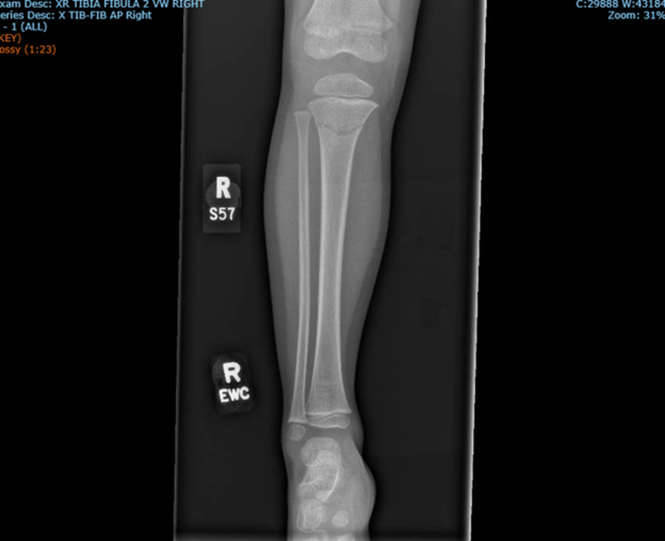 Figure 1
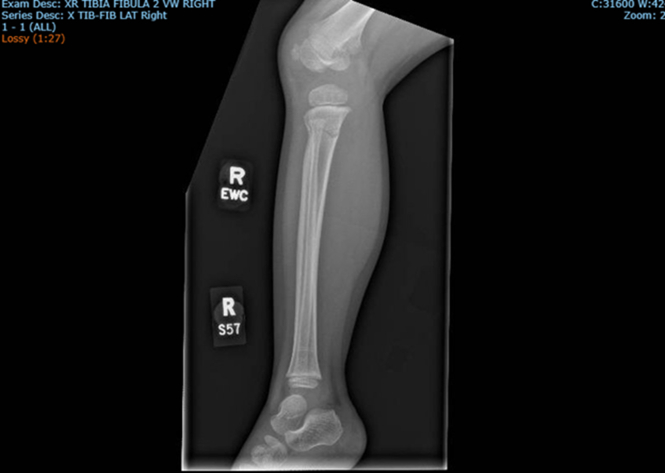 Figure 2
Peer Reviews
No public reviews on file for this paper yet. If you reviewed it on a platform where reviews are public (OpenReview, ICLR, NeurIPS, ICML), you can paste yours below so the community can read it here.
Videos
No videos yet. Explain this paper in a talk, walkthrough, or lecture? Add one.
Taxonomy
TopicsTravel-related health issues · Injury Epidemiology and Prevention
Patient Presentation
1
A 3-year-old boy presents to the emergency department with a complaint of right leg pain. The onset of pain occurred roughly 24 hours prior when the patient accidentally collided with a family member while jumping on a trampoline. The exact positioning of the impact is unclear. The patient noted general lower leg pain without the ability to identify an exact location. The leg was tender, and the patient’s body weight was not tolerated while standing or ambulating. Over-the-counter pain medications were taken at home but provided no relief. No other injury or illness was revealed by the patient or guardian. Plain film x-ray imaging of the right lower leg was ordered and shown below in Figures 1 and 2.Figure 1. Anteroposterior plain film of right lower limb.Figure 2. Lateral plain film of right lower limb.
Diagnosis: Cozen’s Fracture
2
Plain film imaging revealed a nondisplaced right proximal metaphyseal tibial fracture, less commonly referred to as a “Cozen’s Fracture.”1 Proximal tibial fractures are seen most in children 3 to 6 years of age and are associated with a condition known as “Cozen’s phenomenon.”2 Cozen’s phenomenon is a valgus tibial deformity as a result of improper healing in fractures of the proximal tibia including greenstick and complete fractures.2^,^3 Proper angulation in the reduction of tibial fractures is thought to reduce the risk of valgus deformity, although it is unclear how influential initial management is in long-term avoidance as other variables such as body weight and fracture displacement contribute to the incidence of Cozen’s phenomenon.2, 3, 4 Long leg casts in extension with varus mold is the management of choice to prevent the valgus deformity, especially when the fibula remains intact.2^,^4 Cozen’s fractures are commonly cited as injuries related to trampoline use with proximal tibia fractures accounting for 23% of trampoline-related fractures.4 Proximal tibia fractures in 3- to 6-year-old patients should be monitored closely, as there is a tendency for progression to Cozen’s valgus deformity, but the phenomenon typically resolves through observation alone.4^,^5
Conflict of Interest
All authors have affirmed they have no conflicts of interest to declare.
The reference list from the paper itself. Each links out to its DOI / PubMed record.
- 1Tibia and fibula fractures in children. Johns Hopkins Medicinehttps://www.hopkinsmedicine.org/health/conditions-and-diseases/tibia-and-fibula-fractures 2024
- 2Macknet D.Swarup I.Sink E.Proximal tibia metaphyseal fractures—pediatric. Orthobulletshttps://www.orthobullets.com/pediatrics/4025/proximal-tibia-metaphyseal-fractures--pediatric 2024
- 3Morin M.Klatt J.Stevens P.M.Cozen’s deformity: resolved by guided growth Strategies Trauma Limb Reconstr 132201887932954956810.1007/s 11751-018-0309-y PMC 6042219 · doi ↗ · pubmed ↗
- 4Jeong C.Lee S.U.Kim H.G.Joo S.Y.Trampoline-related fractures of the proximal tibia in children J Orthop Surg Res 1620215513449691310.1186/s 13018-021-02707-9PMC 8424931 · doi ↗ · pubmed ↗
- 5Papamerkouriou Y.-M.Tsoumpos P.Tagaris G.Christodoulou G.Does Cozen’s phenomenon warrant surgical intervention?J Child Orthop 14320202132203258238910.1302/1863-2548.14.190147 PMC 7302407 · doi ↗ · pubmed ↗