Peripheral blood mononuclear cell number and paracrine function in responses to a 50‐km trail race: An exploratory study
Rian Q. Landers‐Ramos, Katherine Kim, James Heilman, William S. Evans, Odessa Addison, Sushant M. Ranadive, Steven J. Prior

TL;DR
This study explores how a 50-km trail race affects blood cells that support blood vessel growth, finding that prolonged running temporarily boosts their function.
Contribution
The study is the first to explore PBMC paracrine function and subtype changes during and after a 50-km ultramarathon.
Findings
PBMC paracrine activity increased during the race, enhancing endothelial cell proliferation.
CD31+ PBMCs increased after the race, while CD3+ and CD31+/CD3+ PBMCs decreased.
Changes in PBMC subtypes suggest a protective role in response to prolonged exercise stress.
Abstract
Peripheral blood mononuclear cells (PBMCs) represent a heterogeneous mix of cells with paracrine functions that may be altered following prolonged exercise. We determined the effect of ultramarathon running on PBMC paracrine function and PBMC subtype number. Recreational athletes participated in a 50 km ultramarathon. Blood was sampled from N = 7 at baseline, 10 km, 50 km, and 24 h post‐race. PBMCs were isolated and cultured, and conditioned media was used for a HUVEC‐based proliferation assay. CD31+, CD3+, and CD31+/CD3+ PBMCs were quantified at each time point. Proliferation increased from baseline to 50 km (p = 0.004) and was reduced from 50 km to 24 h post (p = 0.008). There was an increase in CD31+ PBMCs after 50 km (p = 0.014), returning to baseline at 24 h post‐race (p = 0.246). CD3+ PBMC and CD31+/CD3+ PBMC numbers were reduced after 50 km (p = 0.001 and p = 0.002,…
Genes, proteins, chemicals, diseases, species, mutations and cell lines named across the full text — each resolved to its canonical identifier and authoritative record.
Click any figure to enlarge with its caption.
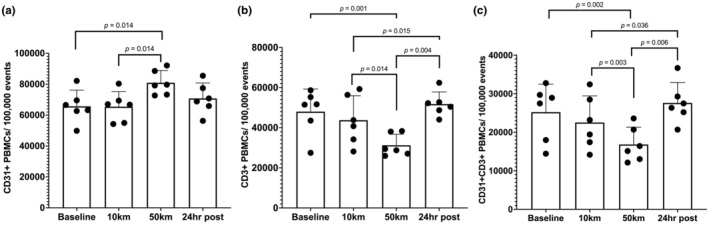 Figure 1
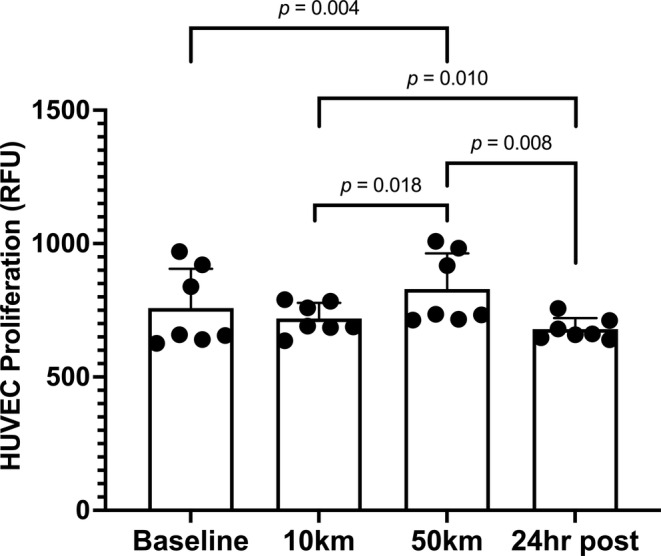 Figure 2
Peer Reviews
No public reviews on file for this paper yet. If you reviewed it on a platform where reviews are public (OpenReview, ICLR, NeurIPS, ICML), you can paste yours below so the community can read it here.
Videos
No videos yet. Explain this paper in a talk, walkthrough, or lecture? Add one.
Taxonomy
TopicsExercise and Physiological Responses · Adipose Tissue and Metabolism · High Altitude and Hypoxia