Neural development goes retro: Gags as essential modulators of synapse formation
Yung-Heng Chang, Josh Dubnau

TL;DR
A retrotransposon's gag protein helps control synapse formation in fruit fly nerve connections.
Contribution
The study identifies Copia's gag protein as a modulator of synapse formation through RNA transfer.
Findings
Copia's gag protein forms virus-like capsids that transfer RNA across neuromuscular junctions.
Copia's gag protein regulates synapse formation in Drosophila.
Copia and Arc, both retrotransposon gag proteins, act antagonistically in synapse regulation.
Abstract
Neurodevelopment requires dynamic control of synapse number. A new study in PLOS Biology reveals that the gag protein of Copia, an active retrotransposon, forms virus-like capsids that transfer its own RNA across the Drosophila neuromuscular junction. Here, Copia acts antagonistically with Arc, another retrotransposon gag protein, to regulate synapse formation. Neurodevelopment requires dynamic control of synapse number. This Primer highlights a new study in PLOS Biology which reveals that the gag protein of Copia, an active retrotransposon, forms virus-like capsids that transfer its own RNA across the Drosophila neuromuscular junction, to regulate synapse formation.
Genes, proteins, chemicals, diseases, species, mutations and cell lines named across the full text — each resolved to its canonical identifier and authoritative record.
Click any figure to enlarge with its caption.
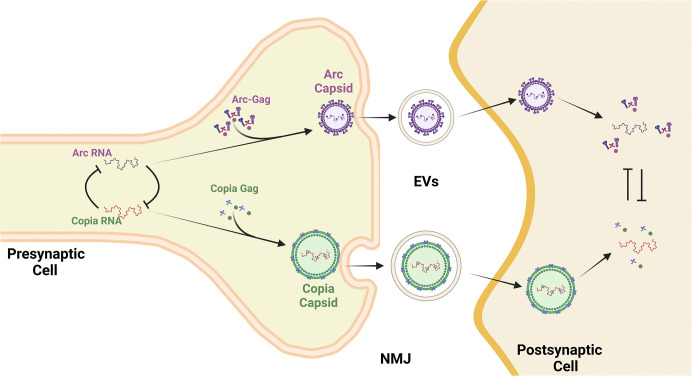 Figure 1
Peer Reviews
No public reviews on file for this paper yet. If you reviewed it on a platform where reviews are public (OpenReview, ICLR, NeurIPS, ICML), you can paste yours below so the community can read it here.
Videos
No videos yet. Explain this paper in a talk, walkthrough, or lecture? Add one.
Taxonomy
TopicsRetinal Development and Disorders · Cellular transport and secretion · Neuroscience and Neuropharmacology Research