Superionic Ionic Conductor Discovery via Multiscale Topological Learning
Dong Chen, Bingxu Wang, Shunning Li, Wentao Zhang, Kai Yang, Yongli Song, Guo-Wei Wei, Feng Pan

TL;DR
This paper introduces a new method using topological learning to discover lithium superionic conductors, which are important for safer and more efficient batteries.
Contribution
The novel multiscale topological learning framework enables efficient discovery of lithium superionic conductors by integrating algebraic topology and unsupervised learning.
Findings
The framework identified 14 novel lithium superionic conductors.
Four of the discovered conductors were validated through recent experiments.
The method shows adaptability for broader materials discovery challenges.
Abstract
Lithium superionic conductors (LSICs) are crucial for next-generation solid-state batteries, offering exceptional ionic conductivity and enhanced safety for renewable energy and electric vehicles. However, their discovery is extremely challenging due to the vast chemical space, limited labeled data, and the understanding of complex structure-function relationships required for optimizing ion transport. This study introduces a multiscale topological learning (MTL) framework, integrating algebraic topology and unsupervised learning to tackle these challenges efficiently. By modeling lithium-only and lithium-free substructures, the framework extracts multiscale topological features and introduces two topological screening metrics-cycle density and minimum connectivity distance-to ensure structural connectivity and ion diffusion compatibility. Promising candidates are clustered via…
Click any figure to enlarge with its caption.
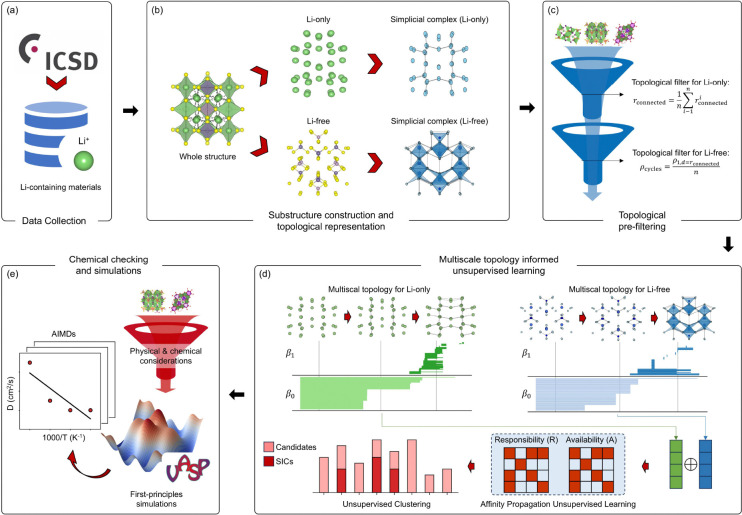 Figure 1
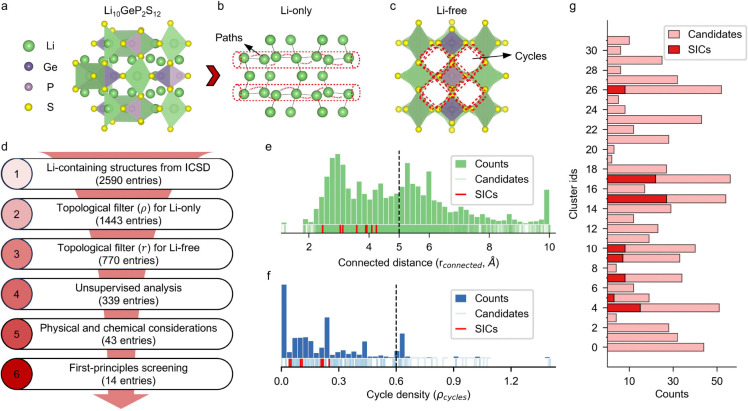 Figure 2
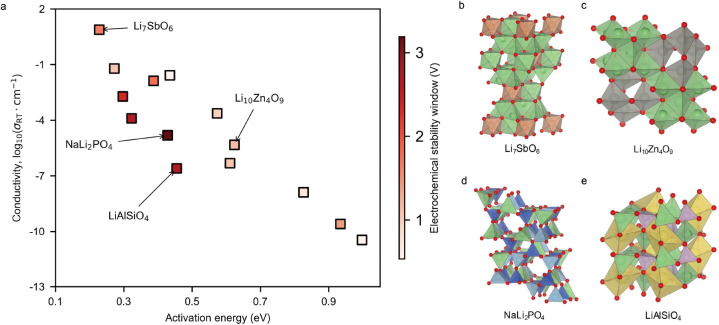 Figure 3
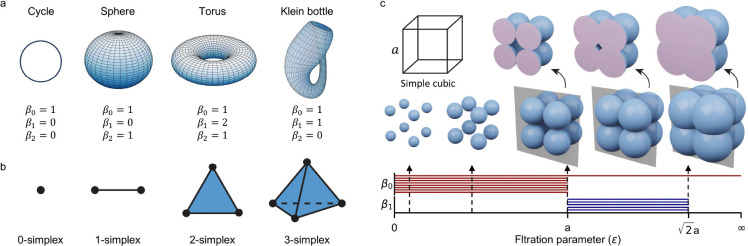 Figure 4
Peer Reviews
No public reviews on file for this paper yet. If you reviewed it on a platform where reviews are public (OpenReview, ICLR, NeurIPS, ICML), you can paste yours below so the community can read it here.
Videos
No videos yet. Explain this paper in a talk, walkthrough, or lecture? Add one.
Taxonomy
TopicsMachine Learning in Materials Science · Surface Chemistry and Catalysis