Long-Read Sequencing is Required for Precision Diagnosis of Incontinentia Pigmenti
Monica H. Wojcik, Robin D. Clark, Abdallah F. Elias, Casie A. Genetti, Jill A. Madden, Dana Simpson, Linda Golkar, Miranda PG Zalusky, Angela L. Miller, Araceli Rodriguez, Joy Goffena, Camille A. Dash, Nikhita Damaraju, Sophia B. Gibson, Sophia HR Storz, Zach Anderson

TL;DR
Long-read sequencing is essential for diagnosing Incontinentia Pigmenti when standard tests fail due to a pseudogene.
Contribution
Demonstrates the necessity of long-read sequencing for accurate diagnosis of IP in cases with negative clinical testing.
Findings
Long-read sequencing identified causal variants in seven individuals with IP who had negative clinical test results.
Methylation analysis explained disease severity and identified a mosaic variant in an atypical case.
Skewed X-chromosome inactivation was confirmed in an XXY individual using methylation analysis.
Abstract
Incontinentia pigmenti (IP) is caused by loss-of-function variants in IKBKG, with molecular genetic diagnosis complicated by a pseudogene. We describe seven individuals from three families with IP but negative clinical testing in whom long-read sequencing identified causal variants. Concurrent methylation analysis explained disease severity in one individual who died from neurologic complications, identified a mosaic variant in an individual with an atypical presentation, and confirmed skewed X-chromosome inactivation in an XXY individual.
Genes, proteins, chemicals, diseases, species, mutations and cell lines named across the full text — each resolved to its canonical identifier and authoritative record.
Click any figure to enlarge with its caption.
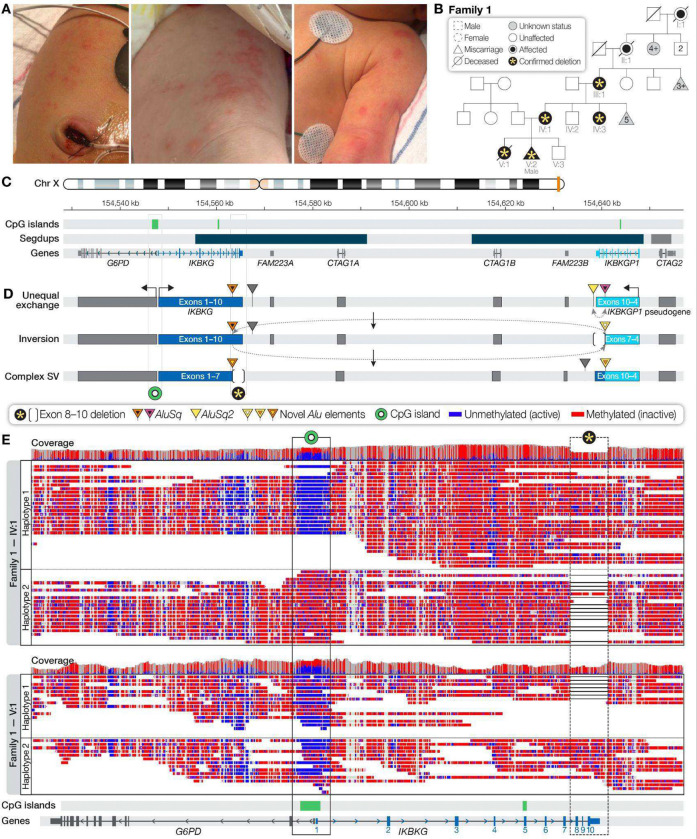 Figure 1
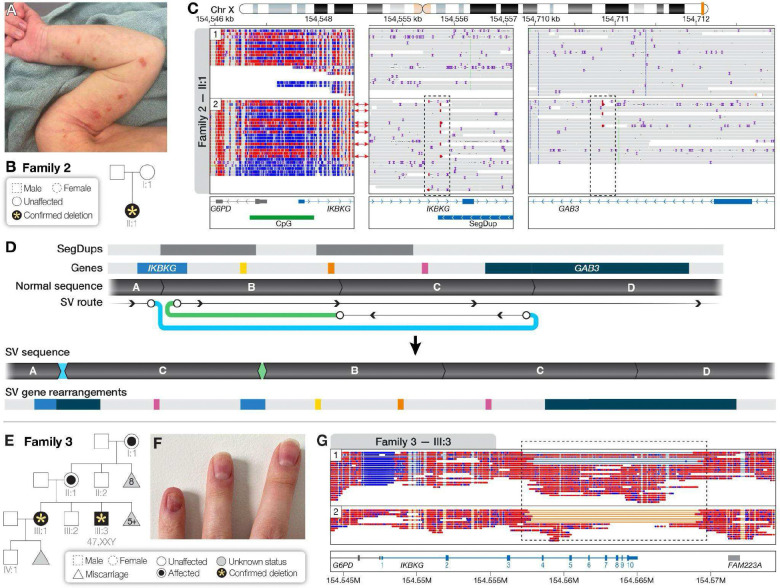 Figure 2
Peer Reviews
No public reviews on file for this paper yet. If you reviewed it on a platform where reviews are public (OpenReview, ICLR, NeurIPS, ICML), you can paste yours below so the community can read it here.
Videos
No videos yet. Explain this paper in a talk, walkthrough, or lecture? Add one.
Taxonomy
TopicsGenetic and rare skin diseases. · melanin and skin pigmentation · Dermatologic Treatments and Research