Alport Syndrome May contribute to Grand Multiparity in a Typical Low Income Setting
Victoria I Ogala-Akogwu, Peter K Uduagbamen, Emmauuel A Anteyi, Habib A Galadanci

TL;DR
A family with multiple cases of Alport Syndrome in a low-income setting may lead to grand multiparity due to the disease's severe health impacts.
Contribution
The paper highlights the potential link between Alport Syndrome and grand multiparity in low-income settings.
Findings
A pathogenic mutation in the COL4A5 gene confirmed X-linked Alport Syndrome in the patient and his siblings.
The patient's condition led to multiple kidney transplants and ultimately death.
Alport Syndrome's impact on family health can contribute to grand multiparity in low-income areas.
Abstract
Alport syndrome (AS) is a rare, inherited disorder affecting the basement membranes of the glomerulus, cochlea, and lens. It presents with visual and hearing deficits, as well as kidney disease, which can progress to end-stage renal failure and death. A 26-year-old male presented with a three-week history of body swelling, foamy urine, worsening hematuria, and hearing and visual impairments of 17- and 10-years' duration, respectively. Three of his siblings (two males and one female) had similar symptoms. Molecular genetic screening, involving children from the two wives, identified a pathogenic mutation in the COL4A5 gene, confirming X-linked AS in the patient and his three maternal siblings. The patient underwent maintenance hemodialysis (HD), followed by two failed living-related kidney transplants, and died in his sleep a year after the second transplant, hours after a routine…
Genes, proteins, chemicals, diseases, species, mutations and cell lines named across the full text — each resolved to its canonical identifier and authoritative record.
Click any figure to enlarge with its caption.
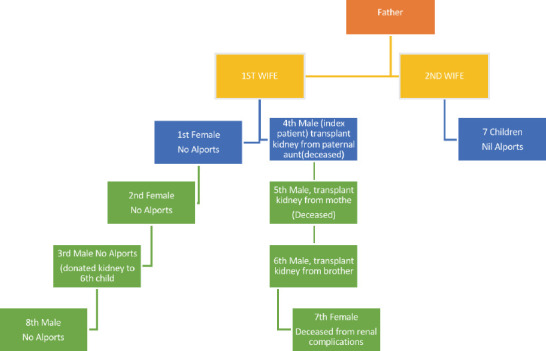 Figure 1
Peer Reviews
No public reviews on file for this paper yet. If you reviewed it on a platform where reviews are public (OpenReview, ICLR, NeurIPS, ICML), you can paste yours below so the community can read it here.
Videos
No videos yet. Explain this paper in a talk, walkthrough, or lecture? Add one.
Taxonomy
TopicsDiabetes Treatment and Management · Cell Adhesion Molecules Research · Cardiac electrophysiology and arrhythmias