Mutations of nhr-49 affect C. elegans susceptibility to Yersinia biofilms
Jonathan Hodgkin, Dave Stroud, Delia O'Rourke

TL;DR
This study shows that mutations in the NHR-49 gene in C. elegans affect the worm's susceptibility to Yersinia biofilms.
Contribution
The paper identifies that the gene bah-3 is an allele of nhr-49 and explores how different mutations in nhr-49 influence biofilm susceptibility.
Findings
The gene bah-3 (dc9) is an ochre nonsense allele of nhr-49.
Severe mutations in nhr-49 produce a Bah phenotype related to biofilm attachment.
5' deletions and 3' missense mutations in nhr-49 do not affect biofilm attachment.
Abstract
The C. elegans transcription factor NHR-49 has been extensively studied for its functions in regulating metabolic processes, stress responses, innate immunity and aging. Molecular identification of a gene previously known as bah-3 , which affects susceptibility of worms to deleterious surface attachment of bacterial biofilms from Yersinia spp., revealed that bah-3 ( dc9 ) is an ochre nonsense allele of nhr-49 . Other severe mutations of nhr-49 also had a Bah phenotype, but deletions affecting 5' isoforms of the gene did not affect biofilm attachment, nor did 3' gain-of-function missense mutations. Other bah genes ( bah-1 , bah-2 , bah-4 ) encode GT92 glycosylation factors, predicted to affect surface coat. NHR-49 may act as a positive transcription factor for one or more of these surface glycosylation genes, in contrast to its other roles in regulating metabolic processes.
Genes, proteins, chemicals, diseases, species, mutations and cell lines named across the full text — each resolved to its canonical identifier and authoritative record.
Click any figure to enlarge with its caption.
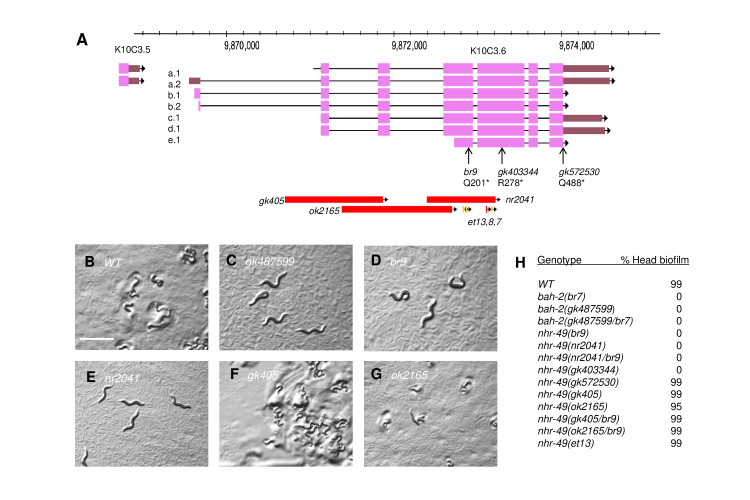 Figure 1
Peer Reviews
No public reviews on file for this paper yet. If you reviewed it on a platform where reviews are public (OpenReview, ICLR, NeurIPS, ICML), you can paste yours below so the community can read it here.
Videos
No videos yet. Explain this paper in a talk, walkthrough, or lecture? Add one.
Taxonomy
TopicsGenetics, Aging, and Longevity in Model Organisms · Yersinia bacterium, plague, ectoparasites research · Bacterial biofilms and quorum sensing