Spermless males fail to remedy the low fecundity of parthenogenetic females in D. melanogaster
Lewis I. Held, Jr., Surya J. Banerjee, Dylan W. Schwilk, Souvik Roy, Kambre A. Huddleston, Jason J. Shin

TL;DR
Using spermless males to increase reproduction in parthenogenetic fruit flies failed due to the short lifespan of the females.
Contribution
The study reveals that parthenogenetic females are more resilient to spermless males but have shorter lifespans when not paired.
Findings
Parthenogenetic females have abysmal fecundity despite mating with spermless males.
Parthenogenetic females live shorter lives when not paired but are more resistant to harm from spermless males.
Using spermless males to boost reproduction in parthenogenetic females only provides a short-lived benefit.
Abstract
The recent construction of a parthenogenetic strain of D. melanogaster offers new avenues of research, but this potential is limited by the stock’s abysmal fecundity. We tried using spermless (placebo) males to “trick” the virgins into producing more offspring, but the boost that we achieved proved to be short-lived due to premature death of the mothers. To explore the cause of this mortality, we compared the lifespans of parthenogenetic vs. wild-type females when mated with spermless males. We found that parthenogenetic females are less robust than wild-females when raised alone but are more resistant to harm from spermless males.
Genes, proteins, chemicals, diseases, species, mutations and cell lines named across the full text — each resolved to its canonical identifier and authoritative record.
Click any figure to enlarge with its caption.
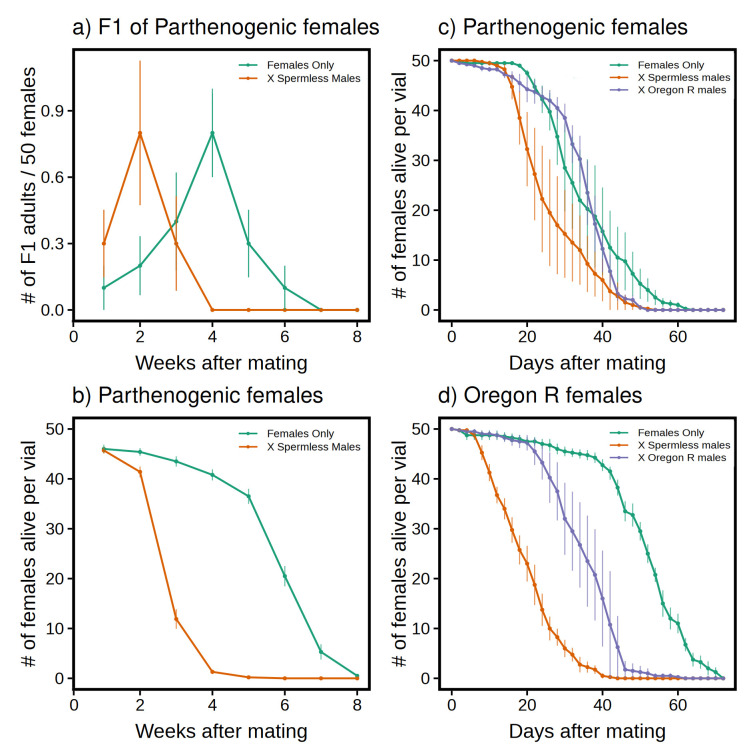 Figure 1
Peer Reviews
No public reviews on file for this paper yet. If you reviewed it on a platform where reviews are public (OpenReview, ICLR, NeurIPS, ICML), you can paste yours below so the community can read it here.
Videos
No videos yet. Explain this paper in a talk, walkthrough, or lecture? Add one.
Taxonomy
TopicsReproductive Health and Technologies · Evolution and Genetic Dynamics