Impact of Certification of Competencies on Undergraduate Medical Students
Arvind K Yadav, Sakshi Singh, Meenu Pichholiya, Sangita Gupta

TL;DR
This study shows that certifying essential skills in medical students significantly improves their knowledge and performance.
Contribution
The study demonstrates the effectiveness of competency certification in improving medical students' knowledge and learning outcomes.
Findings
Certification of competencies led to a statistically significant improvement in students' test scores.
Students showed increased knowledge after the certification process.
Feedback and faculty interaction were identified as important factors in the learning process.
Abstract
Background A competency-based undergraduate curriculum reinforces the need for certification of certain essential skills. The development of competencies would be the main emphasis of teaching-learning and assessment, which would continue until the target competency was attained. This study was planned to evaluate the impact of certification of competencies among second-year students in the Department of Pharmacology in terms of knowledge and feedback. Methodology After receiving approval from the institutional ethics committee, this study was conducted on MBBS second-year students in the department of pharmacology at a tertiary care teaching hospital in Rajasthan, India. After teaching certifiable competencies in practical class, students were given standardized validated multiple choice questions as pre-tests before certification and post-tests after certification. The feedback was…
Genes, proteins, chemicals, diseases, species, mutations and cell lines named across the full text — each resolved to its canonical identifier and authoritative record.
Click any figure to enlarge with its caption.
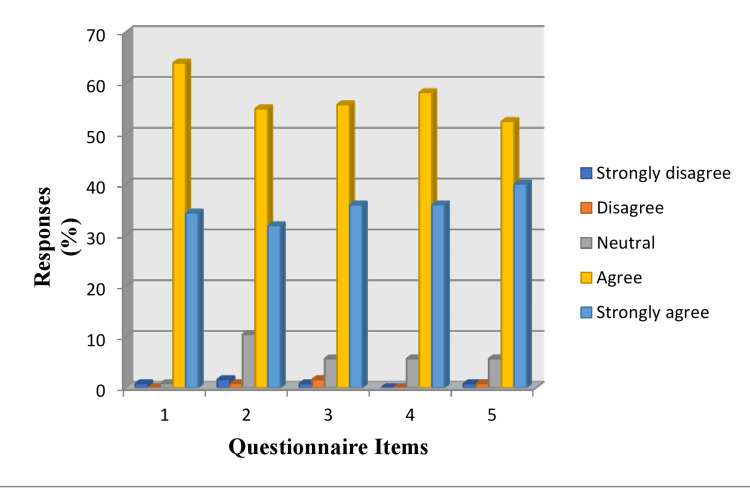 Figure 1
| Questionnaire items | |
| 1 | I was satisfied with the overall learning about certifiable competencies in the certification exercise. |
| 2 | I enjoyed learning in the certification exercise. |
| 3 | I was satisfied with the quality of my learning along with feedback during certification. |
| 4 | I was satisfied with the quantity of my learning along with feedback during certification. |
| 5 | Certification exercises stimulated my desire to acquire more knowledge through certifiable competencies. |
| Subjects | Pre-test (mean± SD) | Post-test (mean ± SD) | p-value |
| Students (n = 123) | 10.90 ± 2.80 | 13.08 ± 2.90 | 0.0001* |
| Competency | Pre-test (mean ± SD) | Post-test (mean ± SD) | p-value |
| P-drug | 0.57 ± 0.52 | 1.09 ± 0.72 | 0.0001* |
| Drug promotional literature | 3.07 ± 0.90 | 3.55 ± 0.86 | 0.0001* |
| Prescription writing | 4.38 ± 1.10 | 5.20 ± 1.15 | 0.0108* |
| Critical appraisal | 2.88 ± 0.99 | 3.24 ± 0.98 | 0.0047* |
Peer Reviews
No public reviews on file for this paper yet. If you reviewed it on a platform where reviews are public (OpenReview, ICLR, NeurIPS, ICML), you can paste yours below so the community can read it here.
Videos
No videos yet. Explain this paper in a talk, walkthrough, or lecture? Add one.
Taxonomy
TopicsInnovations in Medical Education · Medical Education and Admissions · Higher Education Learning Practices
Introduction
The Medical Council of India's "competency-based undergraduate curriculum," also known as competency-based medical education (CBME), will undoubtedly advance medical education and produce competent Indian Medical Graduates (IMGs) who can serve the community [1]. An outcome-based approach to the design, implementation, assessment, and evaluation of a medical education program using a structured framework of competencies is known as competency-based education [2].
The outcome-driven undergraduate curriculum has made a substantial effort to give the orientation and lifelong learning skills needed to provide good patient care. Early clinical exposure, electives, and long-term care are all part of the curriculum. The skill acquisition is a crucial aspect of the learning process in medicine. This CBME-based curriculum reinforces this aspect by requiring certification of certain essential skills. The most advanced degree of skill acquisition in the years before an internship is Show-How (SH) in a controlled or simulated environment. Few abilities necessitate independent performance and certification [1].
All competencies are taught in the practical class in detail with discussion. Certification is a process in which students are given feedback, and this process is repeated until the student is able to perform correctly. After the completion of the exercise to be certified, faculty members certify the exercises with one-on-one discussions and give feedback to students. Certification is a bidirectional process in which faculty also requires feedback from students about what can be improved in certification exercises. Feedback is a formal active engagement that is delivered with the intention of fostering the learner's development, improvement, and positive change through aided reflection on the task completed [3].
The certification process came into existence in India in 2019. In the literature search, no study was found that reported how students gain knowledge through certification, and feedback by students was also not reported after certification. Getting feedback from students will add a new perspective to our study. This study was planned to know the impact of certification of competencies on second-year undergraduate medical students.
Materials and methods
Design and setting(s)
This educational interventional study was conducted in the Department of Pharmacology from 15/10/2022 to 30/04/2023 after ethical permission at a tertiary care teaching hospital in Rajasthan, India.
Participants and sampling
Professional MBBS students were included in the study. The students who refused to take part in the study were excluded.
Ethical considerations
This research was conducted only after receiving approval from the institutional ethics committee (Ref: GU.HREC.EC.2022.2.56). Informed consent was obtained from all the participants before the pre-test was given. The participation of the students in this study was completely voluntary and anonymous. Confidentiality of their personal information was maintained.
Data collection methods
A set of 20 questions from all the certifiable competencies to be certified were formed (Appendix 1). These questions related to competencies were discussed with experts in the Department of Pharmacology of different institutes, and appropriate modifications were made as per the suggestions given. This validated questionnaire was given to students as a pre-test and post-test for assessment of knowledge and awareness. Questions related to respective certifiable competency were also grouped together, and their mean pre-test and post-test scores were analyzed.
Students were taught about each certifiable competency in practical classes or small group teaching, and the duration of each practical teaching class was two hours (Appendix 2) [1]. They learned about competencies during the practical class in small groups. One faculty member was assigned to a group of 10 students. A set of questions was given to the students in class before starting the certification of competencies as a pretest. The defined number of procedures for each certifiable competency were done. In the classes conducted for certification, students were individually given one-on-one feedback by the faculty of the department about their performance. A total of eight to 10 faculty members were present during the certification process. The faculty evaluates the student’s exercise by reviewing their work, posing related questions, and giving feedback for a duration of five to seven minutes. Faculty establish the standards for the level of achievement or criteria that determine a satisfactory (meets expectations) or unsatisfactory (below expectations) grade (Appendix 3). If a required repeat exercise was given, the student had to do it again in the next class. Remedial training was given after a number of repeats. This process was continued until students get complete (C) score for each exercise in competency. After certifying all the certifiable competencies with a completed (C) score, post-test was given. In the end, feedback from the students was taken and analyzed using the Likert scale, where one stands for strongly disagreeing and five for strongly agreeing (Table 1).
Statistical analysis
Using Microsoft Office Excel 2010 (Microsoft® Corp., Redmond, WA), data were entered. Data were recorded in mean ± SD and number or percentage. Pre- and post-test data were compared using a paired t-test, and a p-value of less than 0.05 was regarded as significant.
Results
One hundred twenty-three MBBS second-year students, out of a total of 250 students, were enrolled in the study and given both pre- and post-tests.
The mean score in the pre-test was 10.90 ± 2.80 (Table 2), with the lowest score being four and the highest score being 17 out of 20. The mean score after the test was 13.08 ± 2.90 (Table 2), with the lowest and highest scores being five and 19, respectively. There was a statistically significant difference between before and after test scores (p = 0.0001).
The mean scores of respective competencies were also analyzed in both the pre-test and post-test. The mean score for P-drug competency in the pre-test and post-test was 0.57 ± 0.52 and 1.09 ± 0.72, respectively (p = 0.0001). The mean score for drug promotional literature (DPL) competency in pre-test and post-test was 3.07 ± 0.90 and 3.55 ± 0.86, respectively (p = 0.0001). The mean score for prescription writing in the pre-test and post-test were 4.38 ± 1.10 and 5.20 ± 1.156, respectively (p = 0.0108). The mean score for critical appraisal in pre-test and post-test was 2.88 ± 0.99 and 3.24 ± 0.98, respectively (p = 0.0047). A statistically significant improvement was found in each competency (Table 3).
Students' feedback questionnaire analysis showed that 63% of students agreed that they were satisfied with the overall learning about certifiable competencies in the certification exercise; 40% of students strongly agreed that certification exercises stimulated their desire to acquire more knowledge through certification competencies (Figure 1).
Feedback questionnaire analysis
Discussion
As a part of the new curriculum, certification of certifiable competencies is part of the assessment in all phases of the undergraduate teaching program. All three learning domains (cognitive, psychomotor, and affective) should be taken into consideration when creating an internal evaluation, and weightage should be given to these areas for assessment. The certification process fosters ownership of teaching-learning strategies and gives all teachers and students "hands-on" experience [2].
Pre- and post-test procedures are commonly used methods to assess the effectiveness of any educational program. This process gives feedback to the instructor by measuring the learner's starting knowledge level and the knowledge the learner acquired through the teaching. In this method, the student will be actively involved in education; the assessment is done more efficiently [4]. Multiple-choice questions are the most popular method for evaluating the cognitive ability of an individual. Thus, this study was planned to impart knowledge to the students using the certification process of the new curriculum.
In the present study, students were taught individual competency in their routine practical classes or small group teaching. Prior to certification, the mean pre-test score was 10.90 ± 2.80, in which the lowest score was four and the highest score was 17. These results showed that many students had also gained knowledge during routine classes. The mean post-test score after the certification process was 13.08 ± 2.90, where the lowest score was five and the highest score was 19. the minimum score was five, and the maximum score was 19. Certification is a process in which there is a one-on-one discussion of faculty with the students about that topic, and feedback is given to each student individually. Good feedback practice provides students with relevant information that will help them learn better and provide the teachers with the necessary information to improve their teaching experience [5]. Students get more chances to clear their doubts effectively with this method because the teacher gives attention to the only student who is allotted it. This implies that the certification process helped students improve their knowledge, which is seen by their improved mean post-test scores. It is also a good tool to improve the knowledge of low-scoring students as they get one-on-one attention and feedback from teachers. Other studies also reported similar results, which showed detailed feedback on individual tasks was revealed to be significant in terms of enhancing student performance [6,7]. Feedback should be a process of motivating the students in a positive way.
Most of the students (approximately 98%) were satisfied with the overall learning about certifiable competencies in the certification exercise, out of which 34% of them were highly satisfied. Certification helped students to learn better by understanding the topic in detail through one-on-one discussions with the faculty. More than 50% of students enjoyed the learning process during certification, as they were free to ask questions and resolve their doubts during this process.
More than 50% of students were satisfied with the quality of learning during certification. This could be because teachers gave proper time to each student and also taught them about their mistakes during this process, which improved the quality of learning. If students failed to complete the first attempt, then a repeat exercise was given to students in the next session. If they performed below expectation in repeat exercises and failed to understand the competency properly, a remedial session was conducted. In the remedial session, faculty taught them the same topic again, and a repeat exercise was given for the same. This process improved the overall quality of the certification process [8,9].
More than 50% of students were satisfied with the quantity of learning during certification. This could be because most of the certifiable competencies were related to their future clinical practice, which includes prescription writing, critical appraisal, DPL, and P-drug. The improvement of the health system's quality can be achieved by learning a good understanding and practical aspects of prescription writing, which in turn is capable of creating a more rational prescription [10-12]. Certification of competency in undergraduate coursework to write rational, accurate, and clear prescriptions for the specified condition will enhance their knowledge about prescription writing. Additionally, it will assist them in avoiding prescription-related mistakes in the future. In clinical practice, this will improve their ability to write prescriptions. Students showed statistical improvement after certification of prescription writing competency in the present study. A prescription audit is also an education exercise and, if carried out often, may help to improve the standard of care provided for patients by making a prescription more appropriate [13]. Rational use of drugs will be promoted by evaluating the prescription patterns according to WHO criteria [14,15]. Students showed statistical improvement after certification of critical appraisal competency in the present study. Certification of critical appraisal (audit) of given prescription will help students perform the exercises and discuss with faculty their mistakes. This will decrease the prevalence of prescribing errors and guide them to prescribe a rational prescription. The goal of the P-drug concept is to familiarize students with P-drugs that have been selected from the national essential drug list based on their safety, efficacy, suitability, and cost [16]. While it can be challenging to disregard the advice of seniors and specialists while choosing the P-drug, the students should be able to critically evaluate all of the available material and use it to choose their own P-drug [17,18]. Students showed statistical improvement after certification of P-drug competency in the present study. During certification exercises, students’ knowledge about how to select P-drugs based on different criteria is enhanced as they perform different exercises on their own. When students attempt exercises and receive help and encouragement from the teachers, they can improve their understanding of concepts that were difficult to grasp during practical class.
To spread the word about new medicines, DPL is employed as one of the marketing strategies. During the promotion of the literature, students should thoroughly consider the research findings and make their own judgments, as misleading and erroneous information is now regularly discovered in promotional literature [19,20]. Students showed statistical improvement after certification of DPL competency in the present study. Certification of different DPL exercises will guide them on how to judge different aspects of DPL practically. Every exercise is different, so they will be able to understand the concept in a better way. If they do not perform satisfactorily, they have to perform repeat exercises, which will again improve their understanding.
More than 60% of students agreed certification exercises stimulated their desire to acquire more knowledge through certifiable competencies. Students’ questions were answered more effectively, and they learned more from this process as each student got more personal attention with one-on-one learning. One-on-one teaching is more intense because it identifies the strong and weak points of a student [21]. Certification made an impact on students' performance and helped them gain more knowledge about the topic.
Limitations
This is the first of its kind study; no such study was conducted earlier. Thus, more studies are required to see the impact of certification as per the new CBME curriculum.
Conclusions
According to the study's findings, the certification of certifiable competencies showed a significant improvement in the performance of students after the intervention. This shows that it played an important part in improving students’ knowledge. Thus, it is an effective tool for imparting knowledge among students, and one-on-one discussions with faculty and feedback to students play an important role. This type of formative assessment is where feedback is given to students for learning and also helps faculty to teach students in better and simpler ways in the future.
The reference list from the paper itself. Each links out to its DOI / PubMed record.
- 1Competency Based Undergraduate Curriculum for the Indian Medical Graduate Indian Medical 1 2025 Medical Council of India New Delhi, India Medical Council of India 2018 https://medical.dpu.edu.in/document/MBBS-UG-Curriculum/2019-20/MBBS-UG-Curriculum-Vol-I-2019-2020.pdf
- 2Assessment Module for Undergraduate Medical Education 1 2025 Medical Council of India New Delhi, India Medical Council of India 2019 https://www.nmc.org.in/wp-content/uploads/2020/08/Module_Competence_based_02.09.2019.pdf.
- 3Guidelines for Preparing Logbook for Undergraduate Medical Education Program Medical Council of India New Delhi, India Medical Council of India 2019 https://www.nmc.org.in/wp-content/uploads/2020/08/Logbook-Guidelines_17.01.2020.pdf.
- 4Evaluating the effectiveness of pre- and post-test model of learning in a medical school Natl J Physiol Pharm Pharmacol Shivaraju PT Manu G Vinaya M Savkar MK 94795172017
- 5The value and effectiveness of feedback in improving students’ learning and professionalizing teaching in higher education J Educ Pract Bashir MA Kabir R Rahman I 384172016 https://files.eric.ed.gov/fulltext/EJ 1105282.pdf
- 6Response to assessment feedback: The effects of grades, praise, and source of information ETS Res Rep Ser Lipnevich A Smith J 5712008
- 7The value of students’ feedback 9th International Conference on Manufacturing Science and Education - MSE 2019 “Trends in New Industrial Revolution” Mag AG 57Les Ulis, France EDP Sciences 2019
- 8Effect of remedial teaching on academic performance of poorly performing students in pharmacology: a quasi experimental study Int J Basic Clin Pharmacol Modi SB RBN Kanakamma LG 961966102021