Brief biology and pathophysiology of Tekt bundles
Jun Yin, Min Liu, Xiao Wang, Hongming Miao, Wenjuan He, Wei Liu, Zhongying Yu, Qinghua Zhang, Jialian Bai, Yimei Cheng, Bing Ni

TL;DR
Tektins are essential proteins for cilia and flagella function, and their malfunction is linked to various diseases.
Contribution
This review compiles recent insights into Tektin functions and their regulation in health and disease.
Findings
Tektins stabilize microtubules in cilia and flagella.
Loss of Tekt1–5 leads to motility defects and diseases like infertility and retinal degeneration.
Tektin expression is regulated by multiple molecular mechanisms.
Abstract
Tektins, a family of microtubule-stabilizing proteins, are critical for cilia and flagella assembly in mammals. They maintain doublet microtubule stability and ciliary/flagellar motility. Loss of Tekt1–5 causes microtubule instability, impaired motility, and diseases like infertility, retinal degeneration, Mainzer-Saldino syndrome, and diabetic nephropathy. Pathophysiological stimuli regulate Tektin expression through transcriptional, posttranscriptional, translational, and posttranslational modifications. This review summarizes the latest findings on Tektin functions and their role in diseases.
Genes, proteins, chemicals, diseases, species, mutations and cell lines named across the full text — each resolved to its canonical identifier and authoritative record.
Click any figure to enlarge with its caption.
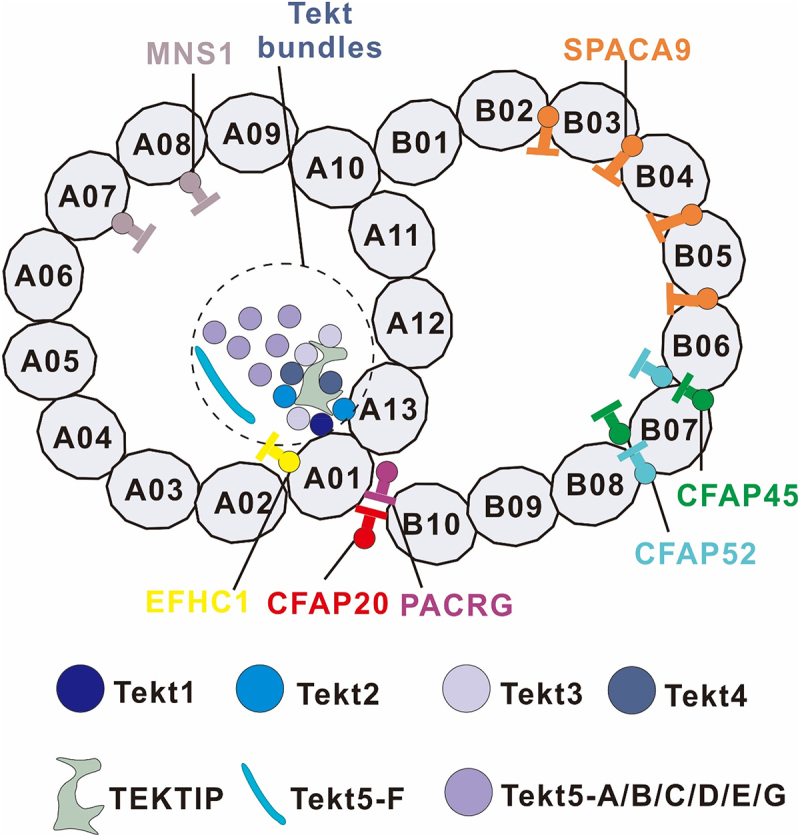 Figure 1
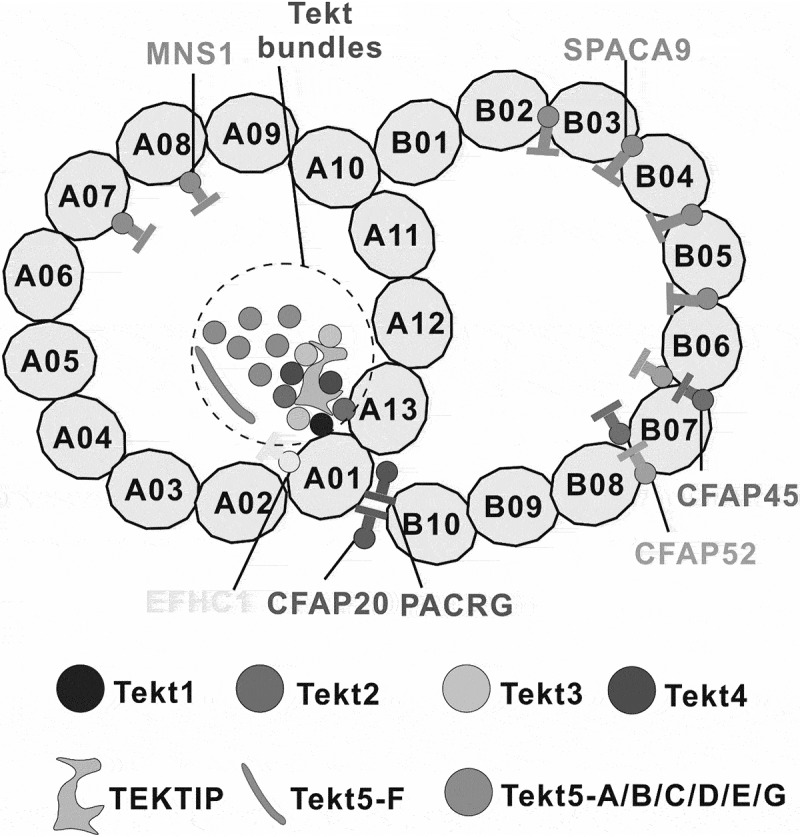 Figure 2
Peer Reviews
No public reviews on file for this paper yet. If you reviewed it on a platform where reviews are public (OpenReview, ICLR, NeurIPS, ICML), you can paste yours below so the community can read it here.
Videos
No videos yet. Explain this paper in a talk, walkthrough, or lecture? Add one.
Taxonomy
TopicsGenetic and Kidney Cyst Diseases · Fetal and Pediatric Neurological Disorders · Hedgehog Signaling Pathway Studies