Incorporating Physical Activity in a New Two-Oscillator Model of Circadian Activity in Nocturnal and Diurnal Mammals
Anouk W. van Beurden, Johanna H. Meijer, Jos H. T. Rohling

TL;DR
This paper proposes a new model to explain how physical activity affects circadian rhythms differently in diurnal and nocturnal mammals.
Contribution
The study introduces a two-oscillator model that explains distinct feedback mechanisms of physical activity in diurnal and nocturnal species.
Findings
Diurnal animals show feedback from physical activity on non-light-receptive SCN neurons.
Nocturnal animals show feedback from physical activity on light-receptive SCN neurons.
The model explains high-amplitude circadian rhythms in both species.
Abstract
In both diurnal and nocturnal species, the neurons in the suprachiasmatic nucleus (SCN) generate a daily pattern in which the impulse frequency peaks at midday and is lowest during the night. This pattern, common to both day-active and night-active species, has led to the long-standing notion that their functional difference relies merely on a sign reversal in SCN output. However, recent evidence shows that the response of the SCN to the animal’s physical activity is opposite in nocturnal and diurnal animals. This finding suggests the presence of additional differences in the circadian system between nocturnal and diurnal species. We therefore attempted to identify these differences in neuronal network organization using the A-B two-oscillator model, which is comprised of Poincaré like oscillators. Based on this model, we infer that in diurnal animals the feedback from physical activity…
Genes, proteins, chemicals, diseases, species, mutations and cell lines named across the full text — each resolved to its canonical identifier and authoritative record.
Click any figure to enlarge with its caption.
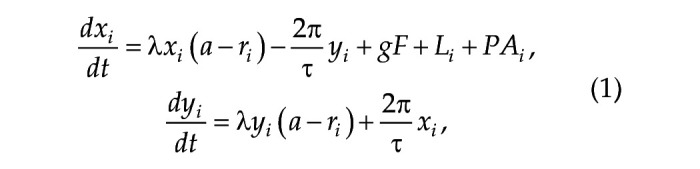 Figure 1
 Figure 2
 Figure 3
 Figure 4
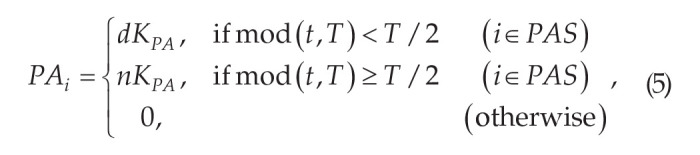 Figure 5
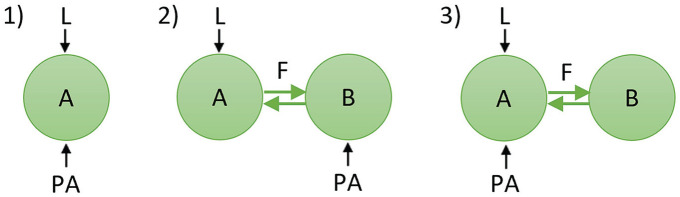 Figure 1
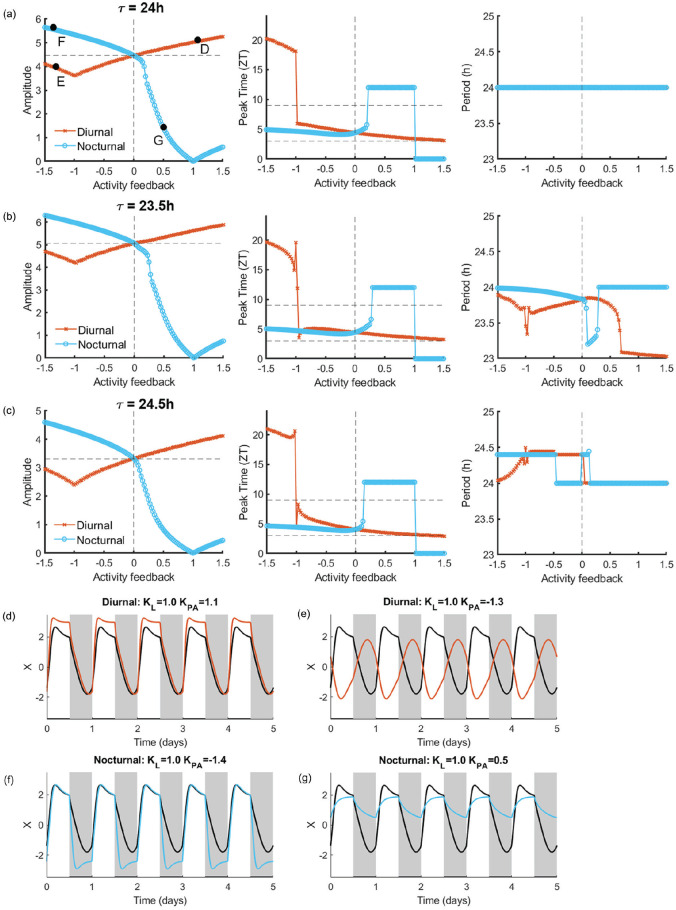 Figure 2
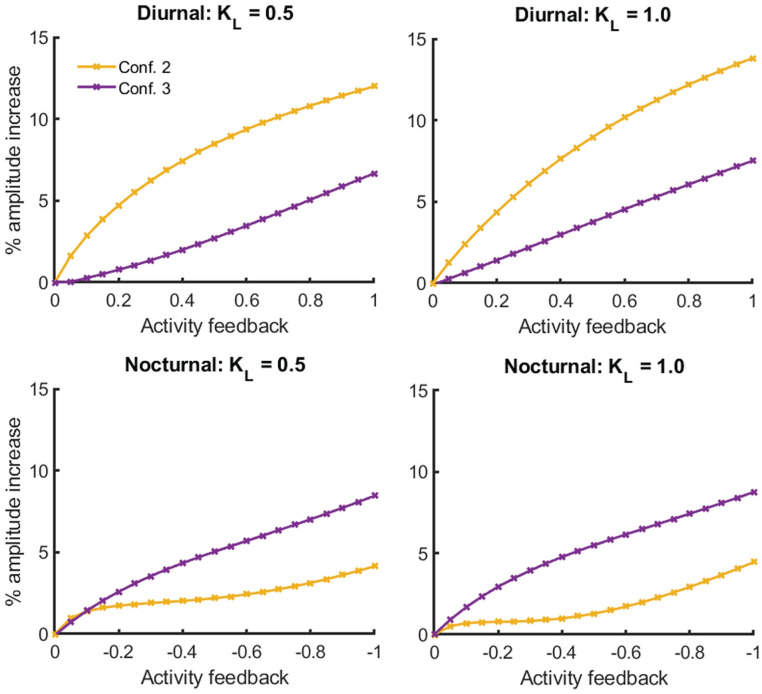 Figure 3
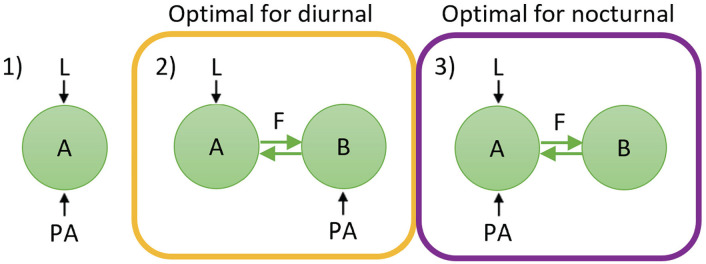 Figure 4
 Figure 10
Peer Reviews
No public reviews on file for this paper yet. If you reviewed it on a platform where reviews are public (OpenReview, ICLR, NeurIPS, ICML), you can paste yours below so the community can read it here.
Videos
No videos yet. Explain this paper in a talk, walkthrough, or lecture? Add one.
Taxonomy
TopicsCircadian rhythm and melatonin · Neurobiology and Insect Physiology Research · Photoreceptor and optogenetics research