Validating the Iowa Test of Consonant Perception in a large cohort of cochlear implant users
Francis X. Smith, Joel I. Berger, Phillip E. Gander, Adam T. Schwalje, Timothy D. Griffiths, Bob McMurray, Inyong Choi

TL;DR
The Iowa Test of Consonant Perception is validated for cochlear implant users, showing it works well for measuring speech recognition abilities.
Contribution
The study validates the ITCP for cochlear implant users, expanding its use beyond normal hearing listeners.
Findings
The ITCP showed strong convergent validity with other speech recognition tasks in cochlear implant users.
The test demonstrated good test-retest reliability at different signal-to-noise ratios.
The ITCP is a useful tool for clinicians and researchers working with cochlear implant users.
Abstract
The Iowa Test of Consonant Perception (ITCP) was designed to test word-initial phoneme perception by uniformly sampling frequently used phonemes as well as balancing feature overlap of response competitors. However, the task has only been validated in normal hearing listeners. In this study, a large cohort of cochlear implant users completed the ITCP and two commonly used clinical measures of speech recognition [AzBio sentences and consonant-nucleus-consonant (CNC) words]. At two different signal-to-noise ratios, the ITCP showed strong convergent validity with other speech recognition tasks and good test-retest reliability. The ITCP is a useful tool for both clinicians and experimental researchers.
Genes, proteins, chemicals, diseases, species, mutations and cell lines named across the full text — each resolved to its canonical identifier and authoritative record.
Click any figure to enlarge with its caption.
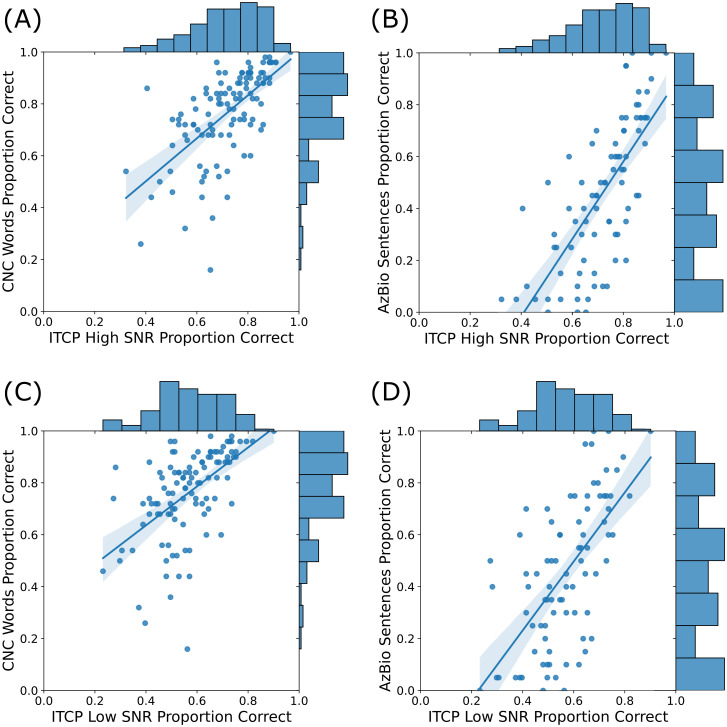 Figure 1
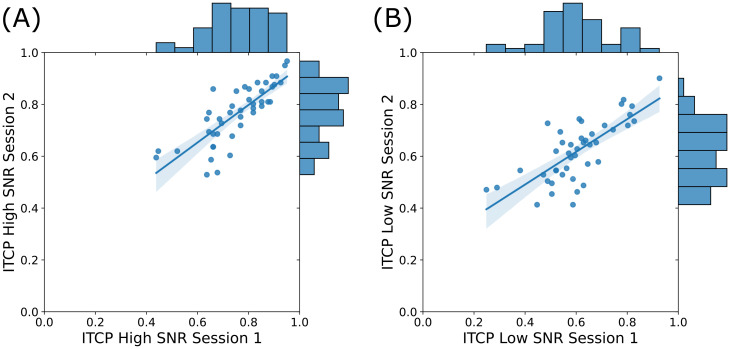 Figure 2
Peer Reviews
No public reviews on file for this paper yet. If you reviewed it on a platform where reviews are public (OpenReview, ICLR, NeurIPS, ICML), you can paste yours below so the community can read it here.
Videos
No videos yet. Explain this paper in a talk, walkthrough, or lecture? Add one.
Taxonomy
TopicsHearing Loss and Rehabilitation · Noise Effects and Management · Neuroscience and Music Perception