Paternal Split‐Liver Transplantation Followed by Haploidentical Hematopoietic Cell Transplantation in an Adult Patient With Protoporphyria‐Induced Liver Failure
Ulrich Stölzel, Lasse Jost, Daniel Seehofer, Katharina Egger‐Heidrich, Uwe Scheuermann, Kristina Hölig, Thomas Stauch, Desiree Kunadt, Detlef Schuppan, Johannes Schetelig, Nils Wohmann, Martin Bornhäuser, Friedrich Stölzel

TL;DR
A 35-year-old patient with protoporphyria-induced liver failure received a split-liver transplant followed by a successful haploidentical stem cell transplant from their father, leading to full recovery.
Contribution
This case demonstrates the feasibility of haploidentical hematopoietic cell transplantation in treating protoporphyria when a matched donor is unavailable.
Findings
Split-liver transplantation was successfully performed followed by a second haploidentical HCT.
Protoporphyrin blood levels normalized and skin light sensitivity resolved after the second HCT.
The patient achieved complete remission without needing immunosuppressive therapy.
Abstract
Erythropoietic Protoporphyria (EPP) caused skin light sensitivity and liver cirrhosis in a 35‐year‐old patient who subsequently developed liver‐failure. In absence of a human leukocyte antigens (HLA)‐matched‐unrelated donor, the father consented in donating for split liver transplantation (SLT) and allogeneic hematopoietic cell transplantation (HCT). After bridging therapy and successful SLT a first paternal HCT resulted in graft failure. For a second haploidentical HCT a different regimen was applied leading to engraftment while protoporphyrin (PP) blood‐levels decreased to normal and skin light sensitivity skin disappeared, leading to complete remission in an immunosuppressive‐free patient. Haploidentical transplantation is a feasible treatment approach in EPP‐patients. The authors have confirmed clinical trial registration is not needed for this submission
Genes, proteins, chemicals, diseases, species, mutations and cell lines named across the full text — each resolved to its canonical identifier and authoritative record.
Click any figure to enlarge with its caption.
 Figure 1
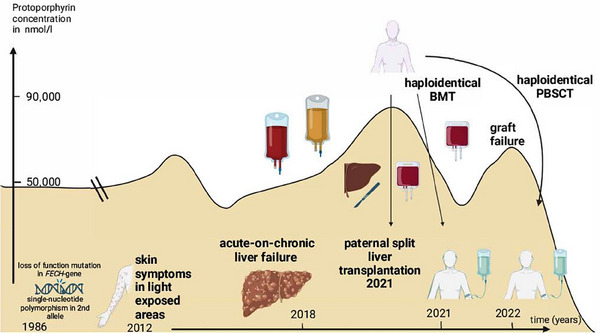 Figure 2
 Figure 3
Peer Reviews
No public reviews on file for this paper yet. If you reviewed it on a platform where reviews are public (OpenReview, ICLR, NeurIPS, ICML), you can paste yours below so the community can read it here.
Videos
No videos yet. Explain this paper in a talk, walkthrough, or lecture? Add one.
Taxonomy
TopicsPorphyrin Metabolism and Disorders · Heme Oxygenase-1 and Carbon Monoxide · Neonatal Health and Biochemistry