Glowing worms: A low-cost fluorescence kit for toxicological education using Caenorhabditis elegans
Sakina Shahid, Chiara Klein, Joel N. Meyer, Javier Huayta

TL;DR
This paper introduces a low-cost fluorescence kit using worms to teach about the effects of heavy metals on health in educational settings.
Contribution
A novel, affordable fluorescence setup for observing gene expression in worms exposed to cadmium in non-lab environments.
Findings
Participants observed cadmium's effects on C. elegans using a DIY fluorescence setup.
The method successfully highlighted mtl-2 gene expression in response to cadmium exposure.
The activity helped connect environmental pollution to human health impacts.
Abstract
Exposures to metals such as lead and cadmium due to environmental pollution cause cardiovascular, liver, kidney, and other diseases. We used the nematode Caenorhabditis elegans paired with an inexpensive “do-it-yourself” fluorescent microscopy setup to highlight the effects of cadmium exposure on expression of the metallothionein-producing gene mtl-2 to enhance education on the effects of heavy metals. This approach enables observation of GFP fluorescence in worms outside of laboratory settings, while also allowing quantification of gene expression after chemical exposure. We developed an activity centering this experiment for the Museum of Life and Science located in Durham, NC. Participants successfully observed the effects of cadmium on C. elegans and made meaningful connections to both environmental and human health.
Genes, proteins, chemicals, diseases, species, mutations and cell lines named across the full text — each resolved to its canonical identifier and authoritative record.
Click any figure to enlarge with its caption.
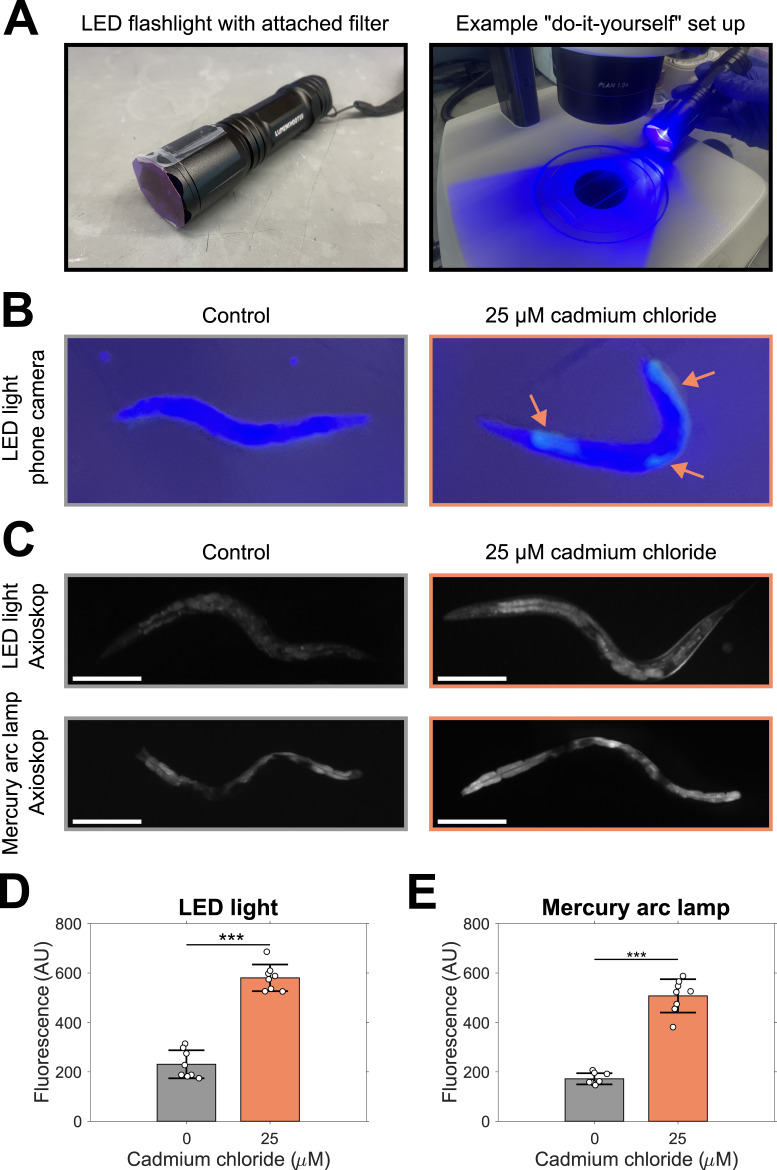 Figure 1
Peer Reviews
No public reviews on file for this paper yet. If you reviewed it on a platform where reviews are public (OpenReview, ICLR, NeurIPS, ICML), you can paste yours below so the community can read it here.
Videos
No videos yet. Explain this paper in a talk, walkthrough, or lecture? Add one.
Taxonomy
TopicsBiomedical and Engineering Education · Genetics, Bioinformatics, and Biomedical Research