White Matter Integrity Differences in 2‐Year‐Old Children Treated With ECMO: A Diffusion‐Weighted Imaging Study
Michaela Ruttorf, Julia Filip, Thomas Schaible, Meike Weis, Frank G. Zöllner

TL;DR
This study finds that 2-year-old children who received ECMO treatment show early white matter changes in the brain that may predict later neurodevelopmental delays.
Contribution
The study introduces early diffusion-weighted imaging as a non-invasive method to detect white matter alterations in ECMO-treated children.
Findings
ECMO-treated children show significant differences in white matter metrics like FA, F1, RD, and MD compared to non-ECMO children.
Key brain regions with altered diffusion measures include the corpus callosum and internal capsule, linked to later cognitive delays.
DWI can detect structural brain changes in early childhood without requiring child cooperation, unlike traditional testing.
Abstract
School‐aged and adolescent survivors of neonatal extracorporeal membrane oxygenation (ECMO) treatment still suffer from neurodevelopmental delays such as verbal, visuo‐spatial and working memory problems, motor dysfunction and sensorineural hearing loss, respectively, later in life, which is well‐documented by neuropsychological testing within follow‐up programs. In this study, we demonstrate that diffusion‐weighted imaging (DWI) in 2‐year‐old survivors of neonatal ECMO treatment reveals white matter (WM) alterations in brain regions related to neurodevelopmental outcome seen later in life. From the DWI data of 56 children, fractional anisotropy (FA), first fibre partial volume fraction estimate (F1), radial diffusivity (RD) and mean diffusivity (MD) are calculated and compared using tract‐based spatial statistics adapted to a paediatric brain atlas. Significant differences in FA, F1,…
Genes, proteins, chemicals, diseases, species, mutations and cell lines named across the full text — each resolved to its canonical identifier and authoritative record.
Click any figure to enlarge with its caption.
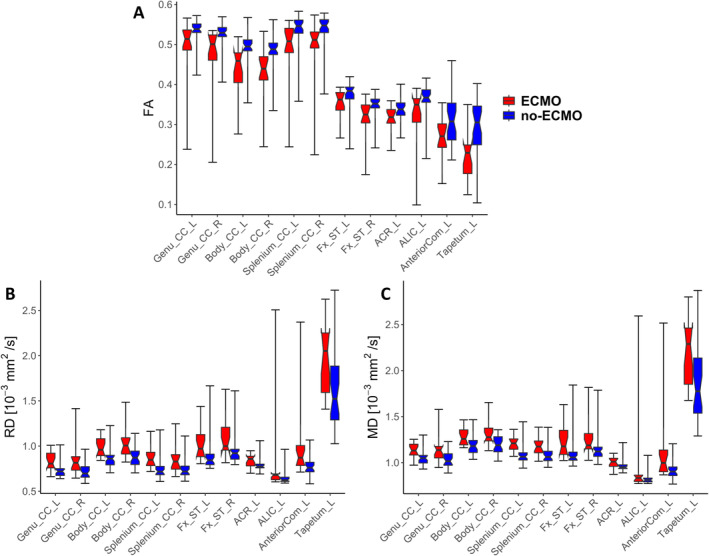 Figure 1
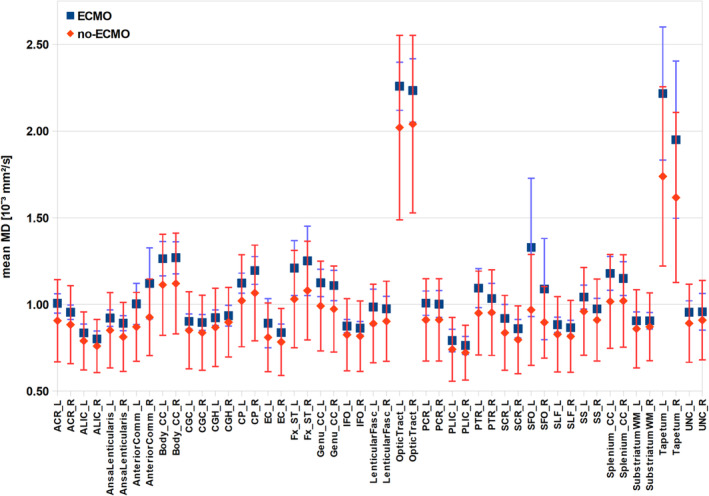 Figure 2
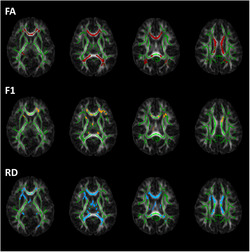 Figure 3
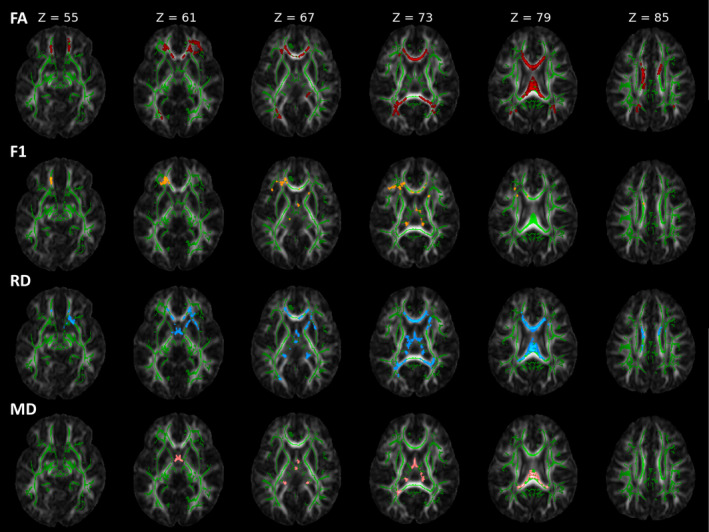 Figure 4
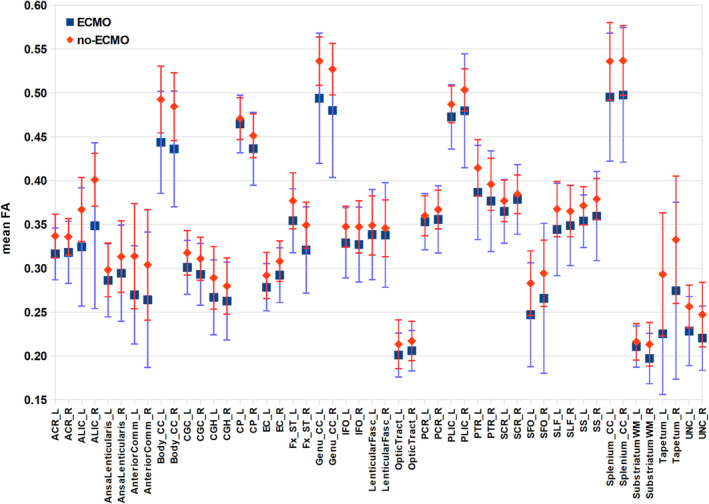 Figure 5
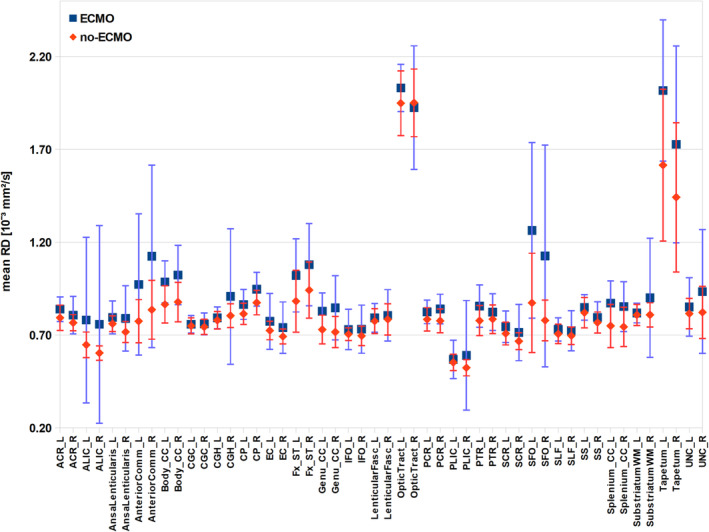 Figure 6
Peer Reviews
No public reviews on file for this paper yet. If you reviewed it on a platform where reviews are public (OpenReview, ICLR, NeurIPS, ICML), you can paste yours below so the community can read it here.
Videos
No videos yet. Explain this paper in a talk, walkthrough, or lecture? Add one.
Taxonomy
TopicsAdvanced Neuroimaging Techniques and Applications · Cerebral Palsy and Movement Disorders · Spinal Dysraphism and Malformations