Effect of an Internet-Based Pilates Telerehabilitation Intervention in People With Multiple Sclerosis: Protocol for a Randomized Controlled Trial
Andrea Tacchino, Michela Ponzio, Paolo Confalonieri, Letizia Leocani, Matilde Inglese, Diego Centonze, Eleonora Cocco, Paolo Gallo, Damiano Paolicelli, Marco Rovaris, Loredana Sabattini, Gioacchino Tedeschi, Luca Prosperini, Francesco Patti, Edoardo Sessa, Elisabetta Pedrazzoli

TL;DR
This study will test if a home-based Pilates program using a digital tool improves balance, gait, and quality of life for people with mild multiple sclerosis.
Contribution
The study introduces a novel internet-based Pilates telerehabilitation tool for MS patients, evaluated in a randomized controlled trial.
Findings
The study will assess the efficacy of the MS-FIT exergame on physical function and well-being in MS patients.
Results will provide evidence for using digital Pilates as a home-based rehabilitation method for MS.
Data analysis is expected to show whether the intervention improves balance, gait, and quality of life.
Abstract
Physical activity (PA) has been recommended in multiple sclerosis (MS) to maintain good physical fitness and mental health, reduce the severity of symptoms and risk of relapse, and improve quality of life. Pilates has been suggested as an ideal PA to manage physical, cognitive, and psychological symptoms of MS and a useful method to maintain and improve balance and gait. This paper presents the protocol for a study that aims to evaluate the efficacy on the physical domain (specifically balance and gait) of a home-based, self-managed PA intervention delivered through the MS-FIT exergame (HELAGLOBE Società a responsabilità limitata). In addition, measures of cognitive performance, quality of life, and well-being will be considered. This is a 2-arm, multicenter, randomized controlled trial with 3 assessment points (baseline, 12 weeks postintervention, and 6 weeks follow-up). People with…
Genes, proteins, chemicals, diseases, species, mutations and cell lines named across the full text — each resolved to its canonical identifier and authoritative record.
Click any figure to enlarge with its caption.
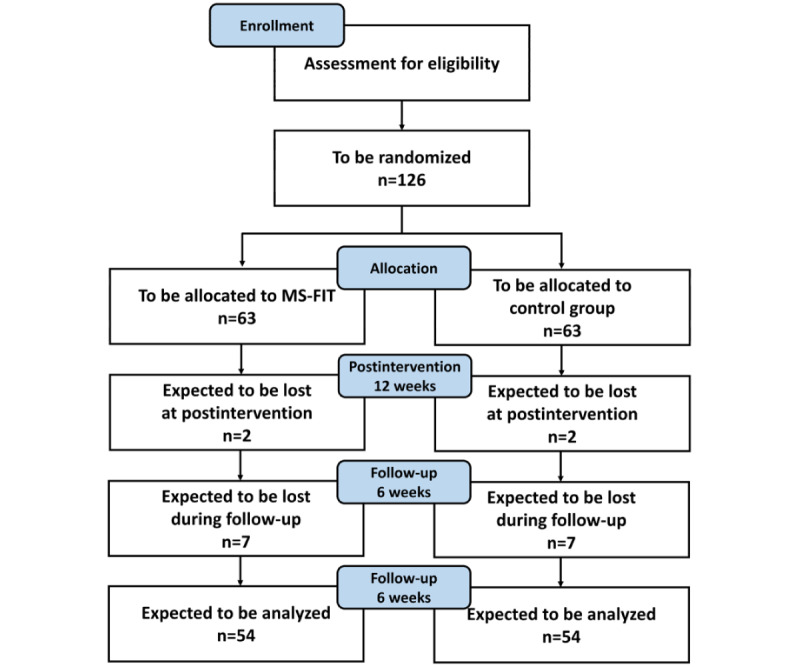 Figure 1
Peer Reviews
No public reviews on file for this paper yet. If you reviewed it on a platform where reviews are public (OpenReview, ICLR, NeurIPS, ICML), you can paste yours below so the community can read it here.
Videos
No videos yet. Explain this paper in a talk, walkthrough, or lecture? Add one.
Taxonomy
TopicsMultiple Sclerosis Research Studies · Cerebral Palsy and Movement Disorders · Scoliosis diagnosis and treatment