Predicted indirectly recognizable HLA epitopes scores and clinical outcomes after haploidentical stem cell transplantation in pediatric patients with relapsed neuroblastoma
Eun Seop Seo, In Hwa Jeong, Hee Young Ju, Ju Kyung Hyun, Ji Won Lee, Keon Hee Yoo, Won Young Heo, Ki Woong Sung, Hee Won Cho, Eun-Suk Kang

TL;DR
This study shows that higher PIRCHE scores in donor-recipient pairs are linked to better outcomes in pediatric neuroblastoma patients after stem cell transplants.
Contribution
The study demonstrates the clinical utility of PIRCHE scores in predicting outcomes for pediatric neuroblastoma patients undergoing haplo-SCT.
Findings
Higher PIRCHE-I scores correlate with faster platelet recovery and fewer infections and complications.
Combined PIRCHE-I and PIRCHE-II scores are strongly associated with improved overall survival.
PIRCHE-II scores are independently linked to reduced disease progression in multivariable analysis.
Abstract
The Predicted Indirectly ReCognizable HLA Epitopes (PIRCHE) model is a recently developed algorithm that predicts indirect T-cell recognition by calculating the number of such epitopes in donor-recipient pairs. In this study, the clinical significance of PIRCHE was evaluated in pediatric patients with relapsed/progressed neuroblastoma undergoing haploidentical stem cell transplantation (haplo-SCT). A higher PIRCHE-I score was associated with faster platelet recovery (P = 0.007) and lower incidence of hemorrhagic cystitis (13% vs. 41%, P = 0.028) and invasive fungal infections (0% vs. 18%, P = 0.045). Additionally, a higher PIRCHE-I score was significantly associated with better overall survival (OS) (HR 0.57, 95% CI 0.34-0.97, P = 0.038). A higher PIRCHE-II score was associated with better OS (HR 0.57, 95% CI 0.34-0.94, P = 0.028) and reduced progression (HR 0.48, 95% CI 0.30-0.77, P…
Genes, proteins, chemicals, diseases, species, mutations and cell lines named across the full text — each resolved to its canonical identifier and authoritative record.
Click any figure to enlarge with its caption.
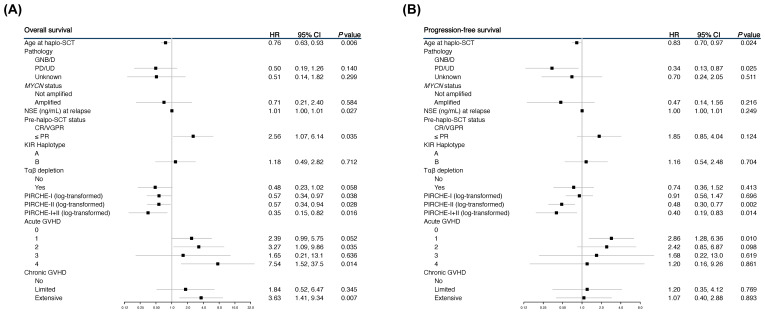 Figure 1
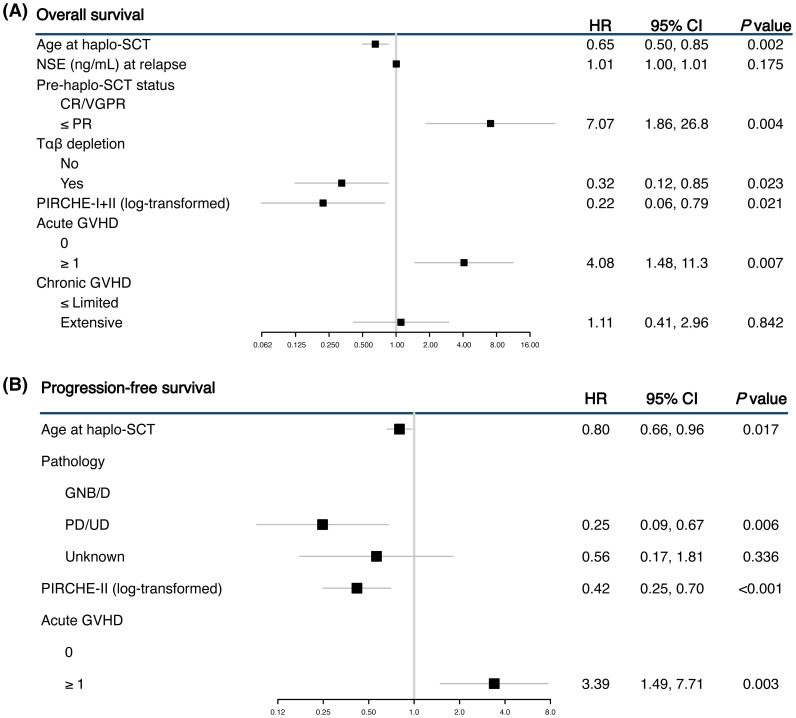 Figure 2
Peer Reviews
No public reviews on file for this paper yet. If you reviewed it on a platform where reviews are public (OpenReview, ICLR, NeurIPS, ICML), you can paste yours below so the community can read it here.
Videos
No videos yet. Explain this paper in a talk, walkthrough, or lecture? Add one.
Taxonomy
TopicsNeuroblastoma Research and Treatments · Hematopoietic Stem Cell Transplantation · Neonatal Respiratory Health Research