Comparative performance of PROMIS Sleep Disturbance computerized adaptive testing algorithms and static short form in postmenopausal women
Andrew Trigg, Claudia Haberland, Huda Shalhoub, Christoph Gerlinger, Christian Seitz

TL;DR
This study compares different methods for measuring sleep disturbances in older women, finding that both short forms and adaptive testing work well.
Contribution
The study evaluates the performance of two adaptive testing algorithms and a short form of the PROMIS Sleep Disturbance measure in postmenopausal women.
Findings
The CAT1 algorithm used an average of 4.18 items with slightly lower performance than CAT2 or the short form.
Both the 8-item short form and adaptive testing with 8 items performed similarly in terms of accuracy.
Women with sleep disorders reported higher sleep disturbance than those without.
Abstract
The Patient-Reported Outcomes Measurement Information System (PROMIS) Sleep Disturbance v1.0 item bank (27 items) measures sleep disturbances. Rather than the full item bank, an 8-item short form (PROMIS SD SF 8b) or computerized adaptive testing (CAT) can be used. This study compares the performance of the PROMIS SD SF 8b with two CAT algorithms in postmenopausal women. This is a secondary analysis of data collected for the original psychometric testing of the PROMIS Sleep Disturbance item bank, in a sub-sample of women aged ≥55. A graded response model (GRM) was fitted for the item bank, then simulations evaluated the performance of CAT algorithms and the short form, in terms of root mean square error (RMSE) versus the latent trait estimate derived from the full bank. Two CAT algorithms were tested: CAT1 (stop once standard error <0.3 or 12 items administered) and CAT2 (stop once 8…
Genes, proteins, chemicals, diseases, species, mutations and cell lines named across the full text — each resolved to its canonical identifier and authoritative record.
Click any figure to enlarge with its caption.
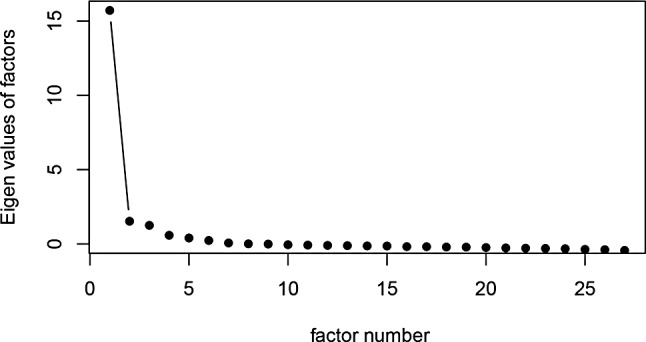 Figure 1
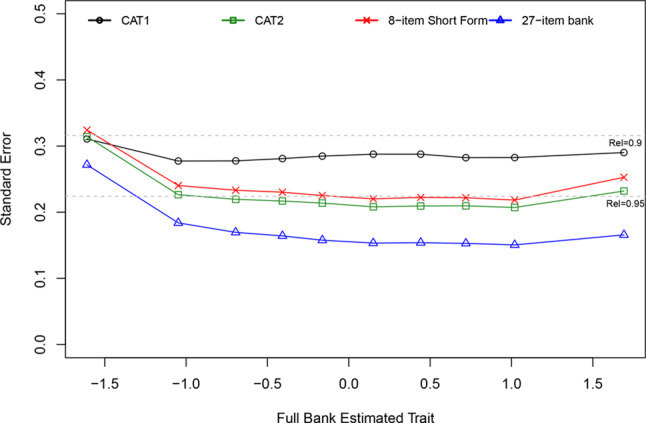 Figure 2
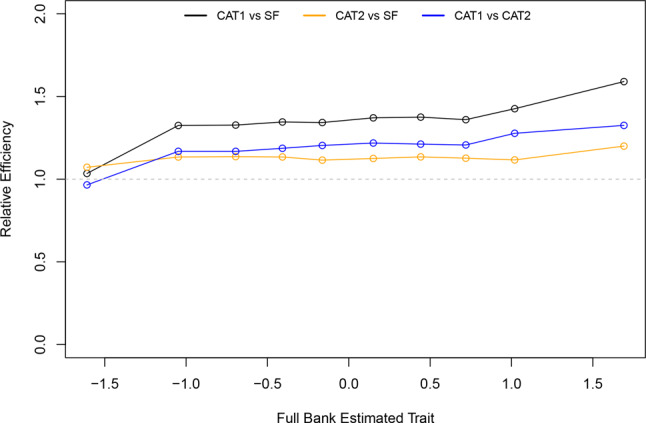 Figure 3
Peer Reviews
No public reviews on file for this paper yet. If you reviewed it on a platform where reviews are public (OpenReview, ICLR, NeurIPS, ICML), you can paste yours below so the community can read it here.
Videos
No videos yet. Explain this paper in a talk, walkthrough, or lecture? Add one.
Taxonomy
TopicsSleep and related disorders · Cognitive Abilities and Testing · Sleep and Wakefulness Research