Using temperature coefficients to support resonance assignment of intrinsically disordered proteins
Paulina Putko, Javier Agustin Romero, Christian F. Pantoja, Markus Zweckstetter, Krzysztof Kazimierczuk, Anna Zawadzka-Kazimierczuk

TL;DR
This paper introduces a new method for identifying protein structures using temperature changes to improve accuracy in disordered proteins.
Contribution
The novel approach combines temperature coefficients with chemical shifts to enhance resonance assignment in intrinsically disordered proteins.
Findings
Adding temperature coefficients improves the classification of amino acid residues in disordered proteins.
The method successfully distinguishes between lysine and glutamic acid, as well as valine and isoleucine.
The LDA-based program is publicly available and demonstrates improved recognition efficiency.
Abstract
The resonance assignment of large intrinsically disordered proteins (IDPs) is difficult due to the low dispersion of chemical shifts (CSs). Luckily, CSs are often specific for certain residue types, which makes the task easier. Our recent work showed that the CS-based spin-system classification can be improved by applying a linear discriminant analysis (LDA). In this paper, we extend a set of classification parameters by adding temperature coefficients (TCs), i.e., rates of change of chemical shifts with temperature. As demonstrated previously by other groups, the TCs in IDPs depend on a residue type, although the relation is often too complex to be predicted theoretically. Thus, we propose an approach based on experimental data; CSs and TCs values of residues assigned using conventional methods serve as a training set for LDA, which then classifies the remaining resonances. The method…
Genes, proteins, chemicals, diseases, species, mutations and cell lines named across the full text — each resolved to its canonical identifier and authoritative record.
Click any figure to enlarge with its caption.
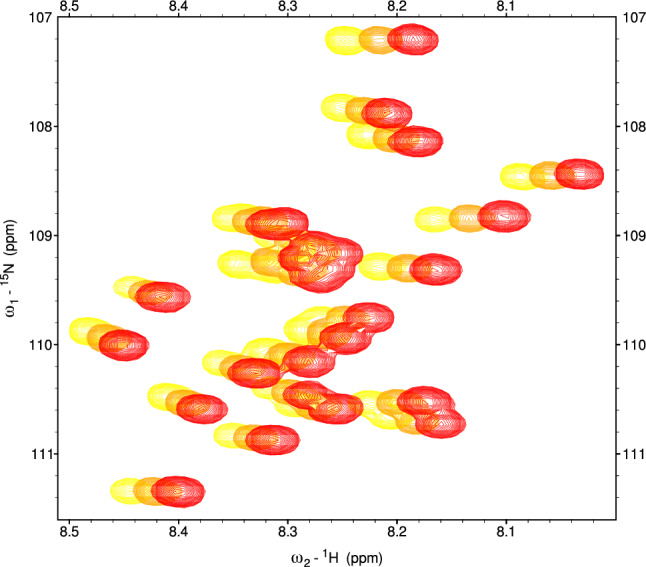 Figure 1
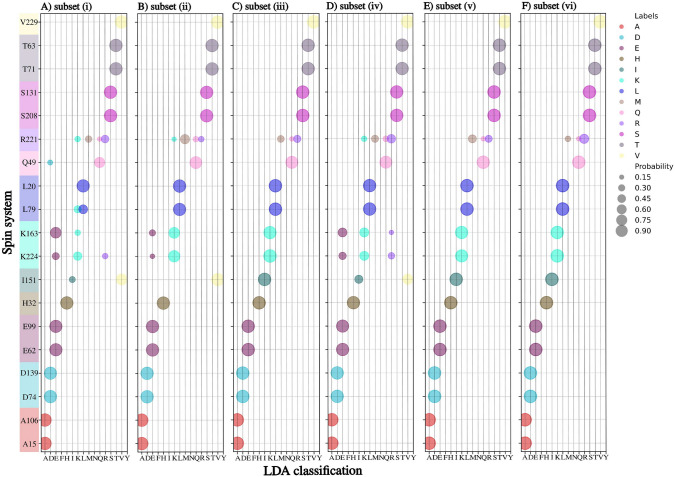 Figure 2
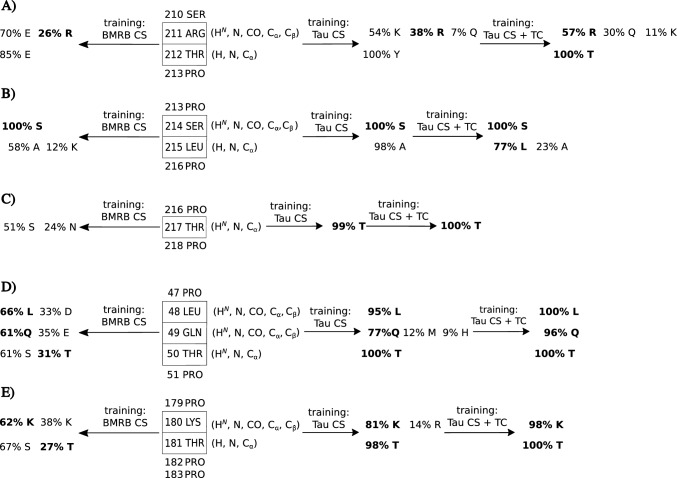 Figure 3
Peer Reviews
No public reviews on file for this paper yet. If you reviewed it on a platform where reviews are public (OpenReview, ICLR, NeurIPS, ICML), you can paste yours below so the community can read it here.
Videos
No videos yet. Explain this paper in a talk, walkthrough, or lecture? Add one.
Taxonomy
TopicsProtein Structure and Dynamics · Molecular spectroscopy and chirality · Enzyme Structure and Function