Illuminating what lies in darkness: Circadian regulation of hypocotyl growth in Arabidopsis via ELF3 recruitment of demethylases
Julie Robinson

Abstract
Genes, proteins, chemicals, diseases, species, mutations and cell lines named across the full text — each resolved to its canonical identifier and authoritative record.
Click any figure to enlarge with its caption.
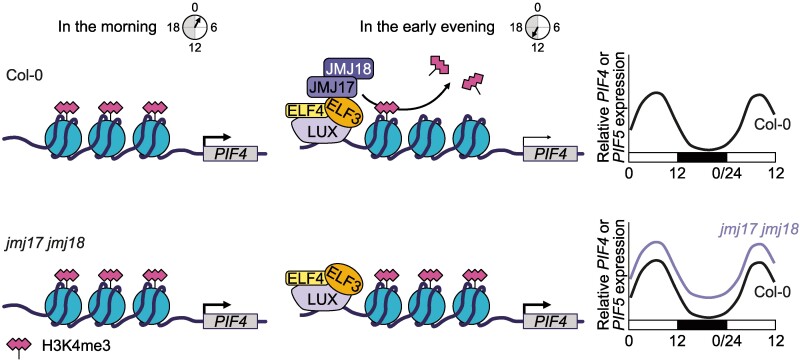 Figure 1
Peer Reviews
No public reviews on file for this paper yet. If you reviewed it on a platform where reviews are public (OpenReview, ICLR, NeurIPS, ICML), you can paste yours below so the community can read it here.
Videos
No videos yet. Explain this paper in a talk, walkthrough, or lecture? Add one.
Taxonomy
TopicsPlant Molecular Biology Research · Light effects on plants · Photosynthetic Processes and Mechanisms
Do you ever get so sleepy at night that you literally can’t keep your eyes open, even though you really want to finish watching the show you’re hooked on? Those heavy eyelids are the result of your body's circadian clock, which keeps you on a 24-hour cycle of wakefulness and sleep. Plants also rely on their circadian clock to coordinate biological functions, including those that promote the light reactions of photosynthesis only during the day when sunlight is available. The hypocotyl grows primarily during the night, and this, too, is regulated by the circadian clock in Arabidopsis (Arabidopsis thaliana; Niwa et al. 2009). Circadian clocks are composed of many different proteins, many of which operate in a complex system of overlapping negative feedback loops (Sanchez and Kay 2016).
Key players in plants’ circadian clocks are phytochrome-interacting factors (PIFs), transcription factors that transduce external light signals received by phytochromes, among other signals, into specific control of gene expression (de Lucas and Prat 2014). PIF4 and PIF5 repress hypocotyl growth during the day, while the evening complex enables hypocotyl growth during the night by repressing PIF4/5 transcription. In new work, Shiyu Tian and colleagues (Tian et al. 2025) seek to elucidate the molecular mechanism by which the evening complex regulates PIF4/5 expression.
Two key components of the evening complex are EARLY FLOWERING 3 (ELF3) and its interaction partner ELF4. Tian et al. performed a yeast three-hybrid screen to identify binding partners of ELF3 in the presence of ELF4. Through this screen, they identified JMJ17 and JMJ18, which are known members of a family of demethylases known as Jumonji (JMJ) proteins. The authors go on to characterize the role of JMJ17/18 in the light-dependent regulation of hypocotyl growth in Arabidopsis by investigating which gene region(s) of PIF4/5 the demethylases bind to and the role of ELF3 in that interaction. They find enrichment of H3K4me3 within PIF4/5 in both elf3 and jmj17jmj18 mutants, suggesting that the association of the demethylases with PIF4/5 depends on ELF3.
Chromatin structure around a gene affects how well transcription machinery can access the gene to transcribe it. Methylated H3K4 is generally associated with actively transcribed genes (Hyun et al. 2017), and indeed PIF4/5 genes are actively transcribed when methylated. Thus, the interaction of the demethylases JMJ17/18 with these genes has a significant effect on their expression, as summarized in the model presented by the authors (Figure). During the day, the evening complex is not formed and thus does not recruit the demethylases JMJ17/18 to PIF4/5, thus leaving them methylated. In their methylated state, they are actively transcribed, and the downstream effect of this is the prevention of hypocotyl growth. During the night, however, the evening complex recruits JMJ17/18 to PIF4/5 through the action of ELF3, resulting in the demethylation of PIF4/5. When demethylated, transcription of these genes is repressed, which has the downstream effect of allowing hypocotyl growth. Interestingly, the authors also found significantly low expression of PIF4/5 during the day in elf3 despite significantly enriched H3K4me3 at PIF4/5 at this time; epigenetic effects may explain this discrepancy.
The next evening you feel sleep overtaking you, know that seedlings the world over are just beginning to put their energy toward hypocotyl growth thanks to two JMJ demethylases under the direction of the evening complex.
The reference list from the paper itself. Each links out to its DOI / PubMed record.
- 1de Lucas M, Prat S. PI Fs get B Rright: PHYTOCHROME INTERACTING FACTO Rs as integrators of light and hormonal signals. New Phytol. 2014:202(4):1126–1141. 10.1111/nph.1272524571056 · doi ↗ · pubmed ↗
- 2Hyun K, Jeon J, Park K, Kim J. Writing, erasing and reading histone lysine methylations. Exp Mol Med. 2017:49(4):e 324. 10.1038/emm.2017.1128450737 PMC 6130214 · doi ↗ · pubmed ↗
- 3Niwa Y, Yamashino T, Mizuno T. The circadian clock regulates the photoperiodic response of hypocotyl elongation through a coincidence mechanism in Arabidopsis thaliana. Plant Cell Physiol. 2009:50(4):838–854. 10.1093/pcp/pcp 02819233867 · doi ↗ · pubmed ↗
- 4Sanchez SE, Kay SA. The plant circadian clock: from a simple timekeeper to a complex developmental manager. Cold Spring Harb Perspect Biol. 2016:8(12):a 027748. 10.1101/cshperspect.a 02774827663772 PMC 5131769 · doi ↗ · pubmed ↗
- 5Tian S, Zhang S, Xu F, Sun Q, Xu G, Ni M. The evening complex component ELF 3 recruits H 3K 4me 3 demethylases to repress PHYTOCHROME INTERACTING FACTOR 4 and 5 in Arabidopsis. Plant Cell. 2025:37(1). 10.1093/plcell/koaf 014PMC 1177931139880018 · doi ↗ · pubmed ↗