Go with the flow: ABCC4 mediates cytokinin efflux to control root development
Héctor H Torres-Martínez

Abstract
Genes, proteins, chemicals, diseases, species, mutations and cell lines named across the full text — each resolved to its canonical identifier and authoritative record.
Click any figure to enlarge with its caption.
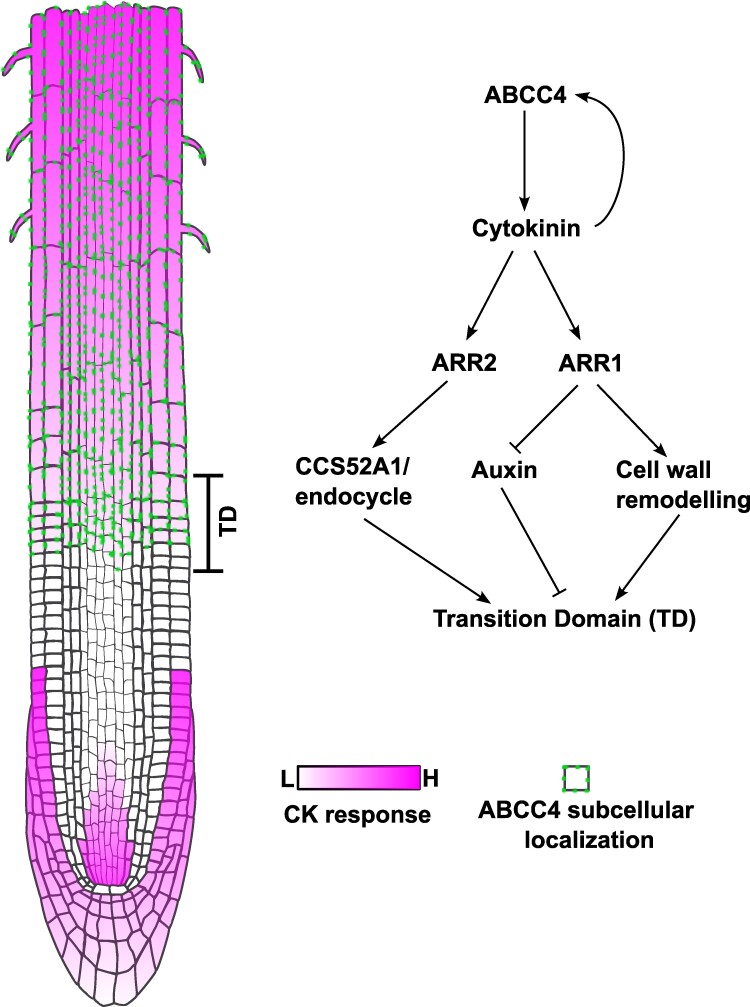 Figure 1
Peer Reviews
No public reviews on file for this paper yet. If you reviewed it on a platform where reviews are public (OpenReview, ICLR, NeurIPS, ICML), you can paste yours below so the community can read it here.
Videos
No videos yet. Explain this paper in a talk, walkthrough, or lecture? Add one.
Taxonomy
TopicsPlant Molecular Biology Research · Renal and related cancers
The plant hormone cytokinin controls many developmental processes in plants, including shoot apical meristem establishment, flower development, leaf cell proliferation, root vascular development, lateral root initiation, and root meristem size (Wybouw and De Rybel 2019). Specifically in root tips, cytokinin plays an important role in establishing meristem size by defining the proximal end of the meristem. For instance, cytokinin signaling induces the onset of the endocycle, a cell cycle where DNA replication is repeated several times without cytokinesis that is associated with cell differentiation and establishing the transition domain (Takahashi et al. 2013). On the other hand, cytokinin acts as a negative regulator of polar auxin transport and promotes auxin degradation in that specific zone (Ioio et al. 2008; Di Mambro et al. 2017). Cytokinin also controls the expression of EXPANSIN A1, facilitating cell wall remodeling in cells that will start to elongate (Pacifici et al. 2018).
The uneven distribution of cytokinins, such as trans-Zeatin (tZ), N^6^-(Δ^2^-isopentenyl)-adenine (iP) and cis-Zeatin, in planta is partly explained by the differential expression of cytokinin synthesis genes (Sakakibara 2021). However, cytokinin transporters also play an important role in mediating the spatial distribution and functional effects of cytokinins on plant development. Significant progress has been made in the past 2 decades in identifying transporters responsible for cytokinin flow. To date, 4 major classes of cytokinin transporters have been identified: PURIN PERMEASE (PUP), EQUILIBRATIVE NUCLEOSIDE TRANSPORTER (ENT), AZA-GUANIN RESISTANT (AZG), and ATP-BINDING CASSETTE (ABC) transporters (Zhang et al. 2023). While most of the identified cytokinin transporters function as importers, little is known about cytokinin efflux carriers, including their location and roles in developmental programs.
In this issue of Plant Physiology, Uragami et al. (2024) report on the isolation and characterization of ABCC4, a cytokinin efflux transporter in Arabidopsis thaliana, that modulates cytokinin distribution important for root apical meristem size in the primary root. Specifically, ABCC4 appears to be important for defining the transition domain by exporting cytokinin to the apoplast at the proximal end of the root apical meristem, thereby triggering the developmental shift from meristematic cell to cell elongation/differentiation (Fig. 1).
By heterologous expression analysis coupled with liquid chromatography-mass spectrometry, the authors screened 61 candidate genes derived from a transcriptomic profile study of the shoot apical meristem (Yadav et al. 2009). To this end, the candidate genes were constitutively expressed in tobacco leaves, and aliquots from the incubation buffer were sampled to quantify cytokinins. Tobacco leaves overexpressing ABCC4 (AT2G47800) showed a significant accumulation of all types of cytokinins compared with the control condition. Time-course experiments showed a progressive accumulation of cytokinins in the incubation buffer. Inhibition experiments with known ABC transporter inhibitors limited the ABCC4-dependant cytokinin accumulation in the incubation buffer.
Arabidopsis transgenic lines with β-estradiol–inducible ABCC4 expression in MS liquid medium showed a significant increase of iP and cis-Zeatin in the medium after 24 h of treatment with β-estradiol. Similarly, in a heterologous expression system, yeast carrying ABCC4 under the control of a galactose-inducible promoter showed a significant intracellular reduction of isotope-labeled tZ compared with the control. Together, these results confirm that ABCC4 functions as a cytokinin efflux transporter.
Expression analysis by quantitative reverse transcription polymerase chain reaction (qRT-PCR) showed that ABCC4 is predominantly expressed in roots during early developmental stages but broadly expressed across the plant at later stages. These results confirmed what was previously reported in a transgenic line where GUS activity was driven by ABCC4 promoter (Klein et al. 2004). Roots treated with tZ and iP for 2 h showed striking induction of ABCC4 expression, while auxin, Indole-3-acetic acid (IAA) treatment suppressed ABCC4 expression. This confirms that cytokinins explicitly induce transporter expression.
T-DNA insertion and CRISPR/Cas9 loss-of-function mutants abcc4-1 and abcc4-2, respectively, exhibited significantly longer primary roots with an increased root apical meristem size. When mutants were grown on tZ-supplemented media, the elongated root phenotype was abolished, indicating that cytokinin transport deficiency is responsible for abcc4 mutants’ phenotype. Conversely, ABCC4 overexpressing lines showed reduced primary root and root apical meristem sizes. Interestingly, the lateral root growth rate was higher in overexpressing lines.
Finally, analysis of the activity of a synthetic cytokinin response promoter, TCSn (Zürcher et al. 2013), in abcc4-1 and overexpressing line backgrounds showed altered distribution of TCSn activity in the root tip epidermis relative to wild-type plants, suggesting that ABCC4 regulates cytokinin distribution at a cellular level in root tips. To investigate whether the ABCC4 transporter contributes to root-to-shoot cytokinin transport, the authors applied tZ to roots of abcc4-1, overexpressing line, and wild-type plants. They then looked at expression levels of ARABIDOPSIS RESPONSE REGULATOR5 (ARR5), a member of a cytokinin-responsive transcription factor family (D’Agostino et al. 2000) in the shoots. In all 3 genotypes, there was an increase in ARR5 expression level in the shoot after tZ treatment of the root, indicating root-to-shoot cytokinin transport. These findings indicate that ABCC4 is important for local cytokinin transport within the root tip, while it does not appear to influence long-distance transport to the shoots.
Taken together, these experiments uncover the central role of ABCC4 in cytokinin distribution in the root tips, potentially helping to set the position of the proximal root apical meristem end, also known as the transition domain (Fig. 1). Combined with previous knowledge about other cytokinin transporters, the results presented by Uragami et al. (2024) help to visualize a clearer landscape of cytokinin transport and action across the plant. However, key questions remain, such as how ABCC4-mediated efflux is coupled with other cytokinin transporters or other hormonal pathways, like auxin, to establish the transition domain. Moreover, given ABCC4's broad expression, its role in other developmental processes needs to be addressed. Elucidating the overall role of cytokinins in plants will advance our understanding of plant biology and pave the way for developing new technologies for future applications in plant biotechnology.
The reference list from the paper itself. Each links out to its DOI / PubMed record.
- 1D’Agostino IB , Deruère J, Kieber JJ. Characterization of the response of the Arabidopsis response regulator gene family to cytokinin. Plant Physiol.2000:124(4):1706–1717. 10.1104/pp.124.4.170611115887 PMC 59868 · doi ↗ · pubmed ↗
- 2Di Mambro R , De Ruvo M, Pacifici E, Salvi E, Sozzani R, Benfey PN, Busch W, Novak O, Ljung K, Di Paola L, et al Auxin minimum triggers the developmental switch from cell division to cell differentiation in the Arabidopsis root. Proc Natl Acad Sci U S A.2017:114(36):E 7641–E 7649. 10.1073/pnas.170583311428831001 PMC 5594665 · doi ↗ · pubmed ↗
- 3Ioio RD , Nakamura K, Moubayidin L, Perilli S, Taniguchi M, Morita MT, Aoyama T, Costantino P, Sabatini S. A genetic framework for the control of cell division and differentiation in the root meristem. Science. 2008:322(5906):1380–1384. 10.1126/science.116414719039136 · doi ↗ · pubmed ↗
- 4Klein M , Geisler M, Suh SJ, Kolukisaoglu HÜ, Azevedo L, Plaza S, Curtis MD, Richter A, Weder B, Schulz B, et al Disruption of At MRP 4, a guard cell plasma membrane ABCC-type ABC transporter, leads to deregulation of stomatal opening and increased drought susceptibility. Plant J.2004:39(2):219–236. 10.1111/j.1365-313X.2004.02125.x 15225287 · doi ↗ · pubmed ↗
- 5Pacifici E , Di Mambro R, Dello Ioio R, Costantino P, Sabatini S. Acidic cell elongation drives cell differentiation in the Arabidopsis root. EMBO J.2018:37(16):e 99134. 10.15252/embj.20189913430012836 PMC 6092616 · doi ↗ · pubmed ↗
- 6Sakakibara H . Cytokinin biosynthesis and transport for systemic nitrogen signaling. Plant J.2021:105(2):421–430. 10.1111/tpj.1501133015901 · doi ↗ · pubmed ↗
- 7Takahashi N , Kajihara T, Okamura C, Kim Y, Katagiri Y, Okushima Y, Matsunaga S, Hwang I, Umeda M. Cytokinins control endocycle onset by promoting the expression of an APC/C activator in Arabidopsis roots. Curr Biol.2013:23(18):1812–1817. 10.1016/j.cub.2013.07.05124035544 · doi ↗ · pubmed ↗
- 8Uragami T , Kiba T, Kojima M, Takebayashi Y, Tozawa Y, Hayashi Y, Kinoshita T, Sakakibara H. The cytokinin efflux transporter ABCC 4 participates in Arabidopsis root system development. Plant Physiol.2024:197(1):kiae 628. 10.1093/plphys/kiae 62839719052 PMC 11668331 · doi ↗ · pubmed ↗