Enantioselective Synthesis of the Sex Pheromone of Sitodiplosis mosellana (Géhin) and Its Stereoisomers
Jianan Wang, Xiaoyang Li, Yun Zhou, Qinghua Bian, Jiangchun Zhong

TL;DR
This study describes the enantioselective synthesis of the sex pheromone of Sitodiplosis mosellana and its stereoisomers using a six-step chemical process.
Contribution
The paper introduces a novel synthetic strategy for the sex pheromone and its stereoisomers using chiral epoxide ring opening and triple bond hydrogenation.
Findings
The sex pheromone (2S,7S)-2,7-Nonanediyl dibutyrate and its three stereoisomers were successfully synthesized.
The synthesis involved a six-step process with total yields of 59–64%.
The method utilized chiral epoxide ring opening and hydrogenation of the triple bond as key steps.
Abstract
(2S,7S)-2,7-Nonanediyl dibutyrate is the sex pheromone of Sitodiplosis mosellana (Géhin). In this study, this sex pheromone and its three stereoisomers were prepared. Central to this strategy was the ring opening of chiral epoxide with an alkynyllithium and the hydrogenation of the triple bond. Moreover, this approach consisted of six steps, and the total yields were 59–64%.
Genes, proteins, chemicals, diseases, species, mutations and cell lines named across the full text — each resolved to its canonical identifier and authoritative record.
Click any figure to enlarge with its caption.
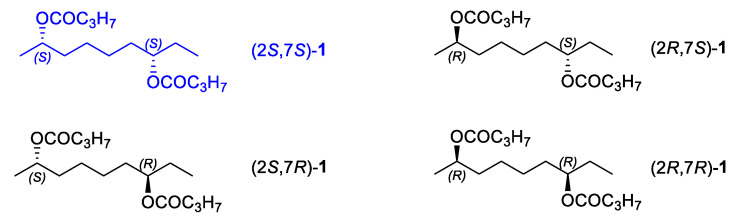 Figure 1
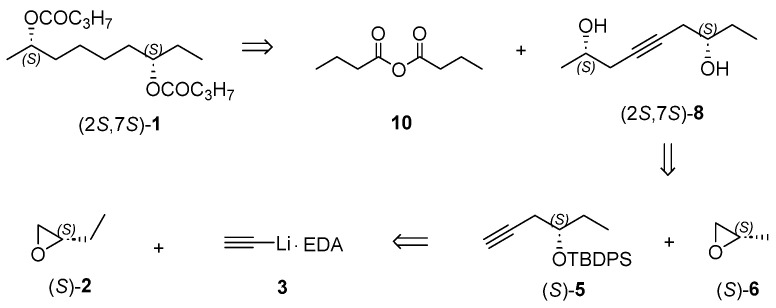 Figure 2
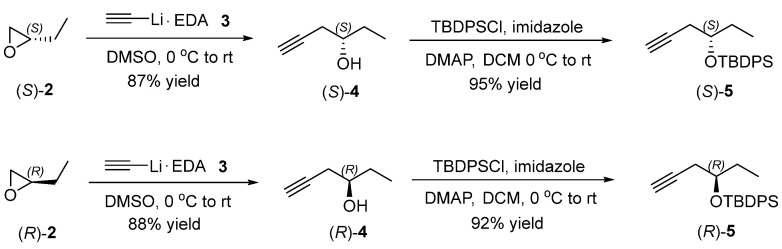 Figure 3
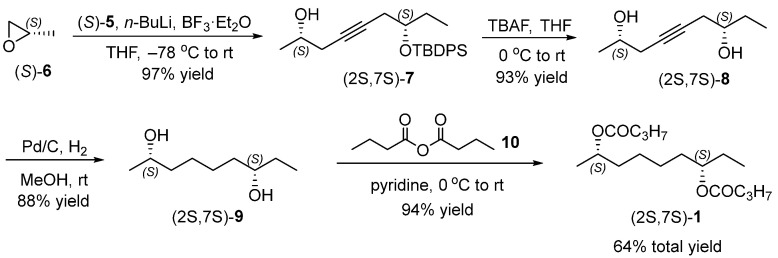 Figure 4
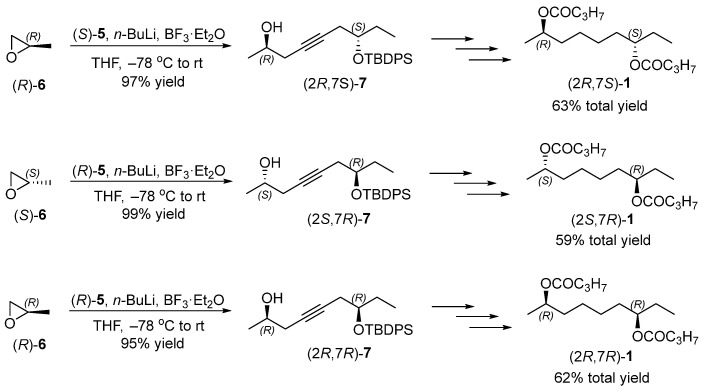 Figure 5
Peer Reviews
No public reviews on file for this paper yet. If you reviewed it on a platform where reviews are public (OpenReview, ICLR, NeurIPS, ICML), you can paste yours below so the community can read it here.
Videos
No videos yet. Explain this paper in a talk, walkthrough, or lecture? Add one.
Taxonomy
TopicsSynthetic Organic Chemistry Methods · Chemical synthesis and alkaloids · Asymmetric Synthesis and Catalysis