New Combination Regimens vs. Fludarabine, Cytarabine, and Idarubicin in the Treatment of Intermediate- or Low-Risk Nucleophosmin-1-Mutated Acute Myeloid Leukemia: A Retrospective Analysis from 7 Italian Centers
Giulia Battaglia, Davide Lazzarotto, Ilaria Tanasi, Carmela Gurrieri, Laura Forlani, Endri Mauro, Francesca Capraro, Giulia Ciotti, Eleonora De Bellis, Chiara Callegari, Luca Tosoni, Matteo Fanin, Gian Luca Morelli, Claudia Simio, Cristina Skert, Michele Gottardi, Francesco Zaja

TL;DR
This study compares new drug combinations with traditional chemotherapy for a specific type of leukemia, finding better outcomes with new treatments in low-risk patients.
Contribution
The study provides the first retrospective comparison of new combination regimens with standard chemotherapy in NPM1-mutated AML.
Findings
New combination regimens showed better overall survival in low-risk NPM1+ AML patients.
There was no significant difference in outcomes between regimens for intermediate-risk patients.
Allogeneic transplantation improved survival in intermediate-risk patients regardless of treatment.
Abstract
Background: Nucleophosmin-1 (NPM1) mutation accounts for 30% of acute myeloid leukemia (AML) cases and defines either low- or intermediate-risk AML, depending on FLT3-ITD mutation. New combination regimens (NCRs), adding midostaurin and gemtuzumab ozogamicin (GO) to the 3 + 7 scheme, are commonly used, though there are no data that compare NCRs with intensive induction chemotherapy. Methods: To evaluate the efficacy and safety of NCRs and FLAI in NPM1+ AML, we retrospectively analyzed 125 patients treated with FLAI (n = 53) or NCRs (n = 72) at seven Italian Centers. Results: The median age was 61 years and 51/125 (41%) were FLT3-ITD+. The complete remission (CR) rate was 77%, slightly better with NCRs (83% vs. 68%; p = 0.054). NCRs yielded a superior median overall survival (OS) (not reached (NR) vs. 27.3 months; p = 0.002), though the median event-free survival (EFS) was similar (NR…
Genes, proteins, chemicals, diseases, species, mutations and cell lines named across the full text — each resolved to its canonical identifier and authoritative record.
Click any figure to enlarge with its caption.
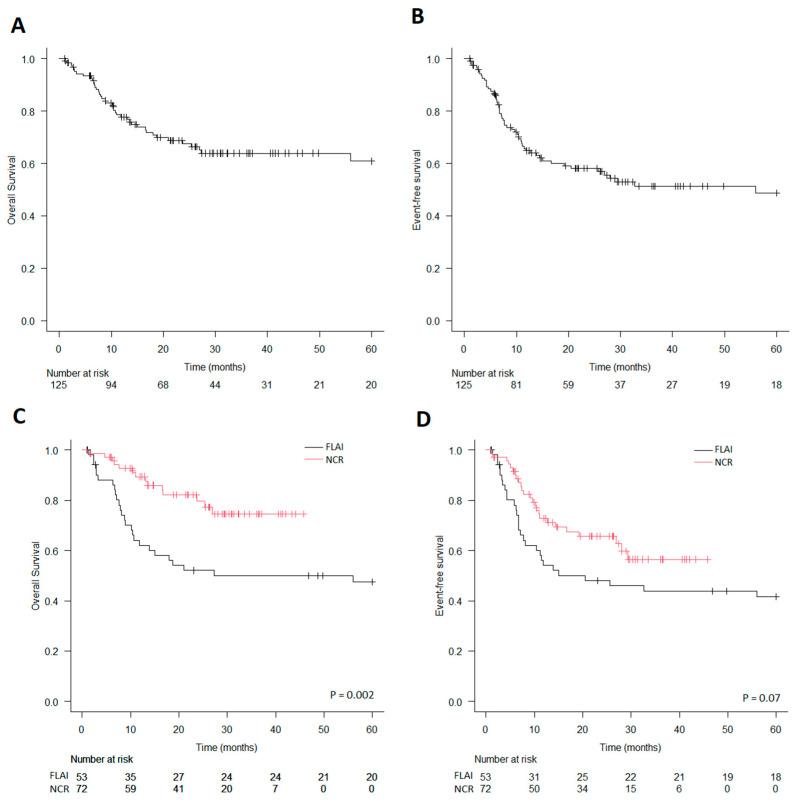 Figure 1
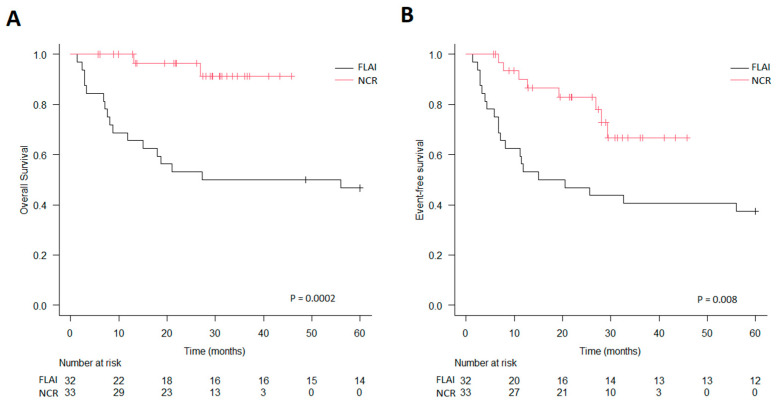 Figure 2
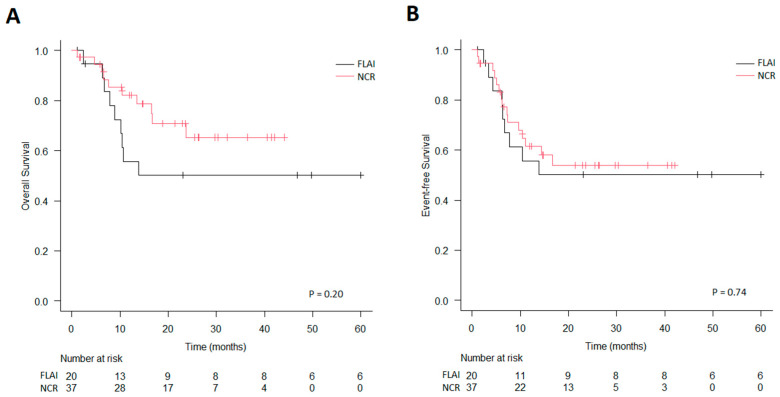 Figure 3
Peer Reviews
No public reviews on file for this paper yet. If you reviewed it on a platform where reviews are public (OpenReview, ICLR, NeurIPS, ICML), you can paste yours below so the community can read it here.
Videos
No videos yet. Explain this paper in a talk, walkthrough, or lecture? Add one.
Taxonomy
TopicsAcute Myeloid Leukemia Research · Myeloproliferative Neoplasms: Diagnosis and Treatment · Acute Lymphoblastic Leukemia research