Bone Densitometry Parameters in Females with Ehlers-Danlos Syndrome—Does the Hypermobile Subtype Increase the Risk of Low Bone Mass in Patients with Ehlers-Danlos Syndrome?
Bernadetta Kałuża, Ivan Rychlik, Jan Domański, Aleksandra Żuk-Łapan, Emilia Babula, Iga Poprawa, Jakub Podstawka, Ewa Kowalów, Edward Franek

TL;DR
This study found no increased risk of low bone mass in females with hypermobile Ehlers-Danlos syndrome compared to those with the classical subtype.
Contribution
The study provides new evidence that hypermobile EDS does not increase the risk of low bone mass.
Findings
No differences were found in densitometry parameters between classical and hypermobile EDS groups.
Hypermobile EDS patients did not show an increased risk of low bone mass (Z-score < −2).
Calcium-phosphate metabolism markers were similar in both EDS subtypes.
Abstract
Background: The purpose of this study was to assess bone densitometry parameters in patients with classical and hypermobile Ehlers-Danlos syndrome (EDS) and to determine whether the hypermobile subtype increases the risk of low bone mass, which is particularly important in this patient group, since the genetic mutation responsible for this subtype is still unknown. Material and Methods: In order to conduct this study, we collaborated with the EDS society in Poland. A total of 30 females of reproductive age who were included in the study were divided into two groups: Group 1—those with classical EDS (n = 9) and Group 2—those with hypermobile EDS (n = 21). Routine laboratory test results, bone turnover markers, and densitometry parameters were evaluated and compared. Results: The study groups showed no differences in terms of densitometry parameters or markers of calcium-phosphate…
Genes, proteins, chemicals, diseases, species, mutations and cell lines named across the full text — each resolved to its canonical identifier and authoritative record.
Click any figure to enlarge with its caption.
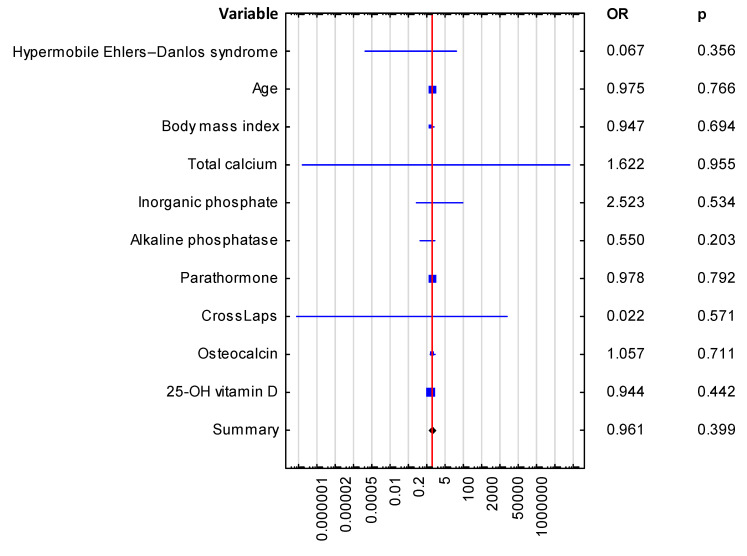 Figure 1
Peer Reviews
No public reviews on file for this paper yet. If you reviewed it on a platform where reviews are public (OpenReview, ICLR, NeurIPS, ICML), you can paste yours below so the community can read it here.
Videos
No videos yet. Explain this paper in a talk, walkthrough, or lecture? Add one.
Taxonomy
TopicsConnective tissue disorders research · Bone health and treatments · Fibroblast Growth Factor Research