Possible Use of Body Surface Area Value for Estimating Skeletal Muscle Mass in Chronic Liver Disease
Kazunori Yoh, Takashi Nishimura, Naoto Ikeda, Tomoyuki Takashima, Nobuhiro Aizawa, Yukihisa Yuri, Taro Kimura, Kohei Yoshihara, Ryota Yoshioka, Shoki Kawata, Yuta Kawase, Ryota Nakano, Hideyuki Shiomi, Shinya Fukunishi, Shinichiro Shinzaki, Shuhei Nishiguchi, Hirayuki Enomoto

TL;DR
This study shows that body surface area can be used to estimate muscle mass in patients with chronic liver disease, offering a noninvasive alternative to specialized devices.
Contribution
The study introduces body surface area as a practical and noninvasive tool for estimating skeletal muscle mass in chronic liver disease patients.
Findings
BSA strongly correlates with skeletal muscle mass index (r = 0.883, p < 0.0001).
BSA cutoffs of 1.68 m² for men and 1.48 m² for women predict low SMI effectively.
Combining BSA and grip strength correctly diagnosed 95.6% of sarcopenia cases.
Abstract
Background/Objectives: Sarcopenia is an important clinical feature of patients with chronic liver disease (CLD). However, special devices are required to determine skeletal muscle mass. We evaluated the usefulness of body surface area (BSA) for estimating muscle mass and diagnosing sarcopenia in patients with CLD. Methods: We retrospectively studied 1889 Japanese patients with CLD who underwent bioimpedance analysis (BIA) (training cohort, n = 983; validation cohort, n = 906). The optimal cutoff values for predicting low skeletal muscle mass index (SMI) were determined using ROC analysis. We also assessed 1229 patients whose BSA and grip strength (GS) data were obtained on the same day and evaluated the diagnostic performance of the determined cutoff values of BSA for the diagnosis of sarcopenia. Results: In the training cohort, a strong correlation was observed between the SMI and BSA…
Genes, proteins, chemicals, diseases, species, mutations and cell lines named across the full text — each resolved to its canonical identifier and authoritative record.
Click any figure to enlarge with its caption.
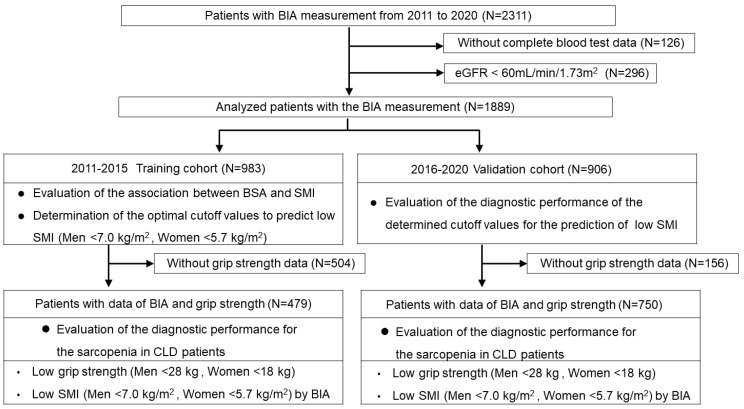 Figure 1
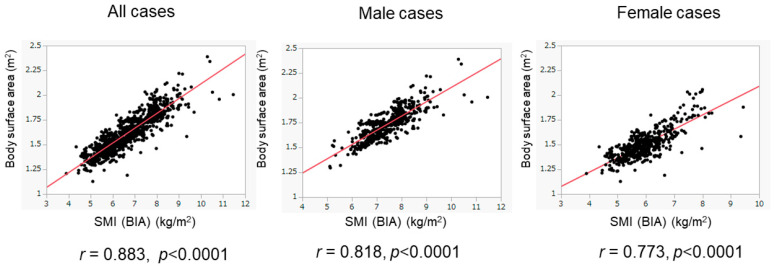 Figure 2
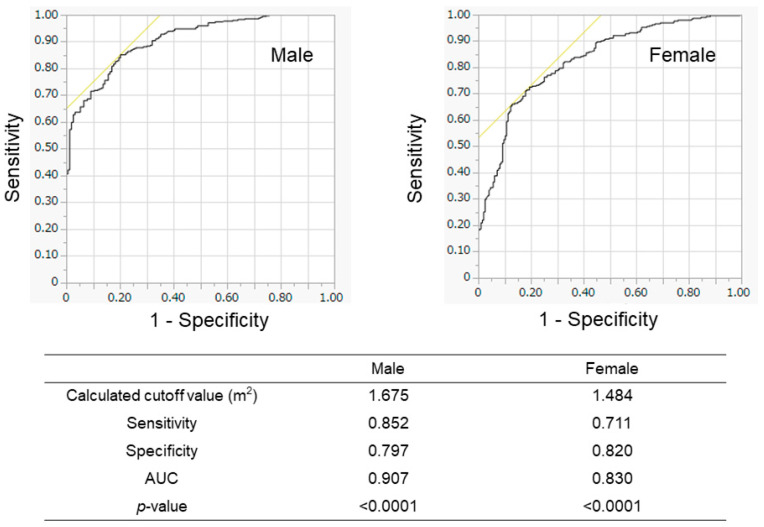 Figure 3
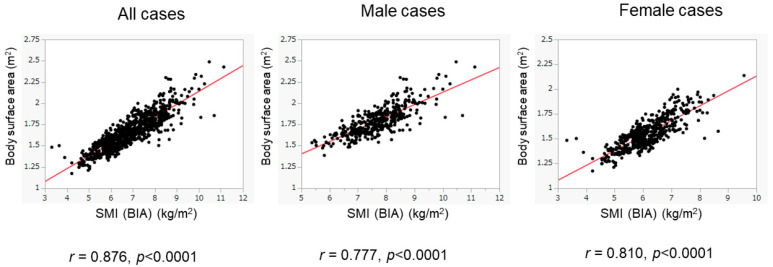 Figure 4
Peer Reviews
No public reviews on file for this paper yet. If you reviewed it on a platform where reviews are public (OpenReview, ICLR, NeurIPS, ICML), you can paste yours below so the community can read it here.
Videos
No videos yet. Explain this paper in a talk, walkthrough, or lecture? Add one.
Taxonomy
TopicsNutrition and Health in Aging · Body Composition Measurement Techniques · Clinical Nutrition and Gastroenterology