Ligand-Independent Spontaneous Activation of Purinergic P2Y6 Receptor Under Cell Culture Soft Substrate
Akiyuki Nishimura, Kazuhiro Nishiyama, Tomoya Ito, Xinya Mi, Yuri Kato, Asuka Inoue, Junken Aoki, Motohiro Nishida

TL;DR
This study shows that the P2Y6 receptor can activate without a ligand when cells are cultured on soft silicon substrates, suggesting that substrate stiffness affects GPCR activity.
Contribution
The study reveals a ligand-independent mechanism by which substrate stiffness modulates GPCR spontaneous activity.
Findings
P2Y6R induces Ca2+ oscillation on silicon substrates without a nucleotide ligand.
RGD motif mutation and absence of extracellular Ca2+ inhibit this spontaneous activity.
Ten GPCRs, including P2Y1R, P2Y2R, and P2Y6R, show spontaneous activity on soft substrates.
Abstract
G protein-coupled receptors (GPCRs) exist in the conformational equilibrium between inactive state and active state, where the proportion of active state in the absence of a ligand determines the basal activity of GPCRs. Although many GPCRs have different basal activity, it is still unclear whether physiological stresses such as substrate stiffness affect the basal activity of GPCRs. In this study, we identified that purinergic P2Y6 receptor (P2Y6R) induced spontaneous Ca2+ oscillation without a nucleotide ligand when cells were cultured in a silicon chamber. This P2Y6R-dependent Ca2+ oscillation was absent in cells cultured in glass dishes. Coating substrates, including collagen, laminin, and fibronectin, did not affect the P2Y6R spontaneous activity. Mutation of the extracellular Arg-Gly-Asp (RGD) motif of P2Y6R inhibited spontaneous activity. Additionally, extracellular Ca2+ was…
Genes, proteins, chemicals, diseases, species, mutations and cell lines named across the full text — each resolved to its canonical identifier and authoritative record.
Click any figure to enlarge with its caption.
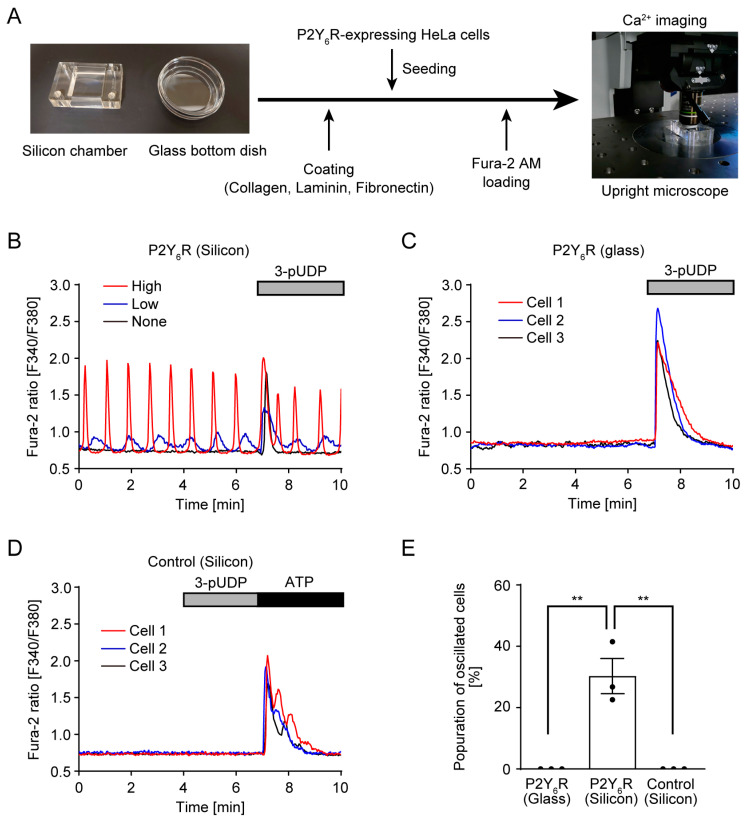 Figure 1
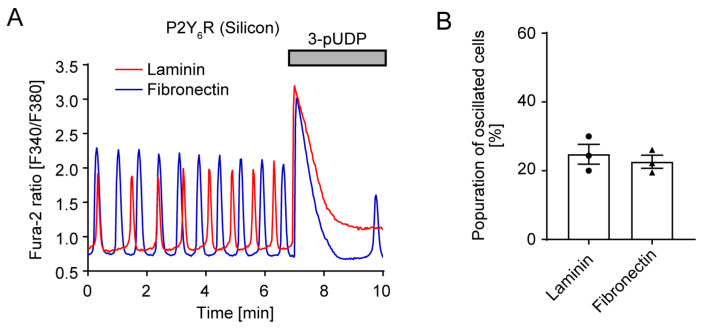 Figure 2
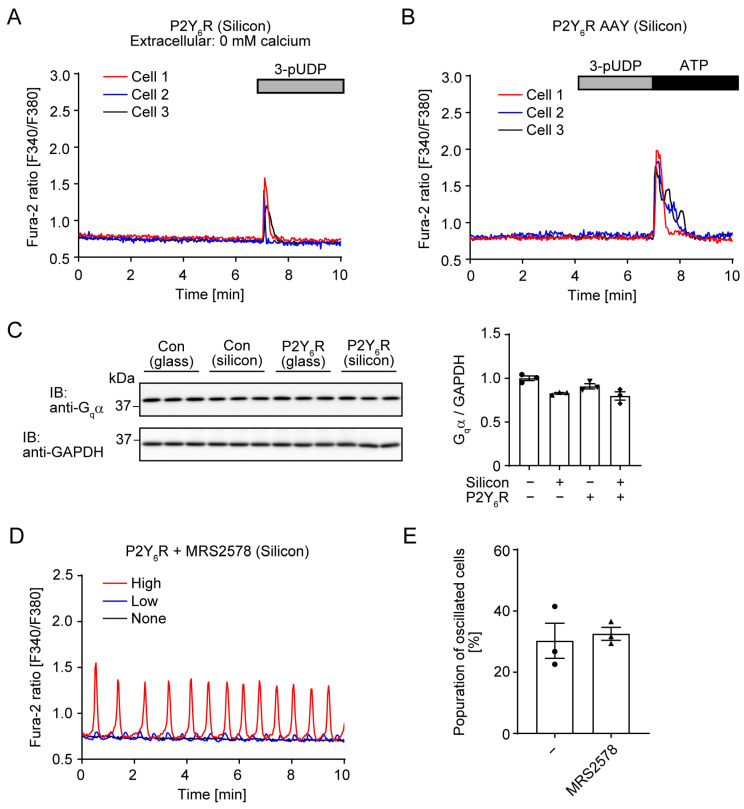 Figure 3
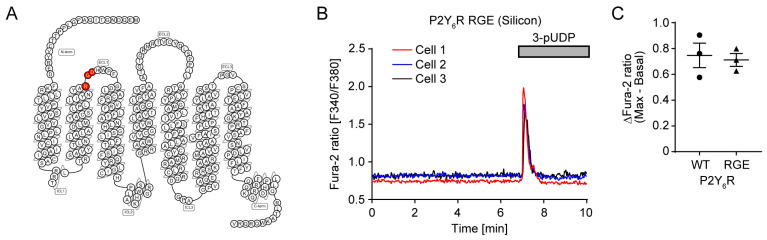 Figure 4
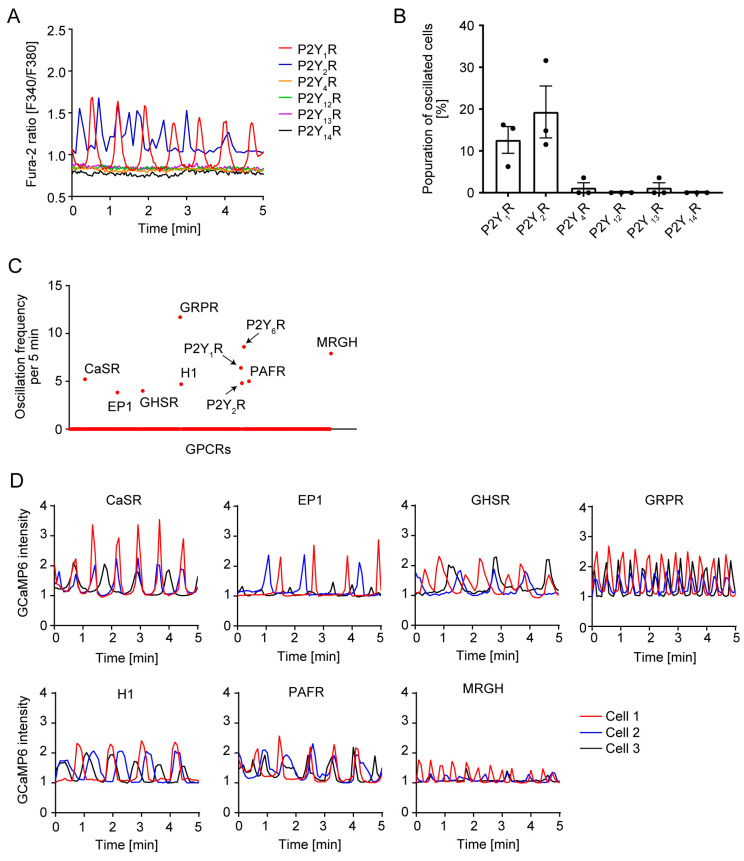 Figure 5
Peer Reviews
No public reviews on file for this paper yet. If you reviewed it on a platform where reviews are public (OpenReview, ICLR, NeurIPS, ICML), you can paste yours below so the community can read it here.
Videos
No videos yet. Explain this paper in a talk, walkthrough, or lecture? Add one.
Taxonomy
TopicsReceptor Mechanisms and Signaling · Adenosine and Purinergic Signaling · Neuropeptides and Animal Physiology