The Role of Traditional and Reverse Algorithms in the Diagnosis of Syphilis in HIV-Infected Individuals: A Case Study on Istanbul
Gizem Yapar, Muammer Osman Köksal, Kutay Sarsar, Pınar Soğuksu, Mehmet Demirci, Eray Yurtseven, Murat Hakan Kır, Aytaj Allahverdiyeva, Arif Atahan Çağatay, Ali Ağaçfidan, Hayriye Kırkoyun Uysal

TL;DR
This study compares traditional and reverse testing methods for syphilis in people with HIV in Istanbul and finds that the reverse algorithm detects more cases.
Contribution
The study demonstrates that the reverse algorithm identifies more syphilis cases in HIV-positive individuals compared to the traditional algorithm.
Findings
The reverse algorithm detected syphilis in 37 patients, while the traditional algorithm detected it in 22 patients.
Most syphilis-positive patients in the study were homosexual.
Syphilis coinfection did not affect CD4+ T-lymphocyte, CD8+ T-lymphocyte, CD4/CD8 ratio, or HIV RNA levels.
Abstract
Background/Objectives: T. pallidum subsp. pallidum is a spirochete that only causes disease in humans as the causative agent of syphilis. HIV and syphilis have common transmission routes. In the present study, our aim was to evaluate the presence of syphilis coinfection in people living with HIV using conventional and reverse algorithms and to investigate its effects on laboratory parameters. Methods: The traditional algorithm for syphilis begins testing with the non-treponemal test. If the non-treponemal test is reactive, a treponemal test is then used to confirm syphilis infection. The reverse algorithm for syphilis begins testing with the treponemal test. If this test is reactive, then a non-treponemal test is performed. When the non-treponemal test is non-reactive, a second treponemal test is performed. Results: A total of 200 patients were included in the study. While 22 patients…
Genes, proteins, chemicals, diseases, species, mutations and cell lines named across the full text — each resolved to its canonical identifier and authoritative record.
Click any figure to enlarge with its caption.
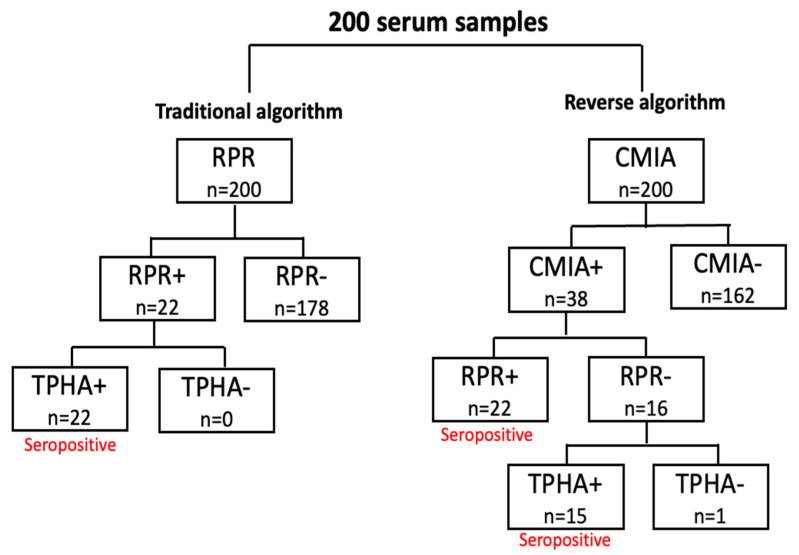 Figure 1
Peer Reviews
No public reviews on file for this paper yet. If you reviewed it on a platform where reviews are public (OpenReview, ICLR, NeurIPS, ICML), you can paste yours below so the community can read it here.
Videos
No videos yet. Explain this paper in a talk, walkthrough, or lecture? Add one.
Taxonomy
TopicsSyphilis Diagnosis and Treatment · Reproductive tract infections research · HIV, Drug Use, Sexual Risk