A new method for phase-pure χ-Fe5C2 synthesis to obtain linear α-olefins
Jie Yan, Ding Ma

Abstract
Genes, proteins, chemicals, diseases, species, mutations and cell lines named across the full text — each resolved to its canonical identifier and authoritative record.
Click any figure to enlarge with its caption.
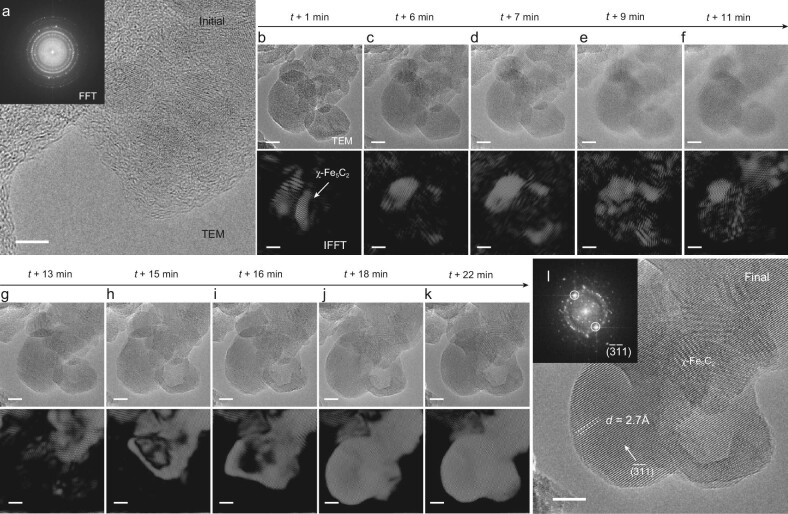 Figure 1
Peer Reviews
No public reviews on file for this paper yet. If you reviewed it on a platform where reviews are public (OpenReview, ICLR, NeurIPS, ICML), you can paste yours below so the community can read it here.
Videos
No videos yet. Explain this paper in a talk, walkthrough, or lecture? Add one.
Taxonomy
TopicsCatalysis and Hydrodesulfurization Studies · Asymmetric Hydrogenation and Catalysis · Nanomaterials for catalytic reactions
Linear α-olefins (LAOs) are essential chemical intermediates for the production of a wide range of high-value chemicals and materials, and are currently obtained by ethylene oligomerization. The Fischer–Tropsch (FT) process offers an alternative route to produce LAOs directly from syngas (a mixture of CO and H_2_) derived from carbon-based feedstocks such as natural gas, coal and biomass. However, the current syngas-to-LAOs process generates significant amounts of CO_2_ as a by-product, which is not only a concern from a greenhouse gas emission perspective, but also reduces the overall carbon efficiency of the process. Fe_5_C_2_ has been found to be highly active for conversion of syngas to LAOs [1,2]. Recently, Wang et al. developed a new method for the synthesis of a phase-pure χ-Fe_5_C_2_ catalyst, which significantly improves both the activity and selectivity of syngas to LAOs while minimizing CO_2_ production [3].
The authors have provided a unique and concise method for the preparation of phase-pure χ-Fe-carbide, enabling the synthesis of 100% pure χ-Fe-carbide for the first time. The formation of phase-pure χ-carbide from passivated Raney Fe was observed by environmental transmission electron microscopy (TEM), as shown in Fig. 1. This synthesis method effectively avoids excessive carbon build-up on the catalyst surface, resulting in unusually high catalytic activity. In previous work, it was shown that phase-pure ε-carbide displays a low primary CO_2_ selectivity due to the absence of Fe-oxides [4]. Primary CO_2_ formation mainly depends on intrinsic properties of the catalyst, while secondary CO_2_ is formed via the water-gas-shift reaction and is mainly determined by the H_2_O partial pressure, which depends on CO conversion. Similar to phase-pure ε-carbide, phase-pure χ-carbide produced negligible primary CO_2_. Although secondary CO_2_ was not completely eliminated, the overall CO_2_ selectivity was drastically reduced, significantly improving carbon efficiency.
After being promoted with Mn, the phase-pure χ-Fe_5_C_2_ catalyst shows higher CO conversion and lower CO_2_ selectivity under industrially relevant conditions at 250°C than the catalysts reported in the literature at higher temperatures (>320°C) [5]. The low CO_2_ selectivity of the catalyst implies a high selectivity to desired LAOs, and the catalyst was able to produce the desired C_2_–C_10_ LAOs with 51% carbon-based selectivity while producing only 9% CO_2_. Further, at 290°C, the Mn/χ-Fe_5_C_2_ catalyst showed 1–2 orders of magnitude higher activity than that of conventional FT catalysts and remained stable for 200 hours, showing high industrial potential.
The development of the phase-pure χ-Fe_5_C_2_ catalyst represents a significant advancement in the field of C_1_ chemistry, particularly for the production of LAOs from syngas. The authors designed and synthesized new phase-pure χ-carbide catalytic materials, which provide an original high-carbon efficiency, low CO_2_ selectivity and high-activity technological route for the direct production of LAOs from syngas, and open the gate of high-carbon efficiency for the direct production of high-end chemicals from syngas. Future work may focus on exploring its applicability in industrial-scale processes. Researchers can also maximize the potential of this catalyst for other C_1_ chemistry applications, such as the production of alcohols, aromatics, or other types of olefins.
The reference list from the paper itself. Each links out to its DOI / PubMed record.
- 1Yang C, Zhao H, Hou Y et al. J Am Chem Soc 2012; 134: 15814–21.10.1021/ja 305048 p 22938192 · doi ↗ · pubmed ↗
- 2Zhai P, Xu C, Gao R et al. Angew Chem Int Ed 2016; 55: 9902–7.10.1002/anie.20160355627445106 · doi ↗ · pubmed ↗
- 3Wang P, Chiang F-K, Chai J et al. Nature 2024; 635: 102–7.10.1038/s 41586-024-08078-539415021 PMC 11541216 · doi ↗ · pubmed ↗
- 4Wang P, Chen W, Chiang F-K et al. Sci Adv 2018; 4: eaau 2947.10.1126/sciadv.aau 294730333996 PMC 6184692 · doi ↗ · pubmed ↗
- 5Xu Y, Li X, Gao J et al. Science 2021; 371: 610–3.10.1126/science.abb 364933542132 · doi ↗ · pubmed ↗