Expression profiles of phytosulfokine signalling components in sorghum drought stress-adaptive response
Tatenda Goche, Rudo Ngara, Stephen Chivasa

TL;DR
This paper explores how phytosulfokine signaling contributes to drought tolerance in sorghum by comparing gene expression in drought-tolerant and drought-sensitive varieties.
Contribution
The study reveals that drought-tolerant sorghum maintains high constitutive phytosulfokine signaling, potentially linking it to drought tolerance.
Findings
Drought-tolerant sorghum shows high constitutive expression of PSK signaling components before stress.
Drought-sensitive sorghum has low PSK gene expression that increases after drought exposure.
Constitutive PSK signaling may be genetically linked to drought tolerance in sorghum.
Abstract
Phytosulfokine (PSK) signalling promotes drought adaptation in drought-sensitive plants. However, whether naturally drought-tolerant plants deploy PSK signalling in drought is unknown. We are using two sorghum varieties with different drought response phenotypes to investigate tolerance mechanisms. We show that PSK signalling components have high constitutive expression before stress in the drought-tolerant variety. In contrast, gene expression is low in the drought-sensitive variety and is induced after drought exposure. Ability of the drought-tolerant sorghum variety to maintain elevated PSK signalling under optimal water availability suggests that genetic and physiological factors driving drought tolerance may be linked to elevated constitutive PSK signalling.
Genes, proteins, chemicals, diseases, species, mutations and cell lines named across the full text — each resolved to its canonical identifier and authoritative record.
Click any figure to enlarge with its caption.
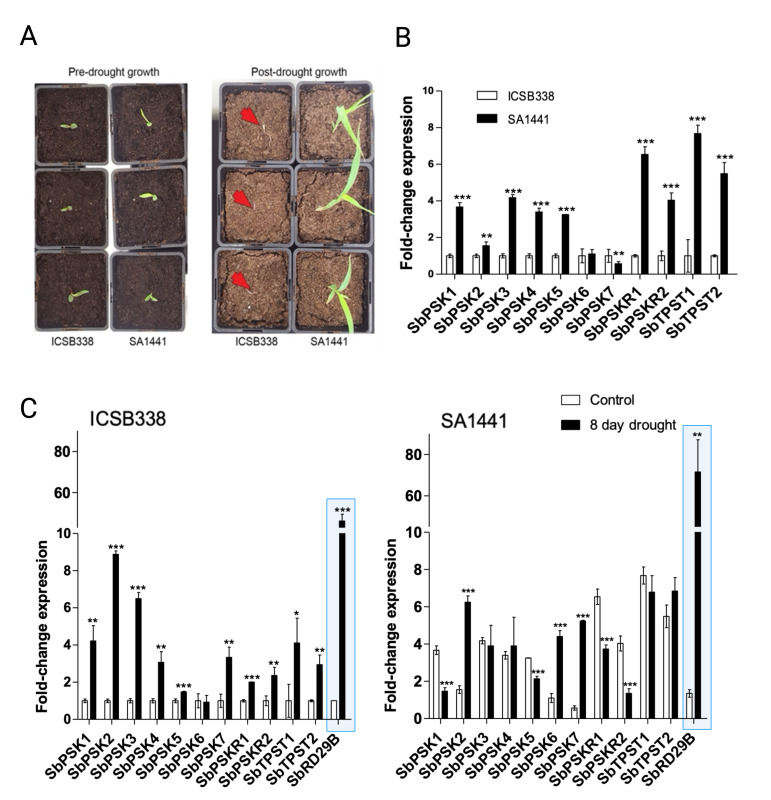 Figure 1
|
|
|
|
|
|
SbPSK1 |
Sobic.001G448300.1 |
TGCTGGCCATGAGAAGAGTG CGACCAACGTCCTCCTCATC |
Target gene |
|
SbPSK2 |
Sobic.008G034500.1 |
GAAGAAGAGCACATGGTGGTG GGACAGATAATACATAGCAGCAGTG |
Target gene |
|
SbPSK3 |
Sobic.008G034700.1 |
TGCGGCATCATCATCTCCTC CTGGGACTGAAGAAGGCAGG |
Target gene |
|
SbPSK4 |
Sobic.005G155200.1 |
TGCTGGCTACCTACATTCATGG GGCGTTGGTTTGGAGTTGAG |
Target gene |
|
SbPSK5 |
Sobic.002G021132.2 |
CCATTTCCACTCTCGCCCAC TTGCGCGTTTCTTGTTGGAG |
Target gene |
|
SbPSK6 |
Sobic.002G021132.1 |
GGTGGGTCGGTCGGTCAAG GGGGCCGGGTATTTGAAGGG |
Target gene |
|
SbPSK7 |
Sobic.005G035300.1 |
TCTCTGAGCACGCCTGAATG ACAGGGGTCACACACAGAAC |
Target gene |
|
SbPSKR1 |
Sobic.004G222100.1 |
TGAGCCCAAGGTTCGGTAAC AGAACTCCAACTTGCGGAGG |
Target gene |
|
SbPSKR2 |
Sobic.002G006100.1 |
GGACTTTGGGGTGTGGACAG ATGATGGAGAGTGGGAGGGG |
Target gene |
|
SbTPST1 |
Sobic.010G045966 |
AGCAATGCCCCGATTCCTAC AAGTTCTCTCCCTTGGCAGC |
Target gene |
|
SbTPST2 |
Sobic.010G045833 |
ACTGAGCCTCAAGGATTTGC AAACTGATGTCCAGTCCAGCG |
Target gene |
|
SbeIF4A1 |
Sb04g003390 |
GATGAGATGCTCTCCCGTGG TGATCTCTAGGGCCTCTGGG |
Reference |
|
Hypothetical |
Sobic.03g038910 |
TCCTGAAGCATCTTTCCCTCC ACAGCCTGATTAGTTGGGGG |
Reference |
|
SbRD29B |
Sobic.001G200700 |
GGGGAAGACGTGAAGGAAGG GGTATTCGTGTTCAGCTTCGC |
Drought marker |
Peer Reviews
No public reviews on file for this paper yet. If you reviewed it on a platform where reviews are public (OpenReview, ICLR, NeurIPS, ICML), you can paste yours below so the community can read it here.
Videos
No videos yet. Explain this paper in a talk, walkthrough, or lecture? Add one.
Taxonomy
TopicsPlant-Microbe Interactions and Immunity · Plant pathogens and resistance mechanisms · Agriculture, Plant Science, Crop Management
Description
Phytosulfokine (PSK) signalling has emerged as a crucial component of drought adaptation in investigated plants. PSK is a sulphated plant peptide that has been classified as a growth factor (Matsubayashi et al., 1997; Matsubayashi and Sakagami, 1996) . Recent research in Arabidopsis demonstrated that PSK activates specific signaling pathways and regulatory networks that confer drought resilience, although its functions extend to other stresses and reproductive processes (Takahashi and Shinozaki, 2019) . However, PSK research thus far has been limited to drought-sensitive species (Nagar et al., 2022; Reichardt et al., 2020; Stührwohldt et al., 2021) . Investigating the likely role of PSK signalling in a drought-tolerant crop like sorghum could provide fundamental knowledge of how drought tolerance works in nature. Use of sorghum as a model crop for drought stress tolerance has gained wider acceptance in this research field (Ngara and Ndimba, 2014) . Several groups have used sorghum as a drought-tolerant model using transcriptomics (Ananda et al., 2022; Dugas et al., 2011; Fracasso et al., 2016; Varoquaux et al., 2019) or proteomics (Goche et al., 2020; Ngara et al., 2018) , and physiological approaches (Li et al., 2020) .
We are studying plant adaptation to drought using two sorghum varieties with different response phenotypes: SA1441 is drought-tolerant while ICSB338 has considerable drought sensitivity ( Figure 1A ; Goche et al., 2020). In this study, we performed gene expression analysis of the PSK gene network in the two sorghum varieties under both optimum water availability and drought stress. Genes encoding tyrosylprotein sulfotransferases (TPSTs, which add a sulphate group to tyrosine residues of PSK peptide), PSK precursor peptides, and PSK receptors (PSKRs) were constitutively highly expressed in the drought-tolerant SA1441 sorghum not exposed to water deficit ( Figure 1B ). Only SbPSK6 and SbPSK7 genes were not expressed at a level significantly higher in SA1441 than ICSB338. Since there is gene redundancy in the PSK pre-peptides, the overall trend is that drought resistance is linked to constitutively high expression of PSK peptide genes. Nonetheless, SbPSK6 and SbPSK7 genes were subsequently upregulated on exposure to drought stress ( Figure 1C ). The drought-sensitive ICSB338 under optimum water conditions had significantly lower expression of the PSK gene network ( Figure 1B ). Notably, the drought-sensitive ICSB338 activated these genes only after exposure to drought stress, though SbPSK6 remained unresponsive ( Figure 1C ). The drought-sensitive ICSB338 response profile is like that observed in drought-sensitive Arabidopsis, where the PSK gene network was activated after drought perception (Stührwohldt et al., 2021) .
These findings implicate PSK signalling in natural drought tolerance of sorghum, and interestingly provides nuance to its deployment and potentially its role. Although PSK signalling is activated after perception of water deficits in ICSB338 sorghum ( Figure 1C ) and in Arabidopsis (Stührwohldt et al., 2021) , these plants remain drought-sensitive. However, PSK signalling is constitutively high prior to stress in SA1441 sorghum, and this is associated with remarkably superior drought tolerance ( Figure 1A ; Goche et al., 2020). While the PSK gene network does not respond to drought in SA1441 sorghum, the drought-marker gene SbRD29B remains inducible, indicating that no defects in inducible defences exist in this variety ( Figure 1C ). Our results implicate constitutive gene expression offering better stress protection than induced gene expression. Whether this is widespread in nature will be established by extending the study to more sorghum varieties and other drought-tolerant crops.
Methods
SA1441 and ICSB338 seeds were sown in potted soil (216 cm3 by volume) and watered until they reached the V3 stage (3 fully formed leaves with a fourth emerging). While control plants continued to receive water as necessary, drought-treated plants were left without watering until harvesting the roots 8 days after the last watering. Three biological replicates were generated, each replicate consisting of root tissues pooled from three independent plants. RNA was extracted from the roots and analysed by quantitative reverse transcription-polymerase chain reaction as previously described (Goche et al., 2020) . Gene-specific primers are given in the reagents table. In sorghum, we identified seven SbPSK precursor genes, two genes encoding PSK receptor proteins (SbPSKR1 and SbPSKR2) and two tyrosylprotein sulfotransferase (SbTPST1 and SbTPST2) genes. The genes Sb04g003390 and Sb03g038910 were used as constitutive reference controls (Goche et al., 2020) . The sorghum RESPONSIVE TO DESICCATION 29B (SbRD29B) was used as a drought-marker. The REST2009 software version 2.0.13 was used for gene expression analysis. The Student’s t-test was used to compare gene expression at 5% confidence level using GraphPad Prism 5.00 software.
Reagents
**: **
The reference list from the paper itself. Each links out to its DOI / PubMed record.
- 1Ananda GKS Norton SL Blomstedt C Furtado A Møller BL Gleadow R Henry RJ 2022127 Transcript profiles of wild and domesticated sorghum under water-stressed conditions and the differential impact on dhurrin metabolism.Planta 25520032-0935515110.1007/s 00425-022-03831-435084593 PMC 8795013 · doi ↗ · pubmed ↗
- 2Dugas DV Monaco MK Olsen A Klein RR Kumari S Ware D Klein PE 20111018 Functional annotation of the transcriptome of Sorghum bicolor in response to osmotic stress and abscisic acid.BMC Genomics 1251451410.1186/1471-2164-12-51422008187 PMC 3219791 · doi ↗ · pubmed ↗
- 3Fracasso A Trindade LM Amaducci S 2016521 Drought stress tolerance strategies revealed by RNA-Seq in two sorghum genotypes with contrasting WUE.BMC Plant Biol 16111511510.1186/s 12870-016-0800-x 27208977 PMC 4875703 · doi ↗ · pubmed ↗
- 4Goche T Shargie NG Cummins I Brown AP Chivasa S Ngara R 2020716 Comparative physiological and root proteome analyses of two sorghum varieties responding to water limitation.Sci Rep 101118351183510.1038/s 41598-020-68735-332678202 PMC 7366710 · doi ↗ · pubmed ↗
- 5Li H Li Y Ke Q Kwak SS Zhang S Deng X 2020121 Physiological and Differential Proteomic Analyses of Imitation Drought Stress Response in Sorghum bicolor Root at the Seedling Stage.Int J Mol Sci 212310.3390/ijms 2123917433271965 PMC 7729455 · doi ↗ · pubmed ↗
- 6Matsubayashi Y Sakagami Y 1996723 Phytosulfokine, sulfated peptides that induce the proliferation of single mesophyll cells of Asparagus officinalis L.Proc Natl Acad Sci U S A 93150027-84247623762710.1073/pnas.93.15.76238755525 PMC 38796 · doi ↗ · pubmed ↗
- 7Matsubayashi Y Takagi L Sakagami Y 19971125 Phytosulfokine-alpha, a sulfated pentapeptide, stimulates the proliferation of rice cells by means of specific high- and low-affinity binding sites.Proc Natl Acad Sci U S A 94240027-8424133571336210.1073/pnas.94.24.133579371850 PMC 24313 · doi ↗ · pubmed ↗
- 8Nagar P Sharma N Jain M Sharma G Prasad M Mustafiz A 2021101 Os PSKR 15, a phytosulfokine receptor from rice enhances abscisic acid response and drought stress tolerance.Physiol Plant 17410031-9317 e 13569 e 1356910.1111/ppl.1356934549425 · doi ↗ · pubmed ↗