Touch inhibits cold: non-contact cooling suggests a thermotactile gating mechanism
Ivan Ezquerra Romano, Maansib Chowdhury, Patrick Haggard

TL;DR
This study shows that touch can reduce the sensation of cold, suggesting a neural mechanism similar to how touch inhibits pain.
Contribution
The paper introduces a novel non-contact cooling method and provides evidence for a thermotactile gating mechanism.
Findings
Touch significantly reduces sensitivity to cooling on the hand dorsum.
The inhibitory effect is specific to tactile input and not explained by distraction or attention.
The findings align with Pain Gate Theory, suggesting a similar mechanism for touch and cold interaction.
Abstract
Skin stimuli reach the brain via multiple neural channels specific for different stimulus types. These channels interact in the spinal cord, typically through inhibition. Inter-channel interactions can be investigated by selectively stimulating one channel and comparing the sensations that result when another sensory channel is or is not concurrently stimulated. Applying this logic to thermal–mechanical interactions proves difficult, because most existing thermal stimulators involve skin contact. We used a novel non-tactile stimulator for focal cooling (9 mm2) by using thermal imaging of skin temperature as a feedback signal to regulate exposure to a dry-ice source. We could then investigate how touch modulates cold sensation by delivering cooling to the human hand dorsum in either the presence or absence of light touch. Across three signal detection experiments, we found that…
Genes, proteins, chemicals, diseases, species, mutations and cell lines named across the full text — each resolved to its canonical identifier and authoritative record.
Click any figure to enlarge with its caption.
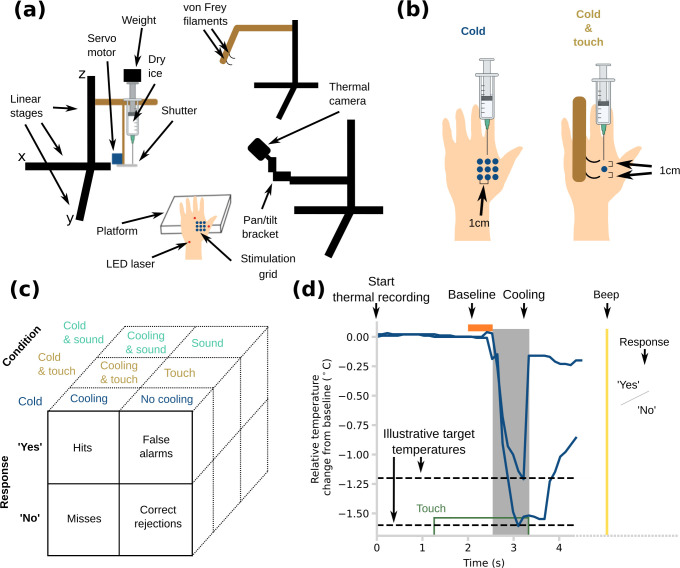 Figure 1
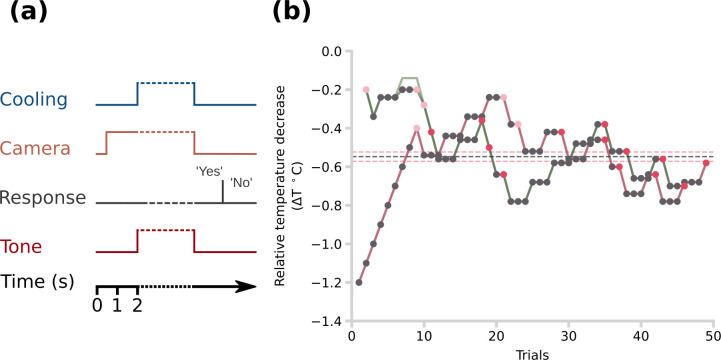 Figure 2
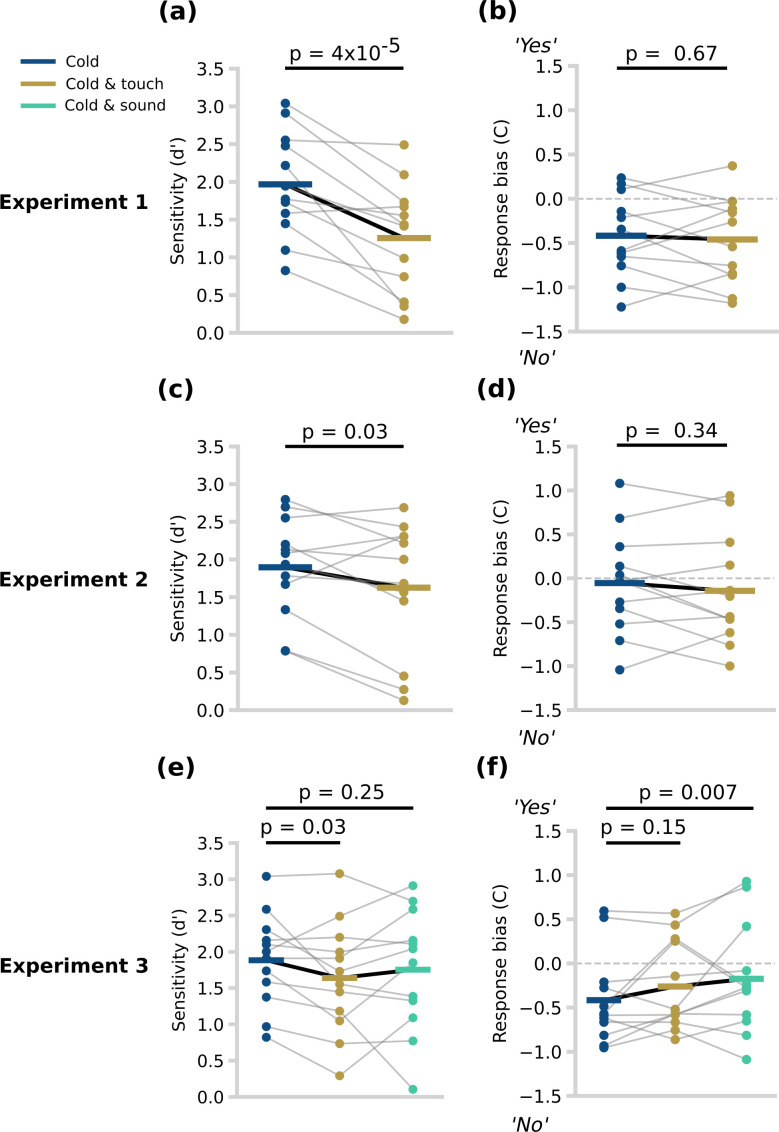 Figure 3
Peer Reviews
No public reviews on file for this paper yet. If you reviewed it on a platform where reviews are public (OpenReview, ICLR, NeurIPS, ICML), you can paste yours below so the community can read it here.
Videos
No videos yet. Explain this paper in a talk, walkthrough, or lecture? Add one.
Taxonomy
TopicsTactile and Sensory Interactions · Action Observation and Synchronization · Pain Mechanisms and Treatments