Identification of TGFBR1 Gene Variants in Two Chinese Pedigrees with Loeys-Dietz Syndrome
Jiehua Qiu, Wei Chen, Xixi Min, Yang Shen, Xianhua Zhu, Jiacong Qiu, Xiande Zeng, Xiong Zeng, Yanchun Ji, Weimin Zhou

TL;DR
This study identifies two new TGFBR1 gene variants in Chinese families with Loeys-Dietz Syndrome, a genetic disorder affecting blood vessels.
Contribution
The study reports novel TGFBR1 gene variants in LDS patients and highlights the potential of endovascular surgery as a treatment option.
Findings
Two novel TGFBR1 gene variants (c.605C>T and c.679G>A) were identified in two LDS patients.
Endovascular surgery was found to be a feasible treatment for LDS patients.
The variants were not present in the parents, suggesting de novo mutations.
Abstract
To investigate a precise treatment and related gene variants in some Loeys-Dietz syndrome (LDS) patients with vascular disease. Two probands (JX001-II1 and JX002-II1) diagnosed with LDS and their families were recruited. Routine blood test, antiphospholipid antibodies, immune globulins, nuclear antibodies (ANAs) and biochemical tests, and computed tomography angiography (CTA) were performed for probands. Deoxyribonucleic acid was collected from the two families and was sequenced by the next-generation sequencing employing the Ion Torrent platform (Life Technologies); the variants were confirmed by Sanger sequencing. Two probands’ antiphospholipid antibodies, immune globulins, and ANAs were near normal. CTA showed that both probands had an LDS patient typical arterial change: aortic aneurysm. Genetic testing of the 10 LDS-associated genes in the two probands showed that c.605C>T…
Genes, proteins, chemicals, diseases, species, mutations and cell lines named across the full text — each resolved to its canonical identifier and authoritative record.
Click any figure to enlarge with its caption.
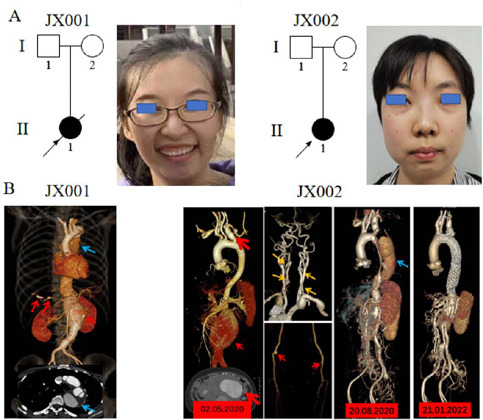 Figure 1
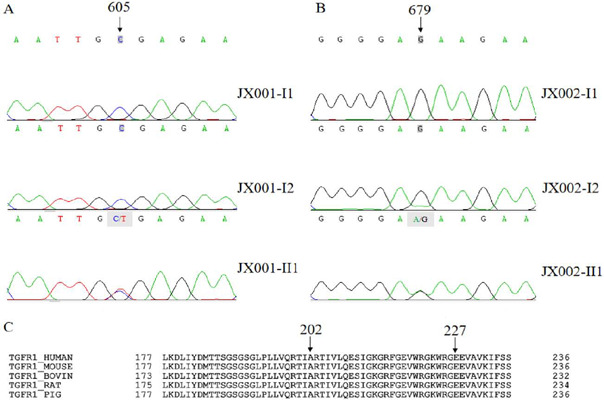 Figure 2
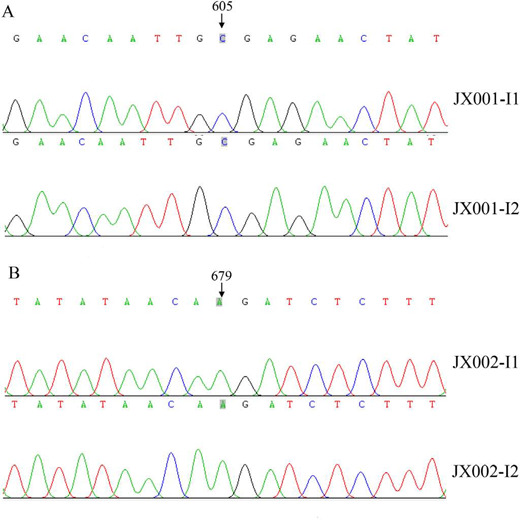 Figure 3
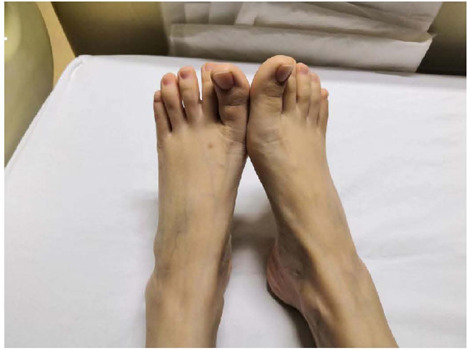 Figure 4
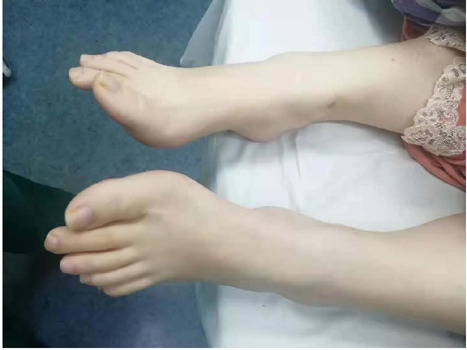 Figure 5
Peer Reviews
No public reviews on file for this paper yet. If you reviewed it on a platform where reviews are public (OpenReview, ICLR, NeurIPS, ICML), you can paste yours below so the community can read it here.
Videos
No videos yet. Explain this paper in a talk, walkthrough, or lecture? Add one.
Taxonomy
TopicsConnective tissue disorders research