Self-perception of vocal fatigue and insomnia severity in teachers
Jaírle Laís Alves do Nascimento, Felipe Silva de Araujo, Vanessa Veis Ribeiro, Juliana Fernandes Godoy, Larissa Thaís Donalonso Siqueira, Jaírle Laís Alves do Nascimento, Felipe Silva de Araujo, Vanessa Veis Ribeiro, Juliana Fernandes Godoy, Larissa Thaís Donalonso Siqueira

TL;DR
Teachers at risk for voice disorders report higher vocal fatigue and insomnia symptoms, with female teachers showing recovery after vocal rest.
Contribution
This study identifies gender-specific differences in vocal fatigue recovery and insomnia severity among teachers at risk for dysphonia.
Findings
Teachers at risk for dysphonia had higher vocal fatigue and insomnia scores than those not at risk.
Female teachers at risk for dysphonia recovered from vocal fatigue after vocal rest, unlike those not at risk.
Both groups experienced subthreshold insomnia, but those at risk showed more severe symptoms.
Abstract
To compare the self-perception of vocal fatigue and insomnia severity between teachers at risk and not at risk for dysphonia and between men and women. The study included 120 female and 80 male teachers from various teaching levels. All participants completed self-assessment questionnaires on their working conditions, the Screening Index for Voice Disorder (SIVD), the Vocal Fatigue Index (VFI), and the Insomnia Severity Index (ISI). Teachers were grouped into those at risk (DG) and not at risk for dysphonia (NDG). Both DG and NDG reported noise, stress, and dust in the work environment. These factors were more frequent in DG, which also scored above the cutoff for all VFI factors, while NDG scored high in Factor I and the total score but scored below the cutoff in Factor IV. Analysis per gender revealed no difference between DG and NDG among males, except for Factor IV. Among females,…
Genes, proteins, chemicals, diseases, species, mutations and cell lines named across the full text — each resolved to its canonical identifier and authoritative record.
Click any figure to enlarge with its caption.
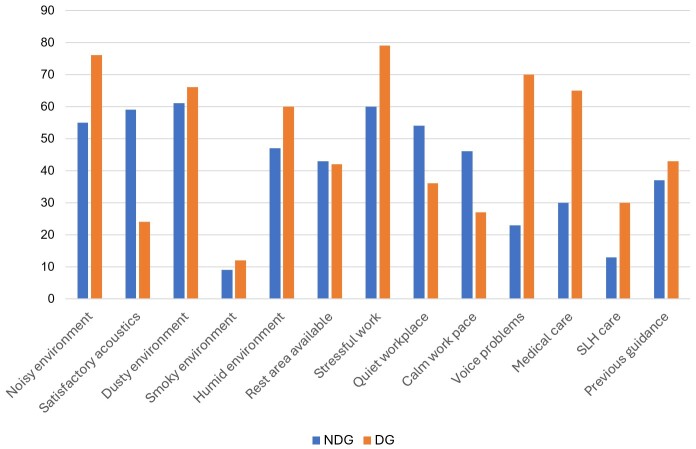 Figure 1
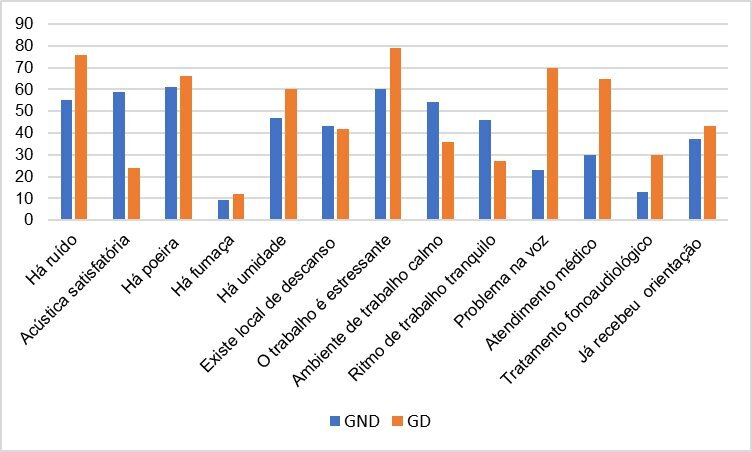 Figure 2
Peer Reviews
No public reviews on file for this paper yet. If you reviewed it on a platform where reviews are public (OpenReview, ICLR, NeurIPS, ICML), you can paste yours below so the community can read it here.
Videos
No videos yet. Explain this paper in a talk, walkthrough, or lecture? Add one.
Taxonomy
TopicsVoice and Speech Disorders · Stuttering Research and Treatment · Respiratory and Cough-Related Research