Multiple Linear Dichroism Inversions in SnO Monolayers for Polarization-Sensitive UV Photodetection: An Ab Initio Investigation
Michele Re Fiorentin, Francesca Risplendi, Maurizia Palummo, Giancarlo Cicero

TL;DR
This paper investigates how the unique structure of SnO monolayers leads to unusual light absorption properties, making them promising for polarization-sensitive UV photodetection.
Contribution
The paper reveals multiple linear dichroism inversions in SnO monolayers due to their reduced symmetry and anisotropic electronic structure.
Findings
SnO monolayers exhibit in-plane anisotropy affecting electronic states and optical absorption.
Multiple linear dichroism inversions are observed between 200 and 400 nm wavelengths.
Optical dichroism can be used to study the ferroelastic-to-paraelastic transition in SnO monolayers.
Abstract
Tin monoxide (SnO) undergoes a phase transition from litharge-like tetragonal (space group P4/nmm) to orthorhombic geometry (layer group pmmn) in passing from multilayer to monolayer crystals. By means of ab initio ground and excited-state methods, we explore the impact of the reduced pmmn spatial symmetry on the electronic and optical properties of SnO monolayers. As a consequence of the in-plane anisotropy, the electronic states of the band edges show asymmetric projections onto the px and py atomic orbitals along orthogonal directions in the Brillouin zone. This results in optical absorption and exciton properties that are highly sensitive to the direction of in-plane polarized light. In contrast to typical linear dichroic materials, which generally favor the absorption of one polarization over the orthogonal one across a wide frequency range, we show that SnO monolayers display…
Genes, proteins, chemicals, diseases, species, mutations and cell lines named across the full text — each resolved to its canonical identifier and authoritative record.
Click any figure to enlarge with its caption.
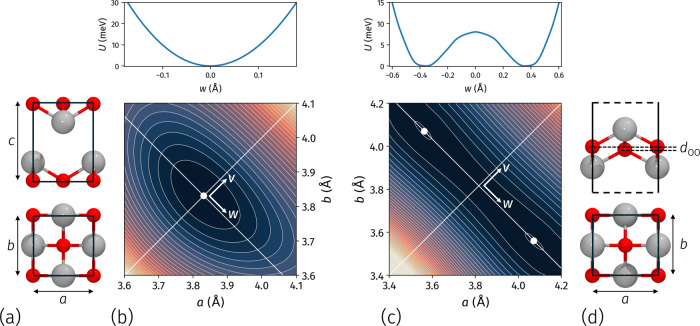 Figure 1
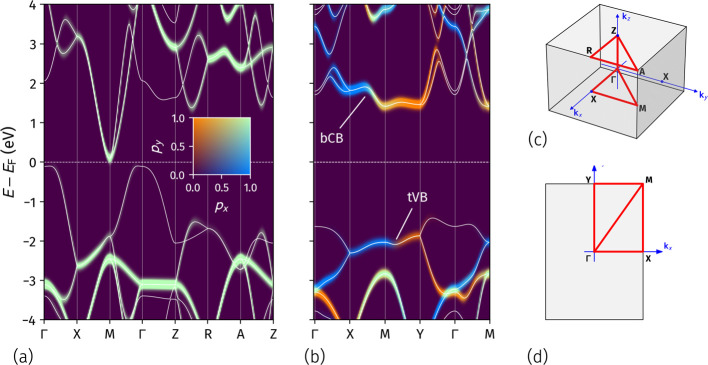 Figure 2
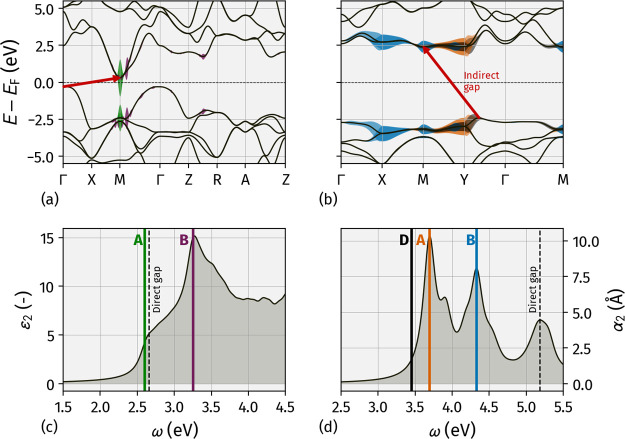 Figure 3
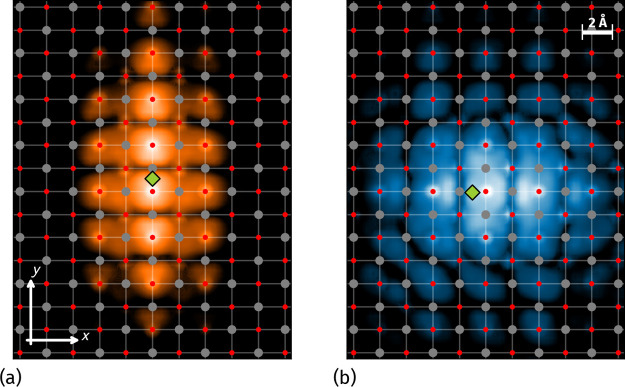 Figure 4
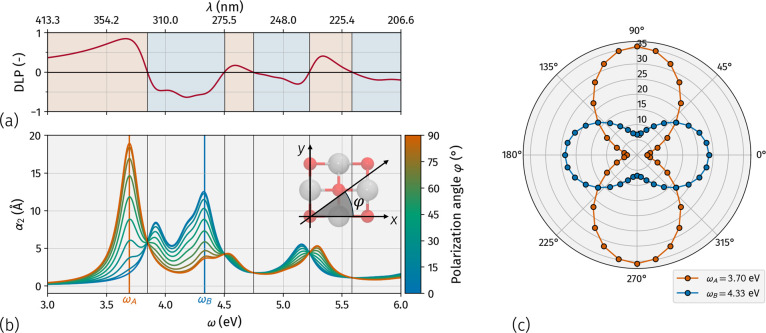 Figure 5
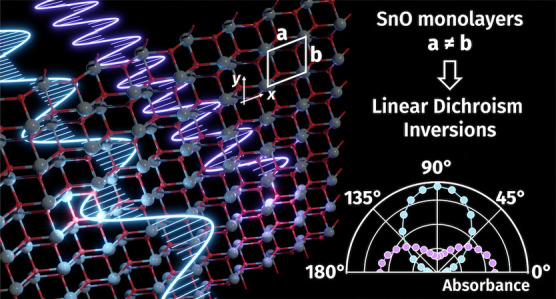 Figure 6
Peer Reviews
No public reviews on file for this paper yet. If you reviewed it on a platform where reviews are public (OpenReview, ICLR, NeurIPS, ICML), you can paste yours below so the community can read it here.
Videos
No videos yet. Explain this paper in a talk, walkthrough, or lecture? Add one.
Taxonomy
TopicsPerovskite Materials and Applications · Gas Sensing Nanomaterials and Sensors · 2D Materials and Applications