Characteristics of Skin Lesions Determine the Therapeutic Response of Facial Café Au Lait Macules Laser Therapy
Yuanzhi Liu, Wanshan Yang, Yuan Ding, Bin Yang, Zhenfeng Liu

TL;DR
This study finds that the characteristics of facial café au lait macules, such as their distribution and border shape, influence how well they respond to laser therapy.
Contribution
The study identifies lesion distribution and border shape as predictors of laser therapy efficacy for café au lait macules.
Findings
Segmental and irregular border CALMs showed better responses to laser therapy.
The overall effective treatment rate was 62.07%.
Lesion characteristics significantly predicted therapeutic outcomes.
Abstract
The efficacy of laser treatment for facial café au lait macules (CALMs) is random. To compare the response of different characteristics of CALMs skin lesions to laser treatment. In this single‐center retrospective case series, patients with café au lait macules who received laser treatment between 2015 and 2022 at our clinic were reviewed. A total of 319 consecutive patients were eligible and were treated with either a 755‐nm‐alexandrite picosecond laser or a quality‐switched 755‐nm‐alexandrite laser. Observers were blinded to the final patient groups. Efficacy was graded according to four levels of treatment response: poor (Grade 1, 0%–25% improvement), fair (Grade 2, 26%–50% improvement), good (Grade 3, 51%–75% improvement), and excellent (Grade 4, 76%–100% improvement). Treatment effects evaluated as Grades 2–4 were considered effective. Of the 319 patients, excellent and good…
Genes, proteins, chemicals, diseases, species, mutations and cell lines named across the full text — each resolved to its canonical identifier and authoritative record.
Click any figure to enlarge with its caption.
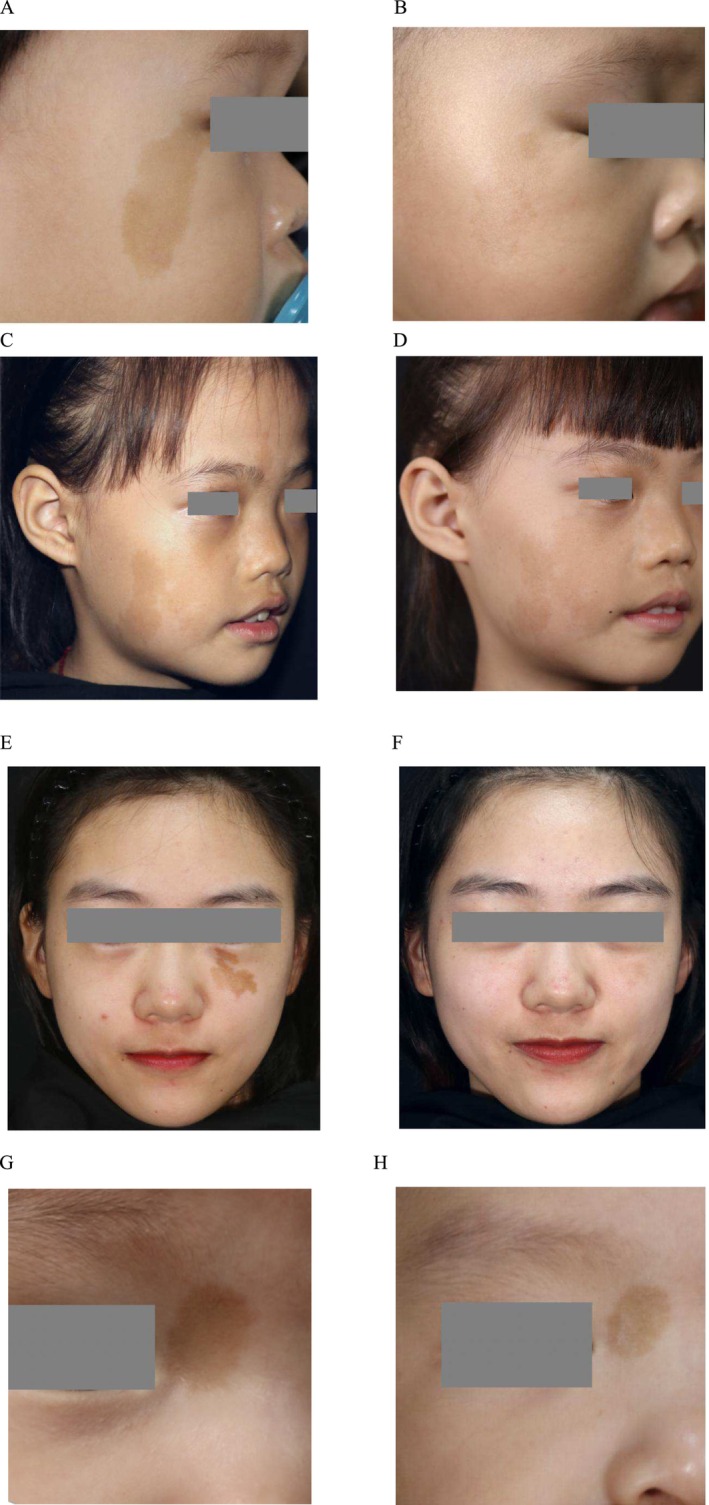 Figure 1
Peer Reviews
No public reviews on file for this paper yet. If you reviewed it on a platform where reviews are public (OpenReview, ICLR, NeurIPS, ICML), you can paste yours below so the community can read it here.
Videos
No videos yet. Explain this paper in a talk, walkthrough, or lecture? Add one.
Taxonomy
TopicsDermatologic Treatments and Research · Vascular Malformations and Hemangiomas · Nonmelanoma Skin Cancer Studies