Two K2P Channels, TWK-46 and TWK-26 do not affect C. elegans Egg-Laying Behavior
Li Chen, Isabel Beets, William Schafer

TL;DR
This study found that two K2P channels in C. elegans, TWK-26 and TWK-46, do not influence egg-laying behavior despite being expressed in the relevant neural circuit.
Contribution
The novelty lies in experimentally determining that these two K2P channels do not affect a specific physiological behavior in C. elegans.
Findings
Null mutants of twk-26 and twk-46 showed no significant differences in egg-laying behavior compared to wild-type worms.
TWK-26 and TWK-46 are expressed in the egg-laying neural circuit but do not influence the behavior.
Abstract
Two-pore domain potassium channels, also known as K2P channels, play vital roles in maintaining the resting membrane potential in excitable cells, affecting a variety of physiological processes across species. The Caenorhabditis elegans ( C. elegans ) genome contains 46 different K2P-encoding genes, yet most of their functions remain unknown. Here, we have investigated the possible roles of two C. elegans K2P channel genes – twk-26 and twk-46 – that are expressed in the egg-laying neural circuit by characterizing the egg-laying behavior of null mutants generated by CRISPR/Cas9 gene editing. However, using a variety of assays, we did not observe significant differences in egg-laying behavior between twk-26 and twk-46 mutants and wild-type worms .
Genes, proteins, chemicals, diseases, species, mutations and cell lines named across the full text — each resolved to its canonical identifier and authoritative record.
Click any figure to enlarge with its caption.
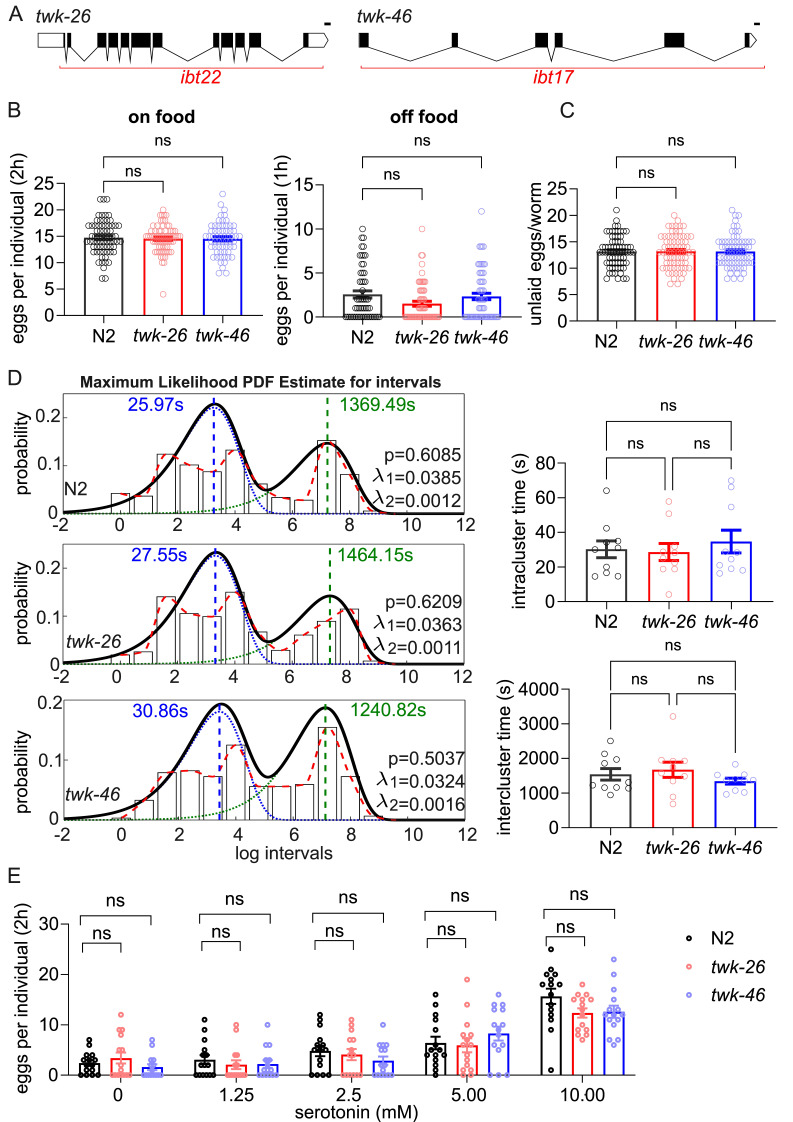 Figure 1
Peer Reviews
No public reviews on file for this paper yet. If you reviewed it on a platform where reviews are public (OpenReview, ICLR, NeurIPS, ICML), you can paste yours below so the community can read it here.
Videos
No videos yet. Explain this paper in a talk, walkthrough, or lecture? Add one.
Taxonomy
TopicsCardiac Arrhythmias and Treatments