An investigation into the critical ingredients of intensive support teams for adults with intellectual disabilities who display challenging behaviour
Lucretia Thomas, Brynmor Lloyd-Evans, Louise Marston, Angela Hassiotis

TL;DR
This study explores what factors influence the success of intensive support teams for adults with intellectual disabilities and challenging behaviors.
Contribution
The study identifies individual factors, such as mental illness severity, as key to clinical outcomes in ISTs.
Findings
Mental illness severity was the only variable linked to reduced challenging behavior.
Accommodation type and gender influenced specific behavior subdomains like irritability and hyperactivity.
Individual factors, not organizational ones, drive variation in clinical outcomes.
Abstract
NHS England recommends the commissioning of intensive support teams (ISTs) to provide effective support to people with intellectual disability (ID) when in crisis. However, there is a paucity of evidence regarding how these services should be organised. This exploratory secondary analysis of data from the IST-ID study aimed to investigate IST characteristics that relate to clinical outcomes. The primary outcome was mean change in the total score on the Aberrant Behavior Checklist and its subscales. A measure of mental illness severity was the only variable associated with our primary outcome of reduction in challenging behaviour. Accommodation type, affective status and gender were associated with the subdomains of irritability, hyperactivity and lethargy in unadjusted and adjusted analyses. Our findings indicate that variation in clinical outcomes is influenced by individual rather…
Genes, proteins, chemicals, diseases, species, mutations and cell lines named across the full text — each resolved to its canonical identifier and authoritative record.
Click any figure to enlarge with its caption.
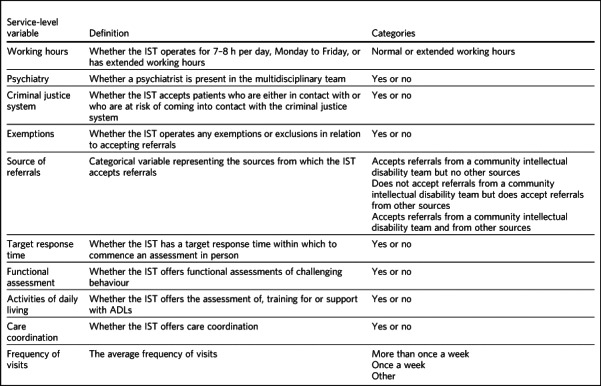 Figure 1
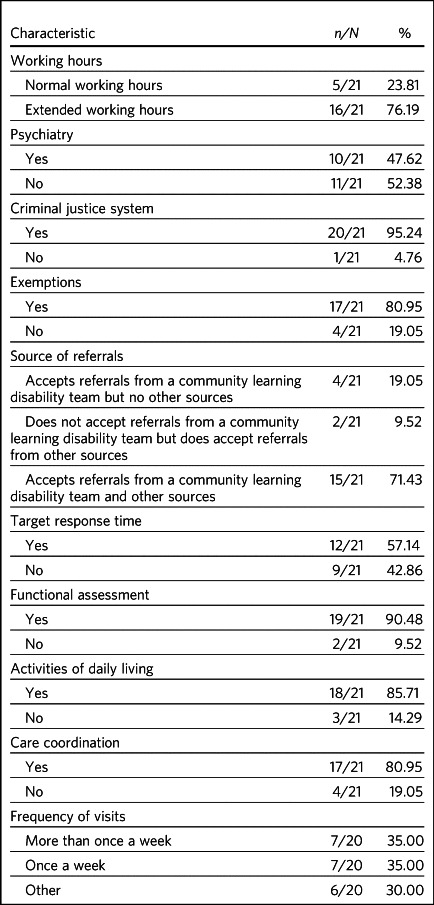 Figure 2
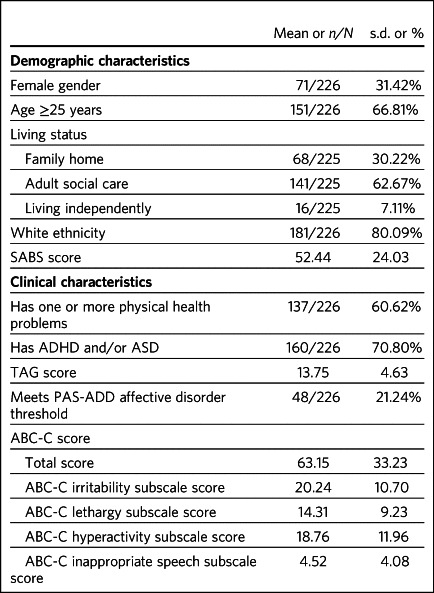 Figure 3
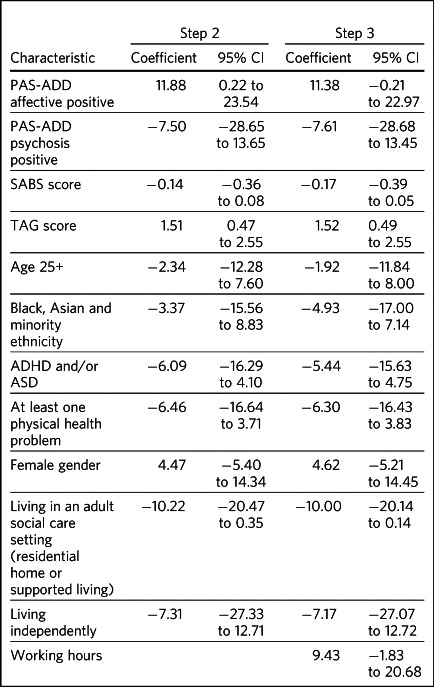 Figure 4
Peer Reviews
No public reviews on file for this paper yet. If you reviewed it on a platform where reviews are public (OpenReview, ICLR, NeurIPS, ICML), you can paste yours below so the community can read it here.
Videos
No videos yet. Explain this paper in a talk, walkthrough, or lecture? Add one.
Taxonomy
TopicsPsychiatric care and mental health services · Chronic Disease Management Strategies · Healthcare innovation and challenges
Intellectual disability is defined as an impairment in intellect and adaptive functioning that begins during the neurodevelopmental period and persists throughout life.^1,2^
The National Institute for Health and Care Excellence (NICE) recommends that individuals with intellectual disabilities who are in crisis due to their mental health or behaviour receive support from a multidisciplinary intensive support team (IST).^3^ ISTs aim to reduce the occurrence and length of in-patient admissions by providing crisis care, in-reach support within in-patient units to facilitate discharge, and positive behaviour support in the community.^3–5^
NHS England's recommendations for ISTs include the provision of 24/7 face-to-face crisis support, multidisciplinary support delivered by specialists in the management of challenging behaviour, and integration between ISTs and specialist community teams that deliver routine care.^6,7^ There is little evidence regarding which service-level or individual participant characteristics of ISTs are associated with effective service delivery, whereas this is better established for crisis services for the general adult population and for older adults.^8–10^ This information is important in guiding the commissioning of services.^4,5^
The Intensive Support Teams for Adults with Intellectual Disabilities and Challenging Behaviour (IST-ID) national study investigated service-level characteristics and individual patient outcomes in existing ISTs.^4,5^ Stage 1 was a cross-sectional study that surveyed 73 ISTs in England and identified two types of such service provision: independent, where the IST is separate from the local community intellectual disability service, and enhanced provision, where the IST is integrated within it.^4^ Stage 2 was a cohort study comparing clinical outcomes between the two IST types at baseline and 9-month follow-up. The study did not find any differences in levels of challenging behaviour or any other secondary outcomes between the two types of IST provision, neither did it show significant cost differences. It concluded that local variations in need may well determine which model is adopted, in the absence of other requirements, including model fidelity.^5^
The present study complements the previous project by exploring how individual and service characteristics relate to clinical outcomes, generating hypotheses about potential critical components of IST care. This is very important because it brings into consideration the theoretical fidelity of ISTs, opening the discourse on the intervention theory behind such teams in the community care of people with intellectual disabilities.
Aims
To investigate whether IST service-level characteristics relate to reduction of challenging behaviour measured by a validated instrument through the secondary analysis of data collected in the IST-ID study.
Method
Data from participants who had enrolled in stage 2 of the IST-ID study were included in this secondary analysis. In stage 2, a random sample of ISTs was selected out of the 73 ISTs that had taken part in stage 1 of the study.^4,5^ To be included in stage 2, the IST must have been operating for at least 12 months, funded for the duration of the study and offering intensive support to adults with mild to profound intellectual disabilities.^5^
Full details of the procedures involved in data collection in the two stages of the IST-ID study can be found in the relevant publications.^4,5^
One individual (L.T.) reviewed all items from the survey administered in stage 1 of the IST-ID study to identify the most clinically important and cross-referenced them against published standards for ISTs.^3,11,12^ The results of this initial screening were reviewed by A.H., resulting in a shortlist of 27 items. This shortlist of items was discussed in a team meeting with all authors, when these were further refined and items that were considered to be less clinically relevant were removed (the longlist of items is provided in the supplementary material available at https://dx.doi.org/10.1192/bjb.2023.94). This resulted in a list of 16 items. We then combined some categories to produce binary or categorical variables with fewer categories. Finally, six items were removed owing to a lack of variation where all ISTs fell into one category, giving rise to a final list of ten service-level characteristics. This final list of variables is shown in Table 1. Table 1. List of service-level variables identified from the IST-ID national surveyService-level variableDefinitionCategoriesWorking hoursWhether the IST operates for 7–8 h per day, Monday to Friday, or has extended working hoursNormal or extended working hoursPsychiatryWhether a psychiatrist is present in the multidisciplinary teamYes or noCriminal justice systemWhether the IST accepts patients who are either in contact with or who are at risk of coming into contact with the criminal justice systemYes or noExemptionsWhether the IST operates any exemptions or exclusions in relation to accepting referralsYes or noSource of referralsCategorical variable representing the sources from which the IST accepts referralsAccepts referrals from a community intellectual disability team but no other sourcesDoes not accept referrals from a community intellectual disability team but does accept referrals from other sourcesAccepts referrals from a community intellectual disability team and from other sourcesTarget response timeWhether the IST has a target response time within which to commence an assessment in personYes or noFunctional assessmentWhether the IST offers functional assessments of challenging behaviourYes or noActivities of daily livingWhether the IST offers the assessment of, training for or support with ADLsYes or noCare coordinationWhether the IST offers care coordinationYes or noFrequency of visitsThe average frequency of visitsMore than once a weekOnce a weekOtherIST-ID, Intensive Support Teams for Adults with Intellectual Disabilities and Challenging Behaviour; ADLs, activities of daily living.
The primary outcome was the mean change in challenging behaviour, measured by the total score on the Aberrant Behavior Checklist-Community version 2 (ABC-C) from baseline to 9-month follow-up.^13^ The secondary outcomes were the mean changes in each of the ABC-C subscale scores within the same time frame.
The scores from other validated questionnaires at baseline and demographic data were included in the multilevel linear regression models as covariates. The validated questionnaires included the affective/neurotic disorder and psychotic disorder subscales of the Psychiatric Assessment Schedule for Adults with Developmental Disabilities (PAS-ADD) Checklist, the Short Adaptive Behavior Scale (SABS) as a measure of adaptive functioning, the Threshold Assessment Grid (TAG) as a measure of clinical risk^14–16^ and the presence of attention-deficit hyperactivity disorder and/or autism spectrum disorder. Demographic data included age group (18–24 and ≥25 years), ethnicity (White, Black, Asian and minority ethnic), gender and accommodation type.
Analysis of the primary and secondary outcomes
All statistical analyses were completed using Stata version 17 MP for Windows. We used descriptive statistics to describe the services and population.
Multilevel linear regression was used to model the effect of service-level characteristics on the mean change in ABC-C total score from baseline to 9-month follow-up, while controlling for covariates. These analyses were repeated for each of the secondary outcomes.
To ensure that the assumptions of multilevel linear regression were met, the residuals were plotted on a histogram and a standardised normal probability plot to assess for normality and were plotted against the predicted values to assess for homoscedasticity.
These analyses were completed as a series of three steps. In step 1, separate models were constructed for each of the service-level variables identified in the screening process described above. Within each model, the change in ABC-C total or ABC-C subscale score from baseline to 9-month follow-up was the dependent variable, the service-level variable was included as a fixed-effect independent variable. The purpose of this step was to identify which of the service-level variables had P < 0.10 and should therefore be included in the final model in step 3.
In step 2, the participant-level variables were included as fixed-effects independent variables.
In step 3, the model was constructed as in step 2 with the addition of the service-level variables identified in step 1 as fixed-effects independent variables. The purpose of step 3 was to determine whether the addition of the service-level variables affected the statistical significance of the model.
Ethics and data protection
This secondary analysis of data from the IST-ID study involved the processing of anonymised data from stages 1 and 2 of study, of which A.H. is the guarantor. These data were stored and processed on a password-protected desktop computer at University College London, Division of Psychiatry, in compliance with General Data Protection Regulation (GDPR) policy and the Data Protection Act 2018. All data were kept strictly confidential.
The IST-ID study was performed in accordance with the Declaration of Helsinki. The Health Research Authority reviewed and approved the study and all amendments (substantial and non-substantial). Ethical approval for the IST-ID study was granted by the London Bromley Research Ethics Committee (reference 18/LO/0890). Further ethical approval was not required for the current study since it involved the secondary analysis of existing anonymised data obtained in the IST-ID study.
Consent of study participants to use their data was covered in the main ethical application for review. Outcomes of the analysis do not allow re-identifying participants and we did not transfer data to facilities outside of the UCL Division of Psychiatry.
Results
Data regarding 226 participants across 21 ISTs were analysed. Tables 2 and 3 present service- and individual-level characteristics. In all the multilevel linear regression analyses, the residuals were normally distributed and there was no evidence of heteroscedasticity. Table 2. Baseline characteristics of the included intensive support teams (ISTs)aCharacteristicn/N%Working hoursNormal working hours5/2123.81Extended working hours16/2176.19PsychiatryYes10/2147.62No11/2152.38Criminal justice systemYes20/2195.24No1/214.76ExemptionsYes17/2180.95No4/2119.05Source of referralsAccepts referrals from a community learning disability team but no other sources4/2119.05Does not accept referrals from a community learning disability team but does accept referrals from other sources2/219.52Accepts referrals from a community learning disability team and other sources15/2171.43Target response timeYes12/2157.14No9/2142.86Functional assessmentYes19/2190.48No2/219.52Activities of daily livingYes18/2185.71No3/2114.29Care coordinationYes17/2180.95No4/2119.05Frequency of visitsMore than once a week7/2035.00Once a week7/2035.00Other6/2030.00a.See Table 1 for clarification of the characteristics (service-level variables). Table 3. Baseline characteristics of the included participantsMean or n/Ns.d. or %Demographic characteristicsFemale gender71/22631.42%Age ≥25 years151/22666.81%Living statusFamily home68/22530.22%Adult social care141/22562.67%Living independently16/2257.11%White ethnicity181/22680.09%SABS score52.4424.03Clinical characteristicsHas one or more physical health problems137/22660.62%Has ADHD and/or ASD160/22670.80%TAG score13.754.63Meets PAS-ADD affective disorder threshold48/22621.24%ABC-C scoreTotal score63.1533.23ABC-C irritability subscale score20.2410.70ABC-C lethargy subscale score14.319.23ABC-C hyperactivity subscale score18.7611.96ABC-C inappropriate speech subscale score4.524.08SABS, Short Adaptive Behavior Scale; ADHD, attention-deficit hyperactivity disorder; ASD, autism spectrum disorder; TAG, Threshold Assessment Grid; PAS-ADD, Psychiatric Assessment Schedule for Adults with Developmental Disabilities Checklist; ABC-C, Aberrant Behavior Checklist-Community version 2.
The univariate analysis conducted in step 1 demonstrated that working hours was the only variable found to be significantly associated with a change in ABC-C score (P < 0.1) (Supplementary Table 1).
Table 4 presents the results of the multivariable analyses in steps 2 and 3 for the primary outcome, change in ABC-C total score from baseline to 9-month follow-up. Results of the multivariable analyses in steps 2 and 3 for the secondary outcomes are shown in Supplementary Tables 2–6. Table 4. Multivariable analyses in steps 2 and 3, for the primary outcome, where change in ABC-C total score from baseline to 9-month follow-up was the dependent variableStep 2Step 3CharacteristicCoefficient95% CICoefficient95% CIPAS-ADD affective positive11.880.22 to 23.5411.38−0.21 to 22.97PAS-ADD psychosis positive−7.50−28.65 to 13.65−7.61−28.68 to 13.45SABS score−0.14−0.36 to 0.08−0.17−0.39 to 0.05TAG score1.510.47 to 2.551.520.49 to 2.55Age 25+−2.34−12.28 to 7.60−1.92−11.84 to 8.00Black, Asian and minority ethnicity−3.37−15.56 to 8.83−4.93−17.00 to 7.14ADHD and/or ASD−6.09−16.29 to 4.10−5.44−15.63 to 4.75At least one physical health problem−6.46−16.64 to 3.71−6.30−16.43 to 3.83Female gender4.47−5.40 to 14.344.62−5.21 to 14.45Living in an adult social care setting (residential home or supported living)−10.22−20.47 to 0.35−10.00−20.14 to 0.14Living independently−7.31−27.33 to 12.71−7.17−27.07 to 12.72Working hours9.43−1.83 to 20.68ABC-C, Aberrant Behavior Checklist-Community version 2; PAS-ADD, Psychiatric Assessment Schedule for Adults with Developmental Disabilities Checklist; SABS, Short Adaptive Behavior Scale; TAG, Threshold Assessment Grid; ADHD, attention-deficit hyperactivity disorder; ASD, autism spectrum disorder.
In step 1, working hours had a P-value <0.10 for the primary outcome and for some of the secondary outcomes (ABC-C irritability, lethargy/social withdrawal and hyperactivity/non-compliance subscales), so it was included in the multivariable analyses. However, for one of the secondary outcomes (inappropriate speech subscale), the exemptions and care coordination variables had a P-value <0.10 and therefore were included in the multivariable analysis for this secondary outcome.
For the primary outcome, change in ABC-C total score from baseline to 9-month follow-up, the TAG score, a measure of the severity of mental illness, was the only independent variable that was statistically significant (1.52, 95% CI 0.49–2.55). This was found in both the unadjusted and adjusted models.
As regards the secondary outcomes, change in the irritability subscale score at 9 months was significantly associated with living in an adult social care setting (−4.25, 95% CI −7.63 to −0.86) and the affective subscale of the PAS-ADD Checklist (4.44, 95% CI 0.59–8.29). Change in the hyperactivity subscale score was found to be significantly associated with the affective subscale of the PAS-ADD Checklist (4.65, 95% CI 0.46–8.83) in both the adjusted and unadjusted models.
Change in the ABC-C lethargy/social withdrawal subscale was found to be significantly associated with gender (2.98, 95% CI 0.04–5.93) when the model was adjusted for working hours.
There were no associations between the stereotypical behaviour and inappropriate speech subscales and demographic or clinical variables.
Discussion
To our knowledge, there has not yet been any study examining the active ingredients of intensive support teams (ISTs) for adults with intellectual disabilities who display challenging behaviour. Prior to the IST-ID study, studies of IST service characteristics and patient outcomes had been conducted within individual ISTs, included small samples of ISTs or had been conducted within individual regions.^8,9,17–19^ Davison et al conducted a cross-sectional study that collected data from community teams that supported people with intellectual disabilities displaying challenging behaviour, but it did not investigate patient outcomes or any associations between teams and behaviour.^20^
We did not find any IST-level characteristics to be associated with changes in behaviour (improvement) as measured by the ABC-C total score. However, we saw a pattern emerge whereby participants’ clinical variables appeared to influence outcomes. The TAG score (a measure of the severity of mental illness), accommodation and affective status were significantly associated with change in primary and secondary measures of challenging behaviour.
Our results indicate that a higher TAG score at baseline is associated with an increase in ABC-C total score from baseline to 9-month follow-up. This association is supported by the well-documented relationship between mental illness and challenging behaviour in people with intellectual disabilities, although what mediates this relationship is unclear and likely to be multifaceted.^21–24^ Individuals with intellectual disabilities who are mentally unwell may display challenging behaviour as a secondary or atypical presenting feature.
The relationship identified between the affective subscale of the PAS-ADD Checklist and the irritability and hyperactivity subscales of the ABC-C may have arisen since those symptoms can be transdiagnostic and therefore present in many different mental disorders.^25–27^ Furthermore, the relationship identified between gender and the lethargy/social withdrawal subscale may be reflective of female gender having been identified as a risk factor for depression and mental ill health more generally among adults with intellectual disabilities.^28,29^
There are potentially several explanations as to why service-level features did not appear to influence patient outcomes in this study. First, it could be that individual characteristics are more important than service-level characteristics in underpinning outcomes, as has been found in a previous study of predictors of readmission in mental health services.^30^ Second, there may have been service-level characteristics that we did not measure and that may have been important in this context, such as area deprivation, intensity of support and specific input to crisis triage. Finally, it could be that the quality of care provided had a greater impact on patient outcomes and that this was not captured by the service-level characteristics we identified. For example, NICE and NHS England recommend that staff working within ISTs must be skilled and competent in delivering interventions to reduce risks associated with challenging behaviour and that these interventions should be delivered in a way that is person centred and is in line with relevant treatment manuals.^3,6,7,31^ In addition, NICE recommends that the clinical competency of staff should be regularly evaluated.^31^ These recommendations may be more difficult to measure, albeit they are an important factor in determining the clinical outcomes of patients supported by ISTs. A previous systematic review identified longer opening hours and inclusion of psychiatrists within the staff skill mix as central factors in implementing crisis resolution teams to prevent hospital admissions.^32^ However, in our study, our analysis did not support this.
Limitations
It is important to highlight that this study has a number of limitations that must be considered when interpreting these findings. The independent variables included were binary and categorical and therefore may not have been sensitive enough to represent more subtle variation in how the ISTs were organised and structured. In addition, this secondary analysis focused on one clinical outcome, the ABC-C and its subdomain scores, although many other clinical outcomes may have been important indicators of service efficacy. It is also important to recognise that this was an exploratory study; although we sought to include the most clinically relevant service-level variables, we did not test any predetermined hypotheses.
About the authors
Lucretia Thomas is a Foundation Year 1 Doctor at Homerton University Hospital, London, UK. Brynmor Lloyd-Evans is Professor of Mental Health and Social Inclusion, Division of Psychiatry, University College London, London, UK. Louise Marston is Professor of Clinical Trials Statistics, Department of Primary Care and Population Health, University College London, London, UK. Angela Hassiotis is Professor of Psychiatry of Intellectual Disability, Division of Psychiatry, University College London, London, UK.
Supporting information
Thomas et al. supplementary materialThomas et al. supplementary material
The reference list from the paper itself. Each links out to its DOI / PubMed record.
- 1Mc Bride O, Heslop P, Glover G, Taggart T, Hanna-Trainor L, Shevlin M, et al. Prevalence estimation of intellectual disability using national administrative and household survey data: the importance of survey question specificity. Int J Popul Data Sci 2021; 6(1): 1342.34164584 10.23889/ijpds.v 6i 1.1342 PMC 8188522 · doi ↗ · pubmed ↗
- 2Mc Kenzie K, Milton M, Smith G, Ouellette-Kuntz H. Systematic review of the prevalence and incidence of intellectual disabilities: current trends and issues. Curr Dev Disord Rep 2016; 3: 104–15.
- 3National Institute for Health and Care Excellence. Learning Disabilities and Behaviour that Challenges: Service Design and Delivery (NICE Guideline NG 93). NICE, 2018.
- 4Hassiotis A, Walsh A, Budgett J, Harrison I, Jones R, Morant N, et al. Intensive support for adults with intellectual disability and behaviours that challenge: a survey of provision and service typologies in England. BJ Psych Open 2020; 6(2): e 20.32043438 10.1192/bjo.2020.2PMC 7176866 · doi ↗ · pubmed ↗
- 5Hassiotis A, Kouroupa A, Hamza L, Morant N, Hall I, Marston L, et al. Intensive support teams for adults with intellectual disabilities displaying challenging behaviour: the IST-ID mixed-methods study. Health Soc Care Deliv Res 2022; 10(33): 1–106.36378807 · pubmed ↗
- 6NHS England. Building the Right Support: A National Plan to Develop Community Services and Close Inpatient Facilities for People with a Learning Disability and/or Autism Who Display Behaviour that Challenges, Including Those with a Mental Health Condition. NHS England, 2015.
- 7NHS England. Supporting People with a Learning Disability and/or Autism Who Display Behaviour that Challenges, Including Those with a Mental Health Condition: Service Model for Commissioners of Health and Social Care Services. NHS England, 2015.
- 8Hassiotis A, Robotham D, Canagasabey A, Romeo R, Langridge D, Blizard R, et al. Randomized, single-blind, controlled trial of a specialist behavior therapy team for challenging behavior in adults with intellectual disabilities. Am J Psychiatry 2009; 166: 1278–85.19687128 10.1176/appi.ajp.2009.08111747 · doi ↗ · pubmed ↗