A155 STOOL-BASED PROTEIN SIGNATURES FOR NON-INVASIVE ACCURATE DIAGNOSIS AND SUBTYPING OF INFLAMMATORY BOWEL DISEASE THROUGH HIGH-THROUGHPUT PROTEOMICS AND MACHINE LEARNING APPROACHES
E Shajari, d gagne, M Malick, P Roy, M Delisle, M Brunet, F Boisvert, J Beaulieu

TL;DR
This study develops a non-invasive stool-based protein test to accurately diagnose and subtype inflammatory bowel disease using mass spectrometry and machine learning.
Contribution
A novel stool proteomic signature is developed for accurate IBD diagnosis and subtyping, outperforming current fecal biomarkers.
Findings
A 7-protein signature achieved 0.98 AUC in distinguishing IBD from IBD-mimicking conditions.
An 8-protein signature reached 0.96 AUC in differentiating Crohn’s disease from ulcerative colitis.
The model generalized well to new samples, with validation AUCs of 0.96 for both tasks.
Abstract
Accurate diagnosis of inflammatory bowel disease (IBD) is essential to distinguish it from other conditions with similar symptoms and to identify whether it’s ulcerative colitis (UC) or Crohn’s disease (CD), ensuring appropriate treatment and management. While colonoscopy and biopsy are the current gold standards, they are invasive, costly, and poorly accepted by asymptomatic patients. Fecal biomarkers like calprotectin are commonly used but lack the specificity and lack of ability to differentiate between CD and UC, highlighting the need for more precise, non-invasive diagnostic methods. This study aims to develop a stool-based protein biomarker panel capable of accurately distinguishing IBD from IBD-mimicking conditions. It also seeks to classify the subtypes, CD and UC, by using high-throughput Data-Independent Acquisition mass spectrometry (DIA-MS) to identify precise biomarker…
Genes, proteins, chemicals, diseases, species, mutations and cell lines named across the full text — each resolved to its canonical identifier and authoritative record.
Click any figure to enlarge with its caption.
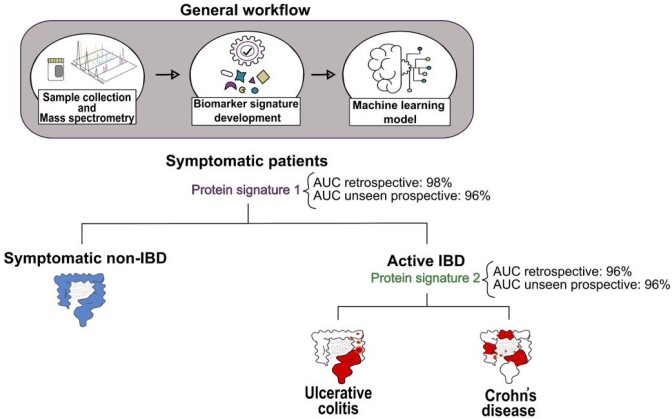 Figure 1
Peer Reviews
No public reviews on file for this paper yet. If you reviewed it on a platform where reviews are public (OpenReview, ICLR, NeurIPS, ICML), you can paste yours below so the community can read it here.
Videos
No videos yet. Explain this paper in a talk, walkthrough, or lecture? Add one.
Taxonomy
TopicsGenetics, Bioinformatics, and Biomedical Research