A128 ANTIBIOTIC RESISTANCE DOES NOT FULLY EXPLAIN HELICOBACTER PYLORI TREATMENT FAILURES
T Krahn, L Turnbull, R Rennie, S Veldhuyzen van Zanten

TL;DR
This study shows that many Helicobacter pylori treatment failures happen even when patients are not resistant to the antibiotics used, suggesting other factors like treatment adherence or regimen choice may play a role.
Contribution
The study quantifies the proportion of H. pylori treatment failures not explained by antibiotic resistance, highlighting the need for broader clinical evaluation.
Findings
27-41% of patients failed treatment despite being sensitive to antibiotics like clarithromycin, metronidazole, and levofloxacin.
Metronidazole resistance can be partially overcome with combination therapies like PBMT or PAMC.
Resistance to amoxicillin and tetracycline is rare, with no tetracycline resistance observed in the study.
Abstract
Most treatment failures of Helicobacter pylori are attributed to antibiotic resistance or patient nonadherence. Commonly used 1st-line treatment regimens include 14 day concomitant [proton pump inhibitor(P), amoxicillin(A), metronidazole(M), and clarithromycin(C):PAMC], or bismuth-based quadruple therapy [P, Bismuth(B), M, and tetracycline(T):PBMT]. Levofloxacin(L)-based PAL is also suggested for 14 days and rifabutin(R)-based PAR for 10 days. Analyses of data on the frequency of treatment failures in antibiotic sensitive cases are scarce. To determine the proportion of H. pylori treatment failures not explained by antibiotic resistance. Cultures of H. pylori positive patients (by histology, urea breath test, or stool antigen test) at the University of Alberta Hospital in Edmonton, Canada were assessed for resistance by E-test according to EUCAST thresholds to C, M, A, T, and L…
Genes, proteins, chemicals, diseases, species, mutations and cell lines named across the full text — each resolved to its canonical identifier and authoritative record.
Click any figure to enlarge with its caption.
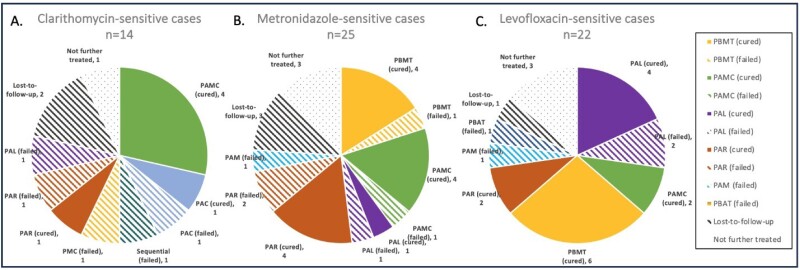 Figure 1
Peer Reviews
No public reviews on file for this paper yet. If you reviewed it on a platform where reviews are public (OpenReview, ICLR, NeurIPS, ICML), you can paste yours below so the community can read it here.
Videos
No videos yet. Explain this paper in a talk, walkthrough, or lecture? Add one.
Taxonomy
TopicsHelicobacter pylori-related gastroenterology studies