A131 ENDOSCOPIC SUBMUCOSAL DISSECTION: EXPERIENCE AT A LOCAL CANADIAN CENTER
C Ching Hui Yee, R Bechara

TL;DR
This study shows that ESD performed by a Canadian expert after formal Japanese training met international quality standards and improved with experience.
Contribution
Demonstrates that formal ESD training outside Japan can achieve and improve upon international proficiency metrics.
Findings
Overall en bloc resection rate was 96%, exceeding the 90% proficiency threshold.
Resection speed improved from 10.1 to 11.7 cm2/hr with increasing experience.
Adverse events remained low at 4%, meeting the <5% proficiency standard.
Abstract
Endoscopic Submucosal Dissection (ESD) was established in Japan. There exist few formalized training programs compared to the growing need for its expertise internationally, with many learning through observation and in-vivo training courses. According to Oyama et. al. (1), western centers conducting ESD have learning curves which were inferior when compared to leading Japanese centers. The proposed quality metrics for a proficient operator in ESD are en bloc resection rates of 90%, complications <5%, curative resection rates of 80%, and resection speed of 9cm2/hr. Whereas, the proposed quality metrics for competency are en bloc resection rates of 80% and complication rates of <10%. (1) Here, we present ESD data from a local Canadian center performed by an expert who underwent formal training in ESD at a expert Japanese center. We aim to assess if internationally proposed quality…
Click any figure to enlarge with its caption.
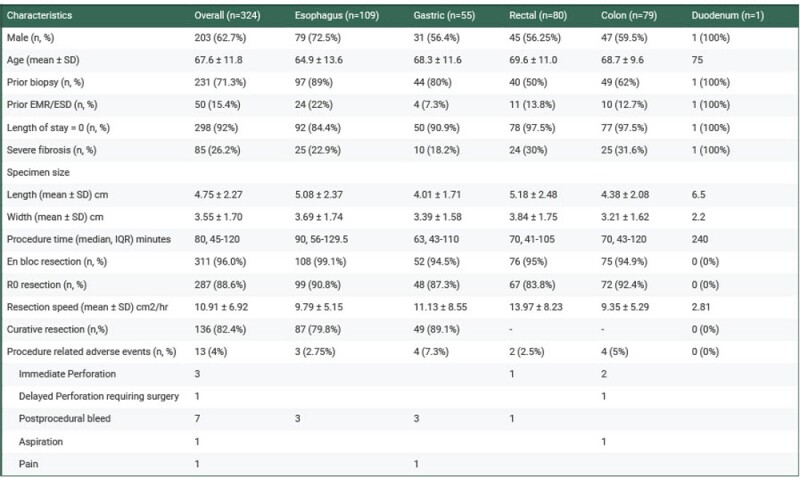 Figure 1
Peer Reviews
No public reviews on file for this paper yet. If you reviewed it on a platform where reviews are public (OpenReview, ICLR, NeurIPS, ICML), you can paste yours below so the community can read it here.
Videos
No videos yet. Explain this paper in a talk, walkthrough, or lecture? Add one.
Taxonomy
TopicsGastric Cancer Management and Outcomes · Metastasis and carcinoma case studies