A234 ELEVATED DIRECT BILIRUBIN DOES NOT PREDICT ELEVATED CONJUGATED BILIRUBIN IN NEONATES
P Samaraweera, H Brill

TL;DR
This study shows that elevated direct bilirubin in neonates does not reliably indicate elevated conjugated bilirubin, challenging current cholestasis guidelines.
Contribution
The study demonstrates that direct bilirubin is not a reliable proxy for conjugated bilirubin in neonates, suggesting a need for guideline revisions.
Findings
Average direct bilirubin (32.0 µmol/L) was significantly higher than average conjugated bilirubin (8.9 µmol/L).
A direct bilirubin below 22 µmol/L rarely results in conjugated bilirubin above 2 µmol/L.
For conjugated bilirubin of 17 µmol/L or higher, the lowest direct bilirubin measured was 34 µmol/L.
Abstract
Neonatal cholestasis guidelines consider direct and conjugated bilirubin to be equivalent because the delta bilirubin component of direct bilirubin is assumed to be negligible. Since 2015 William Osler Health System automatically measures conjugated bilirubin if the direct bilirubin is 20 µmol/L or greater in patients under 3 months old. This afforded us the opportunity to assess if direct bilirubin accurately reflects conjugated bilirubin. To determine if direct bilirubin reliably reflects conjugated bilirubin levels in neonates and confirms the appropriateness of further investigation of neonatal cholestasis Patient data from 2015 to 2024 was retrospectively collected and analyzed, focusing on neonates three months or younger with direct bilirubin levels of 20 µmol/L or higher. Both Direct and Conjugated bilirubin were measured using different assays. Main outcome measure was the…
Click any figure to enlarge with its caption.
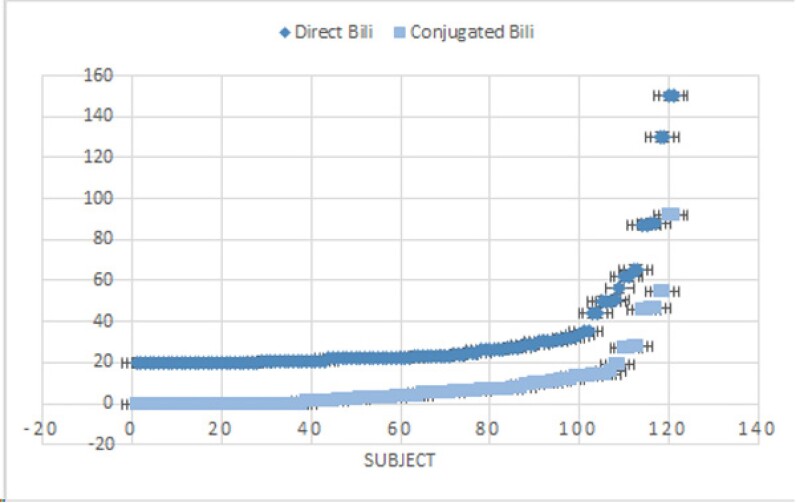 Figure 1
Peer Reviews
No public reviews on file for this paper yet. If you reviewed it on a platform where reviews are public (OpenReview, ICLR, NeurIPS, ICML), you can paste yours below so the community can read it here.
Videos
No videos yet. Explain this paper in a talk, walkthrough, or lecture? Add one.
Taxonomy
TopicsNeonatal Health and Biochemistry · Hemoglobinopathies and Related Disorders · Erythrocyte Function and Pathophysiology