A140 DUPILUMAB IMPROVED HISTOLOGY, CLINICAL SYMPTOMS, AND ENDOSCOPIC FEATURES IN ADULTS AND ADOLESCENTS WITH EOSINOPHILIC ESOPHAGITIS THROUGH 52 WEEKS REGARDLESS OF BASELINE DISEASE DURATION: POST-HOC SUBGROUP ANALYSIS OF THE PHASE 3 LIBERTY EOE TREET STUDY
N Gonsalves, C Schlag, C Santander, K Peterson, R Alkhouri, C Xia, B P Raphael, A Radwan

TL;DR
Dupilumab improved symptoms and tissue health in people with eosinophilic esophagitis over 52 weeks, regardless of how long they had the disease.
Contribution
This study shows dupilumab's long-term effectiveness in EoE patients across different disease durations, including those with long-standing disease.
Findings
Dupilumab improved histology, symptoms, and endoscopic features in EoE patients regardless of disease duration.
Improvements were maintained through 52 weeks, even in patients who switched from placebo to dupilumab.
Safety profile remained consistent with known dupilumab effects.
Abstract
Limited literature is available on EoE disease duration and response to therapy. Dupilumab is approved for EoE in patients aged ≥12 years, weighing ≥40 kg, in the EU, and in patients aged ≥1 year, weighing ≥15 kg, in the USA and Canada. To assess the long-term efficacy of dupilumab in patients with EoE stratified by baseline disease duration. In Part B of LIBERTY EoE TREET (NCT03633617), patients received 24 weeks of dupilumab 300 mg or placebo weekly (qw). Eligible patients who completed Part B received dupilumab through 52 weeks (Part C). Co-primary endpoints were the proportion achieving peak esophageal intraepithelial eosinophil count (PEC) ≤6 eosinophils/high-power field (eos/hpf) and absolute change in Dysphagia Symptom Questionnaire (DSQ) total score. Secondary endpoints included proportion achieving PEC <15 eos/hpf, percent change in PEC, and mean change in Endoscopic…
Genes, proteins, chemicals, diseases, species, mutations and cell lines named across the full text — each resolved to its canonical identifier and authoritative record.
Click any figure to enlarge with its caption.
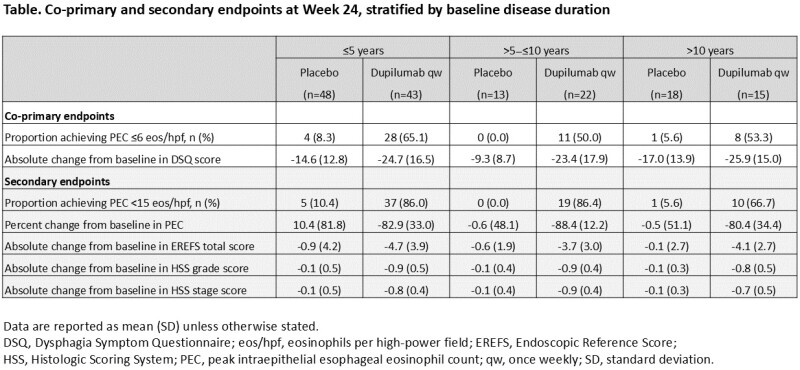 Figure 1
Peer Reviews
No public reviews on file for this paper yet. If you reviewed it on a platform where reviews are public (OpenReview, ICLR, NeurIPS, ICML), you can paste yours below so the community can read it here.
Videos
No videos yet. Explain this paper in a talk, walkthrough, or lecture? Add one.
Taxonomy
TopicsEosinophilic Esophagitis · Eosinophilic Disorders and Syndromes